
Donate
Support us in the fight for a better food system.
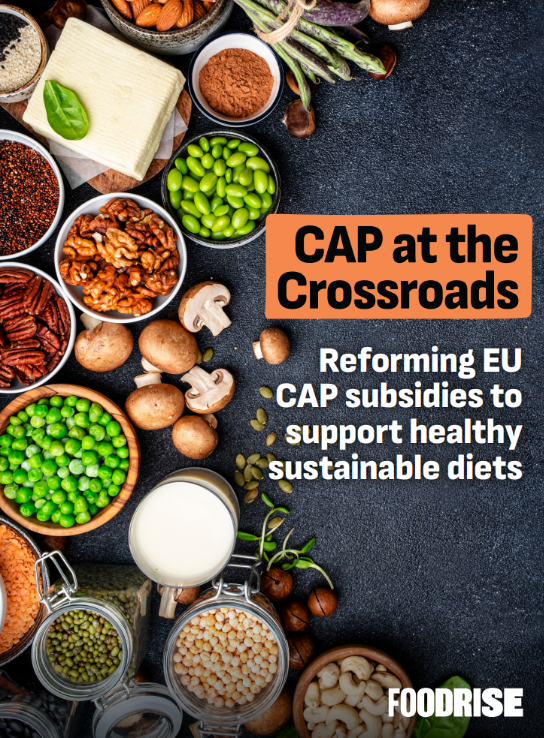
CAP at the Crossroads: Reforming EU CAP subsidies to support healthy sustainable diets, a new report from Foodrise, reveals the scale of EU common agricultural policy (CAP) subsidies directed to meat and dairy, and makes the case for reform to support healthy sustainable diets.
What’s the problem?
Animal-sourced foods are estimated to cause a staggering 81-86% of the total greenhouse gas emissions from EU food production, yet only supply an estimated 32% of calories and 64% of protein consumed in the EU.
This new report reveals that a hugely unfair share of EU CAP subsidies, worth billions of euros of EU taxpayers’ money, are directed to propping up high-emissions meat and dairy production, and to promote meat and dairy products.
The EU is at a crossroads – poised to make crucial decisions on the future of CAP for 2028–2034. Right now, it has the opportunity to support a transition to healthy sustainable diets – a huge economic opportunity with multiple benefits for EU food security, climate mitigation, nature and health. Or continue with a broken status quo.
Key findings:
Solutions
Calls have been growing for agricultural subsidies to be reformed to support a shift to healthy sustainable diets and reduced livestock numbers – including the EU’s Group of Chief Scientific Advisors, the European Court of Auditors, the World Bank, and the 2025 EAT-Lancet Commission.
The benefits this could bring are huge.
The adoption of the plant-rich Planetary Health Diet in high-income countries could reduce agricultural production emissions by an estimated 61%. It could also reduce the EU’s reliance on food imports, boost agricultural incomes, reduce EU fertiliser use by about a quarter, reduce deaths from air pollution, and prevent up to up to 10–39% of cancers in Europe.
Policy recommendations
We recommend that EU policymakers:
What the experts say
Martin Bowman, Senior Policy and Campaigns Manager at Foodrise, said:
“It’s scandalous that such an unfair share of EU subsidies, worth billions of euros of EU taxpayers’ money, are being pumped into propping up high-emissions meat and dairy production and distorting European diets. CAP is at a crossroads, and EU policymakers have a huge opportunity to switch course and take the action required to support a just transition to healthy sustainable plant-rich diets. Which we know have the potential to boost farmer incomes, reduce reliance on imports, mitigate climate change, improve Europeans’ health and restore nature.
“At the very least, plant-based foods deserve a fairer share of CAP subsidies, to compete on an equal footing. In line with the recommendations of the landmark Strategic Dialogue report, EU policymakers should urgently introduce a Plant-Based Action Plan to promote plant-based foods across the supply chain, and an Agri-food Just Transition Fund to support farmers in the transition. The shameful use of EU funds to promote meat and dairy to EU citizens – which is directly contrary to EU health and climate goals – should end immediately.”
Read the full report:

We use cookies where necessary to allow us to understand how people interact with our website and content, so that we can continue to improve our service.
We only ever receive anonymous information, and cannot track you across other websites.
