
Donate
Support us in the fight for a better food system.
In the wake of the publication of our Blue Empire report, this week we sent an open letter to the Norwegian government, calling on it to ban the salmon farming industry from sourcing fish oil from West Africa in light of the threat this practice poses to regional food security and livelihoods.
The 39 signatories comprise organisations and academic experts from around the world. Several of the African groups such as the Collectif Taxawou Cayar, WADAF, RAMPAO and CFFA represent the region’s small-scale fishing sector and communities which are suffering from the impact of overfishing, in part driven by the production of fishmeal and fish oil for the global aquaculture industry. Norwegian and international NGOs including Naturvernforbundet (Friends of the Earth Norway), the Environmental Protection Association of Norway (NMF) and Oceana have also joined the call to action.
Humble beginnings…
From the humble beginnings in the 1970s, Norway is now the world’s biggest farmed salmon producer, with Norwegian companies occupying eleven out of the top 20 slots in the list of global producers of farmed salmon. The industry is dominated by a handful of powerful multinational corporations, including MOWI, the world’s largest salmon farming company, which had a turnover of nearly €5 billion in 2022, and supplies supermarkets all across Europe.
However, what some in Norway view as a corporate success story, has come at the expense of communities and fish populations in the Global South.
Norway’s ‘Blue Empire’
Our ‘Blue Empire’ report published earlier this year, shows that, as the world’s largest salmon producer, Norway’s salmon farming industry has an enormous ‘feed footprint’, driving the extraction of around 2 million tonnes of wild-caught fish each year to produce fish oil, which is fed to Norwegian farmed salmon. A significant share of this fish comes from food insecure regions, such as West Africa where food insecurity has hit a 10 year high. Our research calculates that the production of West African fish oil for the Norwegian aquaculture industry is depriving up to 4 million people in the region of fish.
With this in mind, we argue that what Norway sees as a ‘blue opportunity’ is in fact a ‘blue empire’. The movement of wild fish from the Global South to feed salmon in the Global North which is then sold at a premium is creating a new type of food colonialism, further entrenching global inequity.
‘The fishmeal industry is a serious threat to food security and the future of fisheries in West Africa. This industry plunders our marine resources to feed intensive aquaculture in Asia and Europe, when local populations need it for their own food. It is time that “the fish of the poor stopped feeding the fish of the rich”. Our oceans and our people deserve better!’
Dr. Aliou Ba, Senior Ocean Campaign Manager, Greenpeace Africa
Adding to the absurdity, the Norwegian government’s uncritical embrace of industrial aquaculture stands in stark contrast to Norwegian development policy. In 2022, Norway’s Strategy promoting food security in development policy stated that their overall objective was to “fight hunger and increase global food security”. In the foreword to the strategy, Anne Beathe Tvinnereim, Minister of International Development emphasized that while in sub-Saharan Africa, 70–80% of the population works in agriculture and fishing, “Paradoxically, these very farmers and fishers represent the majority of chronically hungry families.” Whilst the government is setting out admirable goals to fight hunger globally and highlighting the macrotrends driving food insecurity in Africa, they remain silent on Norway’s role, with the extractive business model of its salmon farming industry creating the very conditions they say they want to improve. .
What we are calling for
In light of these findings, we are calling on Norwegian policy makers to:
You can read our letter here:


Download the letter here.


Key points:
Over 100 organisations and academic experts have called on the FAO to retract a report over serious methodological errors, which downplay the emissions saving potential of shifts to lower-meat and dairy diets.
In the report Pathways towards Lower Emissions, published at COP28 in December 2023, the FAO made claims that lower meat and dairy diets had limited potential to reduce emissions from global livestock, promoting instead other methods such as intensification of livestock production. The main evidence the FAO report cited for this claim were papers co-authored by academics Dr Paul Behrens and Dr Matthew Hayek.
In April 2024, Behrens and Hayek wrote to the FAO to express “dismay” that the FAO’s paper “seriously distorts” their scientific papers, calling for a retraction and re-issuing of the report with “more appropriate sources selected and methodological errors rectified” [1]. Behrens and Hayek concluded that as a result of the serious errors it contains, the FAO report “systematically underestimates” the opportunity of sustainable lower-meat and dairy diets for reducing greenhouse gas (GHG) emissions [2] compared to a business-as-usual 2050 scenario by a factor of between 6 and 40 [3].
Now, over 100 organisations and experts have signed a joint-letter to the FAO’s Director-General, Dr. Qu Dongyu, calling for the report to be retracted. The letter, coordinated by Foodrise, is signed by 78 civil society organisations including Greenpeace, Changing Markets Foundation, Friends of the Earth US, Rainforest Action Network, ActionAid US and Seeding Sovereignty. It is also signed by 22 academic experts, Connecticut State Representative David Michel and investor Adasina Social Capital.
The organisations support Behrens and Hayek’s call for the Pathways report to be retracted and call for “a comprehensive investigation of how these serious errors and systemic biases were allowed”, raising concern over a media report from 2023, in which ex-FAO officials said they had been sidelined and censored by the FAO following lobbying from high livestock-producing companies and countries [4].
Echoing the call by Behrens and Hayek, the organisations call for the Pathways report to be retracted and reissued only once the methodological errors it contains have been rectified, drawing on more appropriate and up-to-date studies and following engagement in serious dialogue with independent academics and experts from civil society. The letter also recommends that the release of the FAO’s 2050 Roadmap should “be delayed until it has adopted “more robust, inclusive and transparent processes”.
The significant methodological errors in the FAO’s Pathways report include double counting meat emissions to 2050, mixing different baseline years in its analysis, and including emissions from increases in vegetable, fruit and nut consumption which are unrelated to substituting meat and dairy in diets [5]. In addition, the FAO makes several inappropriate modelling choices, such as ignoring the potential carbon sequestration from land spared by dietary change and conflating sustainable healthy diets with nationally recommended diets (NRDs) – most of which do not factor sustainability into their design – rather than using models like the EAT-Lancet diet. It also uses NRDs which have since become obsolete as many countries have since updated theirs to recommend lower meat consumption [6]. For instance, Spanish Guidelines from 2022 now recommend 0-3 meat portions/week [7] and German guidelines from 2024 now recommend no more than 300g meat per week [8].
The organisations call on the FAO to align its research with other peer-reviewed science, such as EAT-Lancet and the IPCC’s Special Report on Climate Change and Land, which estimate much higher emissions savings. For instance, the IPCC cites a study which estimates that a flexitarian diet (75% of meat and dairy replaced by cereals and pulses, with only one portion of red meat a week) would reduce global emissions by approximately 5 GtCO2-eq per year [9] – over 9 times higher than the FAO’s estimate.
QUOTES
Martin Bowman, Senior Policy and Campaigns Manager at Feedback, said:
“The FAO has made serious and embarrassing errors in its Pathways report – these mistakes are a stain on the FAO’s reputation, unless rectified. All these errors systematically underestimate the emissions reduction potential of lower-meat and dairy diets. People will rightly ask whether FAO staff have simply been incompetent, or whether this indicates systematic bias against dietary change – particularly in light of recent allegations from ex-FAO staffers that they have been ostracised and censored for their work on dietary change, following lobbying from livestock companies and high-meat producing countries. The FAO must restore its integrity by immediately retracting the flawed Pathways report, and reissuing it with mistakes rectified, following engagement with academic experts and civil society.”
Nusa Urbancic, CEO of Changing Markets Foundation, said:
“The debate around the climate impact of food and farming is extremely polarised and riddled with industry-funded disinformation. For this reason, it’s of paramount importance that international organisations, such as the FAO, present impartial and scientifically robust reports that can serve governments as a guide for climate action in the sector. We are concerned about the lack of rigour in the Pathways report and we are convinced that the FAO can and must do better.”
Merel van der Mark, Senior campaigner at Rainforest Action Network, said:
“It was shocking to hear JBS, the world’s largest meat packer, proclaim at an event during the COP in Dubai, that the report just released by the FAO showed that meat was ‘not the problem, but the solution to the climate crisis’. Now that we know that the FAO distorted scientific papers, it makes one wonder what role JBS and other meat companies had in shaping the FAO’s report.”
Pete Smith, Professor of Soils & Global Change at the University of Aberdeen, said:
“While it is reasonable to involve stakeholders in such a report, it is very disappointing to see the pathways and recommendation in the report being so heavily skewed by vested interests. The science is clear that a reduction in consumption of livestock products is overconsuming countries is an essential lever for climate change mitigation, so it is unfathomable to see this option practically ignored and the science misused. The FAO has long been a trusted voice in the space, which makes this report even more disappointing.”
Shefali Sharma, Global Agriculture Campaigner with Greenpeace [16], said:
“The FAO continues to have major problems with conflict of interest, particularly in its partnership with Big Dairy corporations. The influence of the Global Dairy Platform, the dairy industry’s biggest corporate lobby is evident in its joint publication with the industry. The FAO’s Pathways report once again downsizes the estimation of livestock’s contribution to climate change, though the previous estimate was already challenged by academics. We would like to see the FAO hold up stringent standards for peer review that are truly independent, transparent and rigorous so that it can remain trusted and influential in food and climate agriculture policy amidst other UN bodies.”
NOTES TO EDITORS
Joint-letter is available here – please if possible link to report in coverage
Further quotes available on request
CONTACT: Martin Bowman, martin@foodrise.org.uk
FURTHER INFORMATION
Comments by Behrens and Hayek on the FAO report:
In April 2024, Matthew Hayek, Assistant Professor at New York University, commented to the Guardian newspaper that “The FAO’s errors were multiple, egregious, conceptual and all had the consequence of reducing the emissions mitigation possibilities from dietary change far below what they should be. None of the mistakes had the opposite effect.” [10]
Other responses to Behrens and Hayek’s letter:
FAIRR, a global investor network with a membership of $70 trillion in collective assets of support, has also said that since the FAO is responsible for both the Pathways and upcoming 2050 Roadmap, the “concerns raised by the authors [Behrens and Hayek]” extend to the 2050 Roadmap report – saying “It is FAIRR’s expectation that the UN-FAO will provide a substantive response to the issues raised by Professors Behrens and Hayek and will make adjustments to their analyses if and as needed” and emphasising that “the highest level of academic integrity and impartiality must be maintained by the UN-FAO” for the result to be scientifically sound [11].
The emissions mitigation potential of dietary change:
The FAO Pathways report misleadingly estimated that the emissions mitigation potential of dietary change is only 0.19-0.53 Gt CO2-equivalent per year.
Behrens and Hayek estimate that this is between 6 to 40 times lower than the actual potential. Based on Clark et al.’s (2020) modelling, the direct emissions mitigation potential from dietary change in line with the EAT-Lancet diet is closer to 3.10 Gt CO2 equivalent per year, rising to 6.22 Gt CO2eq per year if the carbon sequestration potential from ecosystem restoration on spared land is factored in, compared with a 2050 BAU baseline [12].
The International Panel on Climate Change (IPCC) found, with high confidence, that a shift to more plant-based diets could mitigate GHG emissions by between 0.7 – 8 GtCO2-eq per year, with higher reductions in meat and dairy leading to higher emission reductions [13]. For instance, the IPCC cites a study which estimates that a flexitarian diet (75% of meat and dairy replaced by cereals and pulses, with only one portion of red meat a week) would reduce global emissions by approximately 5 GtCO2-eq per year [14] – over 9 times higher than the FAO’s estimate.
A recent survey [15] of over two hundred climate scientists and food and agriculture experts, over half of whom have authored IPCC reports, found that:
The emissions mitigation of shifting to vegan diets would be even higher. Poore and Namecek (2018), a peer-reviewed meta-analysis in the journal Science based on around 38,000 farms producing 40 different agricultural goods around the world, estimated that the total emissions mitigation potential of dietary change towards vegan diets was 14.7 billion tonnes of CO2eq reduction per year – 6.6 billion tonnes of direct CO2eq reduction, plus an additional 8.1 bn tonnes of CO2eq of carbon removals per year for 100 years if nature is restored on the land spared.
More info on Feedback:
Feedback is a UK- and Netherlands-based environmental campaign group working for food that is food for the planet and its people. For more info, see: https://foodrise.org.uk/
References:
[1] Paul Behrens and Matthew Hayek, “Letter to Dr Tiensin: Retraction Request – FAO’s Pathways toward Lower Emissions Report,” April 9, 2024, https://www.universiteitleiden.nl/binaries/content/assets/science/cml/essays/retraction-request-pathways-to-lower-emissions.pdf.
[2] Paul Behrens and Matthew Hayek, “Letter to Dr Tiensin: Retraction Request – FAO’s Pathways toward Lower Emissions Report,” April 9, 2024, https://www.universiteitleiden.nl/binaries/content/assets/science/cml/essays/retraction-request-pathways-to-lower-emissions.pdf.
[3] NOTE: These are estimated savings if the EAT-Lancet diet was adopted globally. The EAT-Lancet Planetary Health Diet was a diet modelled by the EAT–Lancet Commission of scientists and experts aiming to achieve healthy diets for all, within planetary boundaries. For more info, see: https://eatforum.org/eat-lancet-commission/the-planetary-health-diet-and-you/ Behrens and Hayek mention the “6 to 40” estimate in: Arthur Neslen, “UN Livestock Emissions Report Seriously Distorted Our Work, Say Experts,” The Guardian, April 19, 2024, sec. Environment, https://www.theguardian.com/environment/2024/apr/19/un-livestock-emissions-report-seriously-distorted-our-work-say-experts.
[4] Arthur Neslen, “‘The Anti-Livestock People Are a Pest’: How UN Food Body Played down Role of Farming in Climate Change,” The Guardian, October 20, 2023, sec. Environment, https://www.theguardian.com/environment/2023/oct/20/the-anti-livestock-people-are-a-pest-how-un-fao-played-down-role-of-farming-in-climate-change.
[5] Paul Behrens and Matthew Hayek, “Letter to Dr Tiensin: Retraction Request – FAO’s Pathways toward Lower Emissions Report,” April 9, 2024, https://www.universiteitleiden.nl/binaries/content/assets/science/cml/essays/retraction-request-pathways-to-lower-emissions.pdf.
[6] Paul Behrens and Matthew Hayek, “Letter to Dr Tiensin: Retraction Request – FAO’s Pathways toward Lower Emissions Report,” April 9, 2024, https://www.universiteitleiden.nl/binaries/content/assets/science/cml/essays/retraction-request-pathways-to-lower-emissions.pdf.
[7] ASEAN, “Food-based dietary guidelines – Spain,” Food and Agriculture Organization of the United Nations, 2022, http://www.fao.org/nutrition/educacion-nutricional/food-dietary-guidelines/regions/spain/es/.
[8] Deutsche Gesellschaft für Ernährung e. V., “DGE-Ernährungskreis,” Deutsche Gesellschaft für Ernährung e. V., 2024, http://www.dge.de/gesunde-ernaehrung/gut-essen-und-trinken/dge-ernaehrungskreis/.
[9] C. Mbow et al., “Food Security. In: Climate Change and Land: An IPCC Special Report on Climate Change, Desertification, Land Degradation, Sustainable Land Management, Food Security, and Greenhouse Gas Fluxes in Terrestrial Ecosystems” (IPCC, 2019), https://www.ipcc.ch/site/assets/uploads/sites/4/2021/02/08_Chapter-5_3.pdf Chapter 5 p488.
[10] Arthur Neslen, “UN Livestock Emissions Report Seriously Distorted Our Work, Say Experts,” The Guardian, April 19, 2024, sec. Environment, https://www.theguardian.com/environment/2024/apr/19/un-livestock-emissions-report-seriously-distorted-our-work-say-experts.
[11] FAIRR, “FAIRR Comments on Request by Academics for Retraction of FAO Report | FAIRR,” FAIRR, April 30, 2024, https://www.fairr.org/news-events/press-releases/fairr-comments-on-request-by-academics-for-retraction-of-fao-report.
[12] Michael A. Clark et al., “Global Food System Emissions Could Preclude Achieving the 1.5° and 2°C Climate Change Targets,” Science 370, no. 6517 (November 6, 2020): 705–8, https://doi.org/10.1126/science.aba7357; Behrens and Hayek, “Letter to Dr Tiensin: Retraction Request – FAO’s Pathways toward Lower Emissions Report,” April 9, 2024 https://www.universiteitleiden.nl/binaries/content/assets/science/cml/essays/retraction-request-pathways-to-lower-emissions.pdf.
[13] P.R. Shukla et al., “Climate Change and Land: An IPCC Special Report on Climate Change, Desertification, Land Degradation, Sustainable Land Management, Food Security, and Greenhouse Gas Fluxes in Terrestrial Ecosystems – Technical Summary” (IPCC, 2019), 49, https://www.ipcc.ch/site/assets/uploads/sites/4/2020/07/03_Technical-Summary-TS_V2.pdf.
[14] C. Mbow et al., “Food Security. In: Climate Change and Land: An IPCC Special Report on Climate Change, Desertification, Land Degradation, Sustainable Land Management, Food Security, and Greenhouse Gas Fluxes in Terrestrial Ecosystems” (IPCC, 2019), https://www.ipcc.ch/site/assets/uploads/sites/4/2021/02/08_Chapter-5_3.pdf Chapter 5 p488.
[15] Helen Harwatt et al., “Options for a Paris-Compliant Livestock Sector: Timeframes, Targets and Trajectories for Livestock Sector Emissions from a Survey of Climate Scientists” (Harvard Law School Animal Law and Policy Program, March 2024), https://animal.law.harvard.edu/wp-content/uploads/Paris-compliant-livestock-report.pdf.
[16] Shefali Sharma, is a Global Agriculture Campaigner with Greenpeace Germany
A UN report launched at COP28 contained major errors downplaying the huge emissions saving potential of lower-meat diets – an embarrassing error, or bowing to the livestock industry?
Feedback has coordinated a joint-letter signed by over 100 organisations and leading experts from around the world, calling on the United Nations Food and Agriculture Organization (FAO) to urgently retract a report because it contains serious errors, which significantly understate the emissions saving potential of shifts to lower-meat diets – playing into the livestock industry.
The FAO made its misleading claims based mainly on two scientific papers. But here’s the problem: earlier this year, two of the academics who co-authored those papers called on the FAO to retract the report for seriously distorting their work. The academic experts Paul Behrens and Matthew Hayek identified serious errors in the FAO report, saying to the Guardian “The FAO’s errors were multiple, egregious, conceptual and all had the consequence of reducing the emissions mitigation possibilities from dietary change far below what they should be. None of the mistakes had the opposite effect.”
The scale of this distortion is staggering – Behrens and Hayek estimate that the emissions mitigation from dietary change in line with the EAT-Lancet diet is between 6 and 40 times higher than the FAO’s estimates!
How did the FAO get it so wrong? Some of the mistakes committed by the FAO are embarrassingly basic and objectively wrong – like double-counting meat emissions, mixing different baseline years in its analysis, and including fruit and vegetable emissions unrelated to replacing meat – which all have a big effect on the results. Commenting on this, Hayek said “It wasn’t just like comparing apples to oranges. It was like comparing really small apples to really big oranges.” The rest are inappropriate and biased modelling choices, such as ignoring the potential carbon sequestration from restoring nature on land spared by dietary change, and choosing to only model very unambitious levels of meat reduction in diets.
This leads to the question: Did the United Nations Food and Agriculture Organization (FAO) just make some extremely embarrassing errors? Or did it intentionally distort evidence under pressure from the livestock industry? Either way, the FAO has questions to answer. Unless rectified, these mistakes are a stain on the FAO’s reputation.
Our joint-letter to the FAO’s Director-General backs up Behrens and Hayek’s call for the damaging FAO report to be retracted. It has been supported by 78 organisations and 23 academics and experts from around the world, including Greenpeace, Changing Markets, Friends of the Earth US, ActionAid US, Seeding Sovereignty, investor Adasina Social Capital, Connecticut State Representative David Michel, and over 20 academics and experts.
We raise concern over a media report from 2023 where former FAO staff spoke out, saying they had been sidelined and censored by the FAO for highlighting the high emissions of livestock and more plant-based diets as an effective solution. This reportedly followed lobbying from high livestock-producing companies and countries in backlash to FAO publications like Livestock’s Long Shadow. As a result, we call for “a comprehensive investigation of how these serious errors and systemic biases were allowed”.
The FAO’s new report, by accident or design, seems to play into the hands of big livestock companies – whilst downplaying dietary change as a solution, it enthusiastically advocates for the intensification of livestock. The livestock industry were quick to leap on this – Merel van der Mark, Senior campaigner at Rainforest Action Network, reports that “It was shocking to hear JBS, the world’s largest meat packer, proclaim at an event during the COP in Dubai, that the report just released by the FAO showed that meat was ‘not the problem, but the solution to the climate crisis’”.
That’s why our joint-letter calls for the FAO to urgently retract and reissue its report only once the methodological errors it contains have been rectified, drawing on more appropriate and up-to-date studies and following engagement in serious dialogue with independent academics and experts from civil society. We also recommend that the release of the FAO’s 2050 Roadmap should be delayed until it has adopted “more robust, inclusive and transparent processes”.
There is a strong scientific consensus that one of the most effective ways to reduce emissions from the food system is a shift towards lower-meat, more plant-based diets. A recent survey of over two hundred climate scientists and food and agriculture experts, over half of whom have authored IPCC reports, found that global livestock emissions need to be reduced by 50% by 2030 and 61% by 2036, and that reducing human consumption of livestock products and reducing the number of livestock animals have the highest potential for reducing livestock emissions, whilst intensification of livestock was rated as the measure with lowest potential.
The International Panel on Climate Change (IPCC) found, with “high confidence”, that a shift to more plant-based diets could mitigate GHG emissions by between 0.7 – 8 GtCO2-eq per year, with higher reductions in meat and dairy leading to higher emission reductions. For instance, the IPCC cites a study which estimates that a flexitarian diet (75% of meat and dairy replaced by cereals and pulses, with only one portion of red meat a week) would reduce global emissions by approximately 5 GtCO2-eq per year. That is over 9 times higher than the FAO’s estimate.
It is shocking that a United Nations institution like the FAO, which has so much global influence and is looked to as a reliable scientific authority, should distort evidence so flagrantly in favour of the livestock industry. The FAO must act now to restore its reputation and stop spreading misinformation.
Two locations, five days and an unquantifiable number of meaningful conversations — the Feedback team has just returned from Greece where we attended the Our Oceans conference in Athens and the Seas of Change Summit on Industrial Fish Farming in Poros, a small island in the Saronic Gulf fighting plans to install sea bass farms along a quarter of its stunning coastline.
On the surface of it both events set out with the same objectives: to bring together the global community to discuss and address the challenges that face our oceans, ranging from climate change to overfishing and environmental degradation. However, after diving into both events, we’ve resurfaced with very contrasting impressions.
The Our Ocean Conference (OOC) was first launched under the initiative of the U.S. Department of State and the Secretary of State John Kerry in 2014. This year was the 9th Our Ocean conference hosted in Athens, Greece. The theme for this year’s conference was ‘An Ocean of Potential’, claiming the conference ‘presents an opportunity for all stakeholders to join forces in delivering accelerated, transformative action.’
Governments and international bodies uncritically back the expansion of (industrial) aquaculture
We were shocked by the uncritical embrace of aquaculture on display at the Our Ocean conference, despite the sector’s many well-documented social and environmental impacts.
Our recent Blue Empire report details how Norwegian salmon farms are depleting our seas as a result of farmed salmon’s voracious appetite for wild fish, depriving millions in the Global South of vital nutrients. But when we attended a side event on food security and blue foods (the only event specifically addressing fish farming), all we heard from the panellists was a headlong enthusiasm for the growth of aquaculture worldwide, without offering any critical perspectives.
From the UN Food and Agriculture Organisation (FAO) representative to the Norwegian Deputy Minister of Foreign Affairs, there was a complete lack of nuance or consideration of the damage intensive fish farming is wreaking to wild fish populations, the environment and people’s livelihoods in some of our most vulnerable communities.
Climate justice needs to be central
Despite various events centring voices from those most affected by the climate crisis, we found that climate justice was deprived of the centre stage it deserves.
Events that offered climate justice perspectives tended to be hosted at either lunch time or at the end of the day with the result that they attracted smaller audiences than others. For example, a plenary of the with Heads of State and Government of small island states, which are facing a truly existential threat as a result of climate change, was scheduled as the last event of the day, meaning it was poorly attended. The audience for the most important event of the day dwindled to a handful of people by the end of the session. Climate justice needs to be at the heart of every discussion on climate.
The Seas of Change summit in Poros, Greece was the highlight of our trip, bringing together communities, political representatives, scientists and NGOs from across the world, ranging from Greece and Spain to far-flung Argentina and Tasmania. The aim of the event was to discuss the growing threat of industrial carnivorous fish farming on our shores, in particular in the EU.
Industrial fish farming is increasingly dominated by multi-billion-dollar corporations
Globally, large multinational corporations are aggressively driving the charge on the expansion of fish farming. From Avramar in Europe; MOWI in Norway, Scotland and Chile; JBS in Tasmania, the expansion of destructive fish farming shows no signs of slowing down. Across the world, corporations are taking advantage of the ocean, which is supposed to be a global public good, demonstrating their ruthless pursuit of profit at the expense of communities and the environment.
Despite challenges from communities on the negative local environmental and economic impacts, the companies, backed by huge financing from banks and in the form of public subsidies, continue to push for rapid growth, whilst presenting their industry as the solution to feeding the world.
The movement against destructive fish farming is global and growing
As the industry has expanded worldwide, affecting people at every stage of the supply chain, destructive fish farming has become a global issue. Given how destructive the industry is, it is no surprise that campaigning against intensive fish farming is also going global, uniting communities worldwide around a common cause.
We were lucky enough to meet people actively resisting destructive fish farming around the world, from Argentina, Tasmania, Norway, US, Spain and the UK. The diversity of the movement was reflected in the diversity of tactics used in campaigns. We saw examples of documentaries, art installations, demonstrations, petitions, academic research, legal action, surveys and lobbying. As corporates are growing, the resistance movement is growing in strength too.
We were particularly inspired by the local organisations in Argentina, now known as the Global Salmon Farming Resistance (GSFR), who successfully campaigned for industrial salmon farming to be banned. Their story demonstrated the power of persistent campaigning.
With public awareness rising on the negative impacts of fish farming and the growing global momentum, we can remain ‘stubbornly optimistic’ that we will continue to see even more examples of successful campaigns.
This was the first time the summit had taken place, but participants collectively brought decades of expertise and experience to the table, leaving us feeling energised and ready to embark on the next stage of our work together as a movement.
On 21 December 2023, the tribunal of the Court of Appeal, presided over by Sir Keith Lindblom, recent resignee of the Garrick Club, dismissed Foodrise’s claim for judicial review of the government’s Food Strategy. Aside from putting a significant damper on my year end festivities, the tribunal’s judgment has far reaching and alarming implications for the UK’s plans to cut carbon to net zero.
When the Climate Change Act 2008 was passed, it seemed the government finally had a response to the threat of climate deregulation. Reassuringly, Section 13 of the act states that “The Secretary of State must prepare such proposals and policies as (they) consider will enable the carbon budgets (…) to be met”. Of further comfort was the establishment of the government’s climate change advisory body, the Climate Change Committee (CCC). Fast forward to the 2020s, however, and hope that this once pioneering framework legislation could lead to meaningful emissions reduction has all but been dashed.
In the food, land use and farming sector, Foodrise’s areas of interest, government initiatives to tackle climate change have been scant. This is despite agriculture generating some 12 per cent of national greenhouse gas emissions, and repeated calls from the CCC to curb them, most notably through lower production and consumption of meat and dairy. This is a political hot potato neither the current government, nor seemingly the next, wish to countenance.
The Food Strategy was supposed to support net zero
In October 2021, the government duly published its periodic Net Zero Strategy, as required under the Climate Change Act. Predictably, there was no mention of meat and dairy reduction – or food and agriculture more generally – but the government instead pointed to the upcoming Food Strategy, which was to “support the delivery of net zero, nature recovery and biodiversity commitments”. This statement suggested to us that the Food Strategy would ‘cover’ emissions reduction in the food and farming sector, that it would be the place where the government would finally unveil a suite of measures to, as it said, “incentivise farmers to produce (…) food in the most sustainable way”.
When it was eventually published, in June 2022, after much delay, Lord Deben, then the CCC’s chair, said that the Food Strategy did “precious little to tackle emissions from agriculture which is now one of the most serious contributors to climate change”. The rest of us, not bound by position, just said it was “total rubbish”. Dismayed that a crucial opportunity to tackle climate change had been squandered, we decided to apply for a judicial review of the Food Strategy, enlisting the services of solicitors Leigh Day.
Several refusals, appeals and permissions later, and after several changes to our grounds, the questions put before the Court of Appeal were, as follows:
It turns out, the answer to both these questions is a unanimous ‘no’. And now for those alarming implications for the UK’s ability to meet its climate goals.
In answering the first question, the court ruled that the secretary of state referred to in Section 13 of the Climate Change Act was the secretary of state for the Department for Business, Energy and Industrial Strategy (BEIS), now the Department for Energy Security and Net Zero (DESNZ). It ruled that only the secretary of state for DESNZ has responsibility under the act to put in place proposals and policies to meet carbon budgets, under Section 13.
The secretary of state for the Department for Environment, Food and Rural Affairs (Defra), who signed off the Food Strategy, has no such legal obligation, neither does the secretary of state for transport, or any other department for that matter. The secretary of state for DESNZ, however, has the task of ensuring that proposals and policies “taken as a whole”, across ministries, enable carbon budgets to be met. In doing so, they, as the ruling put it, “may take into account the proposals and policies that other Secretaries of State may prepare”, but the preparation of such policies is tentative and discretionary.
The DESNZ secretary of state’s job to ensure carbon budgets are met is made difficult – perhaps even impossible – by the fact that their counterparts in other ministries do not need to lift a finger to reduce carbon emissions, if they don’t want to. They can instead continue to churn out strategies that ignore this imperative.
And so, the ruling established that secretaries of states – other than DESNZ – are not compelled under the Climate Change Act to develop proposals and policies to reduce emissions. They are not bound by the Section 13 obligation. The act fails to make emissions reduction a core project of all ministries. And, since we know emissions must be reduced across the board, in food, farming, aviation, everywhere, it’s hard to see how the government can plan and make this happen. It seems it can’t.
CCC advice can be ignored
In answering the first question, the second became purely academic and did not need to be addressed. Alas, it was, and the ruling on the second question was startling to my legally untrained eyes and ears: “…we do not doubt that the CCC have the power to give such advice (…) [ie on measures to meet carbon budgets]. It does not follow, however, that the Secretary of State is under a duty to take it into account.”
In other words, the CCC can advise away all it pleases, but the government need not engage with its advice at all. Despite the ruling, it seems unlikely to me that parliamentarians who voted for the act in 2008 envisaged the CCC as a provider of ignorable expert advice, wasting both its time and our money. Not only that, from whom is the government supposed to get advice on proposals to meet its carbon budgets, if not from its own climate advisers, the body with a statutory mandate to provide it? The government’s track record, in food and farming at least, suggest the answer is from no one.
At the time of writing, we have filed for permission to appeal in the Supreme Court. If that is not granted, it will be the end of the road for this case. If it is granted, Foodrise will face an uphill battle to raise the legal fees to proceed. Should we succeed in this, our legal team will make the case to the Supreme Court that the Court of Appeal’s ruling was a terrible mistake. Let’s hope it can be corrected because, as things stand, while the targets set out in the Climate Change Act have the right level of ambition, the implementation framework is such that net zero can’t and won’t be met.
Addendum: Unfortunately, the permission to appeal in the Supreme Court was refused on 8th May, because ‘the application does not raise an arguable point of law’. Naturally, our lawyers would dispute this reason, but it is nonetheless the end of this legal challenge. The implications for the scope and effectiveness of the Climate Change Act as described in this blog stand and the need for climate legislation that is both ambitious and implementable is more pressing than ever.
This blog was originally published by Green Alliance.
Billion-dollar financing is driving unsustainable increases in global meat and dairy production, a report has found.


You may have heard the expression ‘swearing like a fishwife’ or sung along to ‘Molly Malone,’ (also known as ‘Cockles and Mussels’). But have you ever wondered where sayings and songs like these come from?
To celebrate International Women’s Day, we are going to dig into the history of fishwives and explore how women still play a vital role in the global fishing industry, including in the farmed salmon supply chain.
What is a fishwife?
Step back in time to Scotland in the 19th and early 20th century, where fishing was mainly seen as a man’s job. However, on shore, women played critical roles within the industry.
Whilst caring for their large families, these women were responsible for cleaning fishing lines, attaching new bait, gutting, processing the catch, carrying the fish to the marketplace and selling the fish. Sometimes the work even included wading out to the anchored boats to carry the men back to shore on their backs! You can see how this old east coast saying is no exaggeration; “No man can be a fisher and lack a wife“.
They managed the work alone as their husbands were away fishing for extended periods of time, making them self-sufficient. Their role as a salesperson gave birth to the saying ‘swearing like a fishwife,’ as the women were known to be loud and foul-mouthed. However, like any good salesperson, they had to be loud and persuasive. Especially given the highly perishable nature of the fish.
Fishwives were an essential part of the local economy and culture of Scotland until industrialisation in the mid-twentieth century made small-scale fisheries obsolete.
Women in the modern-day fishing industry
Whilst fishwives, such as the ones described, may have vanished from Scotland and elsewhere, women continue to play a vital role in the modern-day fishing industry around the world.
Today, millions of lives and livelihoods are supported by aquatic food systems. According to the FAO, 58.5 million people were employed in the primary fisheries and aquaculture sector in 2020, half of whom are women (including pre- and post-catch). However, women also constitute a disproportionately large percentage of the people engaged in the informal, lowest paid, least stable and less skilled segments of the workforce, and often face gender-based constraints that prevent them from fully exploring and benefiting from their roles in the sector.
When it comes to salmon farming, in our recent report Blue Empire, we found a repetition of these patterns, where women are being negatively impacted by the industry. Salmon are carnivores and depend on wild fish in their diet, in the form of fishmeal and fish oil (FMFO). For the Norwegian salmon farming industry, much of this wild fish is being sourced off the coast of West Africa, depriving local communities and women of this fish.
Traditionally, women play a central role in processing and selling fish throughout the region. They dry, salt, ferment, and smoke fish such as sardinella and bonga, a vital source of affordable protein, then store and sell them for local consumption. This craft is handed down from mother to daughter across generations and is a source of pride.
However, now they are bearing the brunt of the damage caused by the industry which is gobbling up valuable micronutrients in a region where millions of women suffer from anaemia and simultaneously driving up the price of fish, pushing women out of business.
The small fish targeted by the FMFO industry contain key nutrients including iron, zinc, and calcium. These nutrients are critical for children’s cognitive development and for women’s health in West Africa, where more than half of the female population suffer from anaemia.
The increasing scarcity of fish stocks has also driven more and more women out of business as they are unable to compete with ever-increasing prices per crate of fish. Following a major on-the-ground investigation in January this year, The Financial Times quoted Fatou Thoiye, who lives in a Senegalese fishing town:
“A case of yaboi [round sardinella] used to cost 3,000 francs [5 euros], now it costs 50,000”.
Women are fighting back
To survive, in the past, Senegalese women processors came together in so-called economic interest groups (“groupements d’intéret économique”, or GIE) to ensure purchasing strength through numbers. But in recent years, more and more GIEs have lost a substantial number of their members who, despite mobilizing, could no longer make a living through fish processing and sales.
To counteract this problem, processors and fishmongers have been calling for a recognition of their profession which would grant them a better place in decision-making and policy-making processes to defend themselves against powerful fishing and FMFO industries. However, their call has yet to be acted upon despite the economic, social and cultural significance of their work.
Ultimately Norway’s and other countries’ appetite for FMFO to feed farmed fish is creating relentless pressure on West African fisheries, making it increasingly challenging for people in West Africa to defend their livelihoods.
What’s the solution?
To combat these issues, we’re calling on Norwegian decision-makers to stop further growth in salmon farming, mandate genuine transparency throughout the supply chain, and ensure that Norwegian companies’ activities and feed sourcing practices do not run counter to the country’s own development policy, which puts women and Africa centre stage. Feedback will continue to work with local community groups in West Africa, as well as groups challenging the farmed salmon industry in the UK and Norway.
Despite the many issues of the industry, much of the Norwegian farmed salmon ends up being sold as a ‘luxury’ product in restaurants across the UK, like Wagamama. Take action to help stop this injustice by signing our petition, in partnership with Eko and Wild Fish, calling for restaurant chain Wagamama to drop farmed salmon from its menu.
Photo © Clément Tardif / Greenpeace
It’s been a big week for Feedback this week, with the launch of our Blue Empire report detailing the impact of Norway’s enormous salmon farming industry on communities in the Global South.
The report is the fruit of months of careful research and collaboration with our partners to gain insights into the Norwegian salmon farming industry’s global supply chain with a specific focus on its feed sourcing in West Africa.
Our findings have literally made font-page news, having been picked up both in a major investigation by the Financial Times: The hidden cost of your supermarket salmon and by Norwegian Business daily Dagens Næringsliv (DN): Europeisk miljøorganisasjon slakter norsk oppdrett: – Matkolonialisme.
So, what did we find out about this massive industry, second only in value terms to Norway’s oil and gas sector?
Norway’s Salmon Farming Industry
Norway is the world’s biggest salmon farming country, supplying more than half of global production. Norwegian companies occupy eleven out of the top 20 slots in the list of global producers of farmed salmon. Norway is also home to the world’s largest salmon farmer, MOWI, which had a turnover of nearly €5 billion in 2022, and supplies supermarkets across Europe.
Why is this an issue?
Salmon farming is often plugged as the ‘sustainable solution’ to relieving the burden on ocean life. However, this could not be further from the truth.
In fact, Norway’s ‘blue empire’ has created a new type of food colonialism which fuels hunger and unemployment in regions such as West Africa and entrenches the existing power imbalance between rich and poor countries.
Farmed fish, such as salmon, consume millions of tonnes of wild-caught fish in their feed, in the form of fishmeal and fish oil (FMFO). In 2020, nearly 2 million tonnes of wild fish were required to produce the fish oil supplied to the Norwegian farmed salmon industry. This is equivalent to a staggering 2.5% of global marine fisheries catch. Just to supply fish oil to the Norwegian salmon farming industry!
On top of this, this system is inefficient. Norway’s annual output of farmed salmon is one quarter (27%) lower than the volume of wild fish required to produce the fish oil used in Norwegian farmed salmon feed.
But where does this wild fish come from?
Much of this wild fish is sourced from Northwest Africa, threatening the livelihoods, health, food security and nutrition of coastal and inland communities, in direct contradiction with the Norwegian government’s stated development goals, the overall objective of which is to “fight hunger and increase global food security” according to Anne Beathe Kristiansen Tvinnereim, Norway’s Minister of International Development.
But our findings show that beneath shiny promises of a ‘blue revolution’ lies a ‘blue empire’. The industrial scale of FMFO production in West Africa is driving up the price of fish and depleting marine resources in traditional fishing areas. This is reducing the availability of fish for human consumption – in Senegal alone, fish consumption declined by 50% in the 10 years between 2009-2018 – and resulting in the migration of fishers between West African coastal states.
“This is big business stripping life from our oceans, and depriving our fishing communities of their livelihoods. The science is clear, it will soon be too late. They must stop now. These industries established in West Africa use fish to produce fish meal and fish oil to feed animals in Europe and Asia while the African population needs this fish to feed themselves.”, Dr Aliou Ba, Senior Oceans Campaign Manager for Greenpeace Africa
How does Norwegian salmon link to the UK?
Norwegian salmon is now available in most European markets and is sold as a premium product all around the world, including the UK where it can be found in Sainsburys, Tesco, Costco, Aldi and Lidl. Even restaurants in the UK, such as Wagamama, which sees itself as “support[ing] the planet, whilst spreading positivity… from bowl to soul”, source Norwegian farmed salmon.
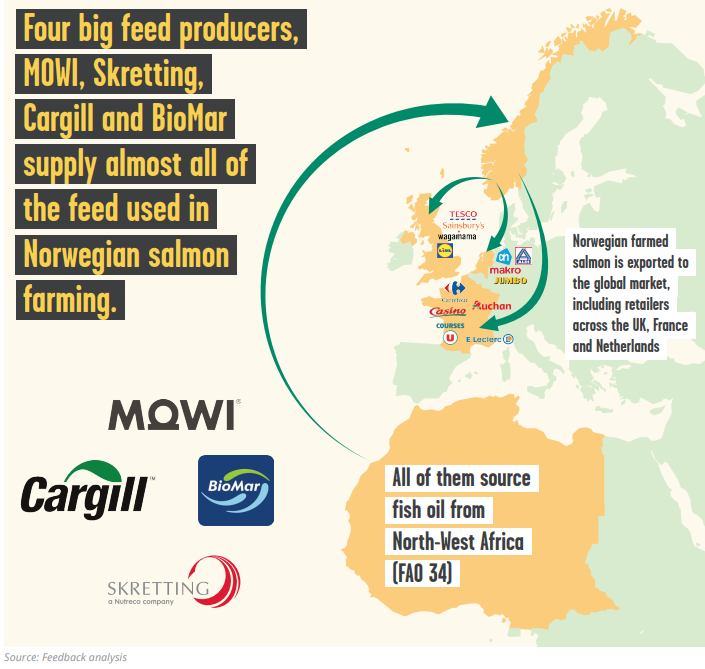
This is a global issue which is being driven by companies seeking to create demand in high-income markets for farmed seafood such as salmon, seabass and prawns. Each year, around one-fifth of the world’s annual marine catch (over 16 million tonnes in 2020) is used to produce FMFO, the bulk of which goes to producing feed for the aquaculture industry. Astonishingly, while salmonid production only accounts for 3.9% of farmed fish produced globally, it uses up 58% of fish oil and 14% of fish meal destined for aquaculture.
Is there a solution?
Luckily, the solutions are already on the table. Our modelling shows that an alternative aquaculture-fisheries model combining the direct consumption of wild-caught fish alongside salmon fed on fish oil and fishmeal exclusively made from trimmings (waste from processing), rather than whole fish, can deliver the same amounts of key micronutrients for the same number of people, whilst freeing up nearly 1 million tonnes of wild fish to feed people, or to continue playing their critical role in the marine ecosystem.
When it comes to Norway’s salmon farming industry, our report points to a clear disconnect between the Norwegian government’s industrial strategy – under which salmon farming is set to expand massively by 2050 – and its development goals. In light of our findings, we’re calling on Norwegian decision-makers to stop further growth in salmon farming, mandate genuine transparency throughout the supply chain, and ensure that Norwegian companies’ activities and feed sourcing practices do not run counter to its own development policy.
What can I do?
Sign our petition, in partnership with Eko and Wild Fish, calling for Wagamama to drop farmed salmon from its menu!
A tumultuous moment for America from which sprung a community food initiative worth revisiting during Black History Month.
1968, in the United States of America, was turbulent. The year’s unrest included the assassinations of Martin Luther King Jr and Bobby Kennedy, violence at the Democratic Party Convention in Chicago, the iconic black power salutes at the Mexico Olympics, and on-going protests over the Vietnam war. From this chaotic context emerged a grassroots initiative in Oakland, California, with a simple yet somehow groundbreaking offer – free breakfasts for children.
These meals were launched in January 1969 by Rev. Earl Neil, a key player in organising the 1965 march from Selma to Montgomery, and held at St. Augustine’s Episcopal Church in Oakland where he served as pastor. He ran the breakfasts under the banner of the Black Panther Party for Self-Defense (BPP), a radical black power political organisation infused with communist ideology, recently founded by Huey P. Newton and Bobby Seale. The BPP’s reputation centres on their militia style confrontation the police and armed patrols of Black neighbourhood, however their social mission to support the Black community is less well known about.
The Community Survival programmes that the BPP ran were geared around empowerment for African Americans and reclaiming power at the social and economic level. As well as food these initiatives included providing transportation, education and healthcare services, alongside connecting people around cultural and sporting activities. “The food component of the BPP was a big part of our organizing.” Melvin Dickson, an organiser for the Oakland breakfast program said, “this included our free breakfast program. Because one thing you can guarantee in an oppressed community is that you’re going to find hunger.” Within a few months of the launch in Oakland, the Breakfast for Children Programme (BCP) was rolled out across the country by the BPP, feeding over 20,000 children in 19 cities by the end of 1969.
On a basic level the meals addressed the self-evident truth that “children can’t learn on an empty stomach,” but going deeper, it’s clear the breakfast clubs successfully embodied an ethic of grassroots organising and anti-oppressive practice. Cooking and eating were entry points for discussions about racism, capitalism, and the possibility of revolutionary change. Corporate power was challenged too – after organisers unsuccessfully attempted to get the support of businesses to donate food, the Black community in Oakland boycotted dairy products at Safeway and forced the supermarket to get behind the effort to feed kids.
Perhaps the clearest indicator that the meals made waves is seen from the way in which the authorities identified them as a threat. In an internal FBI memo, Hoover wrote: “[BCP] represents the best and most influential activity going for the BPP and, as such, is potentially the greatest threat to efforts by authorities to neutralize the BPP and destroy what it stands for”. In 1975, in a move widely considered to be influenced by the BPP, the US government started offering free breakfast in public schools.
 Image Credit: It’s About Time / BPP
So what lessons can Britain learn today from the BPP’s free breakfast programme?
The Black Panther Party made food central to their political action because food, and hunger, have always been political issues. All too often in modern Britain, food support for hard up members of society has failed to face up to home truths about entrenched structural inequality, and instead treats the provision of food to those in need as apolitical acts of charity. In 2012, then prime minister David Cameron spoke in Parliament of ‘welcoming-the-work’ of food banks at the same time as his government’s austerity project pulled away the rug of social support for those in poverty. Since then, there has been a 10-fold increase in the number of food parcels being provided by food banks, and yet ministers have praised the effort required to meet the need as ‘uplifting’. This chasm between the political conditions of food poverty and the feel-good food philanthropy carried out by the political elite was epitomised last Christmas, as Rishi Sunak was photographed serving hot food at a London shelter. In these instances and many other moments in modern Britain, philanthropic food provision risks becoming political cover for structural inequality which is remedied and repeated without addressing root causes.
The Black Panther Party also shows us how food is a chance for us to come together. Community meals are by definition collective moments that provide the chance for relational power to build – contacts to be made, background stories of others to be better understood and shared visions for a better future to be discussed. Any grassroots campaign is stronger by placing food at the centre – as much as anything it makes it easier for people to attend if they don’t need to squeeze in a meal before or afterwards. On top of nourishment a shared meal is a chance for a conversation and connection, a hook for forming better relationships in the public realm.

Additional resources:
BBC World Service History Hour (2021) Black History: The Black Panthers
Huffington Post (2016) The Black Panther Party: A Food Justice Story
Vox (2016) The most radical thing the Black Panthers did was give kids free breakfast
Wikipedia entry on Black Panther Breakfast for Children
[Feature Image Credit: William P. Streater, Granger/Rex/Shutterstock. Bill Whitfield of the Black Panther party serves breakfast To local children in Kansas City, April 1969]


The COVID-19 pandemic made us more aware of the air we share between us. A hushed conversation between lovers, and its sticky heat of promise; the sliver of cool wind that blows in through the cracks of a crowded tube during a muggy ride; and the frosting, oh, the frosting! slick with air-droplets and birthday wishes, smeared atop a birthday cake after the candles are all blown out. My air is never mine, but yours, and ours. And as we yelled hello and goodbye at each other from 6 feet apart, it bound us together, like marriage, for richer or for poorer, in sickness and in health.
But when Black people started dying at a disproportionately high rate compared to our white counterparts, this pandemic reminded us that, despite possessing the same windpipe, and the same weary lung tissue, some air is ours alone to endure.
To take a breath in London, as a Black resident, is to produce life from toxic air. A report commissioned by the city of London showed that Black people are living in areas with disproportionately worse air quality. Nine-year-old Ella Kissi-Debrah, a Black child with sparkling eyes from inner London, was the first person in the world to have air pollution listed as a cause of death.
The surfaces of our lungs have always been contested territory. Our babies’ first breaths are less likely to be heard by their mothers – black women in the UK are 4 times more likely to die in childbirth compared to white women. Throughout history, white supremacy erected oppressive structures across the world, from slavery and colonisation, to the imperial new world order, that suffocated us. Race scientists justified our asphyxiation: they ran biased tests on enslaved people to conclude that “the deficiency in the negro (lung)” was about “20 per cent” compared to that of a white person. Never mind that these test subjects likely spent months crammed into the hull of a slave ship, sucking on just centimetres of expired oxygen. The brand of a deficient lung still follows Black people around, from hospital to hospital, getting in the way of life saving diagnoses, treatment and disability benefits. It is through these systems and their justifications, that the levers of white supremacy enact Necropolitics– using political power to determine if we live or die, if we breathe or not.
Each soul left gasping for air in a sinking dingy off the Mediterranean coast, is a political choice made by members of the European Union. Even as we bore witness to George Floyd’s murder, a live-streamed execution by suffocation, at the hands of American police, the Met Police still strangle our sons as a form of social control. When a Black woman in south London got into an argument with a non-black shop owner, he responded by throwing his hands around her neck. George Floyd’s last words to us were “I can’t breathe.” When Black people took to the streets in the US to protest police killings, they found their own throats closing up, as they choked on teargas sold to US riot police by UK manufacturers. In this way, Black life becomes an appeal for air, if not for basic survival, then to simply have some space. Give me air! As in, let me be. Allow me pause. Let me think, and feel, and live, and love, and process; comfortably, without want; away from hardship, and violence, and scrutiny.
Even outside of the smog city, and the riot gear, Black folk still find themselves battling for clean air. In hog country, eastern North Carolina, the pigs outnumber the mostly Black, Latine and Indigenous residents 35 to 1. Millions of pigs packed into factory farms mean billions of tonnes of pig-waste, which gets dumped, sprayed and crammed into the surrounding areas. What’s sprinkled into the air settles on people’s cars and clotheslines, into the backs of their throats, and into the swell of their lungs. In the shadow of the hog farms, breaths – and lives – become difficult to catch. The old men wheeze as they settle onto their rocking chairs. The young ones cough into the wind.
The UK doesn’t have as many factory farms as the US, but meat producers are always angling for more. Our factory farms already emit tonnes of noxious fumes into the atmosphere. Continuing expansion becomes a question of how much more our government expects us to bear.
But if the UK keeps building its factory farms, and rams the rooms with poultry, and swine, and excess, what then must we think? What then of our Black Girls, and Black Boys, with their Black Lungs, and Black Fists, and Black Dreams? What then of the smog, the strangle, and the fumes that follow? What should we make of this all? What else will come after your factories if not clouds of toxic air like the ones we know from our cities? Whose lungs will they fill but ours?
Foodrise hosted Joao Henrique Borges Azevedo and Daniel Fulga of Year 10 Duke’s Academy, Tottenham for a week of work experience. Here is what they had to say about their time:
Joao Henrique Borges Azevedo:
This week in Foodrise has been an unforgettable experience. I have learned very useful things, like finance, how charity campaigns work , how food waste is damaging ecosystems and climate and ecosystem…etc. I appreciate the opportunity!
Something that caught my attention and I loved learning is how sugar can affect our environment and how the fish industry in the UK is ruining our lives and harming everyone (even if not many are noticing). Also, the co-workers I got to know were very nice to me. Especially thanks to Azalea and Claire for all the lessons I learned with you.
In addition to learning about the environment, finance and many other things, we also learned about some of the different jobs around the office. My favourites were the work of Azalea (Operations Manager) and the work of Caela (Digital Campaigner).
Daniel Fulga:
I’ll start with the beginning. The whole week before work experience I felt excited and scared of the work experience which built up a bit of stress up to Sunday. I knew, however, that adults at work are very nice and helpful. My mentoring courses at LinkLaters really helped.
Anyways, the work experience week.
Day 1 (Monday) – Quite excited for work experience. Had a little trouble finding the workplace but Joao (school friend) showed me which was unexpected as I didn’t know he would be here as well for work experience. I met Azalea and she showed us the work Claire gave us which me and Joao started doing. It was really calm and relaxing in the office. Lunch passed and then we (me and Joao) had a nice conversation with Azalea about her job and other stuff. Great day.
Day 2 (Tuesday) – Got to the office and met Claire. She is a nice person. The work for that day was also quite easy and interesting, I could listen to music. At the end of the day me and Joao had been given a task to research games and artists. It was another great day.
Day 3 (Wednesday) – Another day in the office. Joao got there very early and read a book about the sugar beet campaign Foodrise did. That day we both read some of the book, then we had a talk with Claire about the task she gave us as well as the sugar and other campaigns which were quite interesting to know more about. However, the part where Claire, me and Joao were talking about how to make a campaign was fairly boring and about 60% into it I started zoning out. Overall though it was another great day.
Day 4 (Thursday) – Today is my last day here in the office. I found out about working only 4 days back on Friday last week. Today we talked about funding and some examples of foundations and where money comes from. We talked about an example of how much money can be needed for a campaign as well as planning how to use that budget. This time it was interesting but I was soo surprised at how complex the planning actually is. Me and Joao gave the office colleagues some chocolate which, from their reaction, I’m sure they loved.
Overall, this was much better than my most optimistic expectations and it’s an unforgettable experience that I will only see as a happy memory of my life. I also learned more about nature, campaigns and organisations more than I did in the last 10 years of my life.
Thanks to everyone for the help and support you all gave me and I’m happy to have my work experience here.
Thank you Joao and Daniel for all your hard work!
Alexandra Maruntu and Kyrel Ibrianne Sawal of Year 10, Waterside Academy, spent a week doing work experience at Foodrise’s head office. Here are their reflections.
This week has been our chance to experience what life is like in the working world. Foodrise is an organisation that specializes in how agriculture and food effects our environment but also how this food effects our bodies in the process.
We spent some time researching their campaigns and looking through their reports and found out just how much meat makes up of our global emissions. We even got a chance to make our own campaigns for our school suggesting implementing Meatfree Mondays. We got to try make our own posts and tweets using Canva, though at first, we found it a bit hard to navigate.
Over the course of the week, we got to meet staff from all sectors of the organisation. We got to talk and ask about their journeys as well as their daily routines. It was interesting to see what office life was like by having keys, having desks, going out for lunch and interacting with co-workers.
Near the end of the week, we found out we would have the chance to go to court and excitedly agreed. Reading the briefing we realized it was very hard to follow. Ultimately, we agreed that the government should be upholding their policies regarding taking CO2 emissions into account. Surprisingly, at the court the barristers were wearing wigs which we found laughable. It was our first time entering the royal courts of justice and seeing what it’s like in court.
Overall, we enjoyed learning more about the environment and considered the next steps to take in the future. Thank you to everyone from Foodrise for being very welcoming during this week.
Thank you Alexandra and Kyrel for all your hard work!
‘The Scottish Government supports the industry’s growth strategy to double the production of salmon by 2030’ – a statement now broadcast by every Scottish salmon producer in some variation or other.
But what might the consequences of this huge growth be?
Evidence of the negative impacts of salmon farming is piling up. It seems reasonable, given the magnitude of the salmon farming sector’s ambitions, to question whether there are unaccounted for social, environmental and economic costs to this increase in production and if the industry really is providing the benefits it claims it is.
A billion-pound industry
Growing at a rapid pace since the ‘70s, the Scottish salmon farming industry has gone from producing just 14 tonnes of fish for commercial sale in 1971 to more than 203,000 tonnes in 2019. That same year, the industry turned over more than £1 billion and claimed its position as the UK’s largest food export by value. No two ways about it, over the past five decades, the Scottish salmon farming industry has become a highly profitable and lucrative business. Today, you can find hundreds of salmon farms all along the west and north coasts of Scotland and the fish they produce in every UK supermarket. But as Feedback’s research and investigations have shown, the industry is built on a highly extractive business model which incurs significant external costs for Scottish society and the environment. These findings are backed up by economic analysis which shows that the total environmental and social cost over a seven-year period is in the region of £2 billion. And yet a big chunk of the financial returns generated by the industry are flowing out of the country: in an article published last year, we revealed that the industry is Scottish in name only, with all five of the major salmon farming businesses owned by foreign companies, including several Norwegian companies and a US investment firm.
Key to this industry’s expansion is the Scottish Government. Despite a 2018 parliamentary inquiry showing just how environmentally damaging the salmon industry is, the Government supports the expansion of the industry on account of the contribution it makes to the economy. However, a recent review of the economic contribution of Scottish salmon farms by the Sustainable Inshore Fisheries Trust (SIFT) shows that the Gross Value Added (GVA) used by Marine Scotland to measure the industry’s contribution to the economy has potentially been exaggerated by 124% and the number of people it employs by a massive 251%. SIFT states that the evidence and reasoning for expansion are “partial, incomplete, unreliable and even irrelevant” and should not be used to increase production without further evidence. This didn’t stop cabinet secretary Mairi Gougeon MSP from using these potentially inflated figures to promote the Scottish salmon farming industry at COP26, when she stated, “the Scottish aquaculture sector supports almost 12,000 often highly skilled and well paid jobs”. Even if we consider this figure to be true, it represents a mere 5% of the number of people employed by the tourism industry across Scotland.
The incomplete picture relied upon by the Government fails to include the loss of jobs and income in other marine-based businesses. This is a particularly shocking omission if we consider the significant levels of pollution the industry generates and the rapid decline of Scotland’s wild salmon stocks, threatening the jobs and income of commercial shellfisheries, recreational fishing, recreational diving, and tourism all over Scotland. If the idea behind the Government’s endorsement is to create jobs, then perhaps it would be better off rebuilding wild stocks or supporting the farming of less harmful species. For instance, the shellfish farming industry is dwarfed by salmon and yet it generates proportionally far more jobs. For every £1 million of industry value, 23 shellfish jobs are generated for every 2 salmon jobs. With native mussel farming requiring no feed, helping to clean up waters and providing habitat for other species, it could be a far more beneficial and sustainable industry to support.
The true cost of salmon feed
Another challenge facing the salmon farming industry, in Scotland and elsewhere, is the true cost of salmon feed. The problem with farming a carnivorous species like salmon is the inclusion of fish in their diet. Current practices rely upon wild fish being caught, sometimes thousands of miles away, ground up into fish meal and fish oil (FMFO) and then included in compound feed which is fed to caged salmon along the Scottish coast. Salmon makes up just 4.5% of global aquaculture yet consumes 60% of global supplies of fish oil and 23% of fish meal destined for aquaculture. In 2014, the Scottish industry used at least 460,000 tonnes of wild fish to produce the fish oil necessary to feed just 179,000 tonnes of salmon – roughly equivalent to how much fish is purchased every year by the UK adult population. To meet its growth projections by 2030, the industry would have to increase its use of wild fish by 310,000 tonnes, to a total of 770,000 tonnes!
Up to 90% of the fish in FMFO are nutritious food-grade species, many of which contain a higher nutrient density than the farmed salmon they produce. After they’re fed to salmon, 50-99% of the essential nutrients they contain are lost. Despite the industry’s current reliance on wild fish, there are alternatives. It is possible for the industry to switch to 100% by-product derived FMFO and eliminate wild fish entirely from its supply chain. Furthermore, it has been shown, that by redirecting wild fish and diversifying our plates, we could reduce pressure on wild stocks and increase our nutrition from the ocean. While the Scottish Government endorses the expansion of the salmon industry, some of the fisheries that prop up its operations are showing signs of decline. An especially troubling thought when you consider many of the feed fish are taken from places where coastal communities wholly rely on fish as a vital source of key nutrients. The Government could do more to reduce this reliance and improve transparency by requiring the industry to produce impact reports on feed and regulate the use of wild-caught fish in FMFO.
Given its track record to date, it seems fair to say that the Scottish salmon industry’s focus on extraction, growth, and profit-at-all-costs will always come at the expense of rural communities, coastal ecosystems and a supply chain of exploited farmers and fishers. Ultimately, Scottish salmon is a high-value product sold in affluent markets. And the current usage of wild fish in salmon feed means that critical nutrients are not being distributed to people who need them the most. If we want fair nutrition around the globe, the industry should not be allowed to grow. If we want to reduce pollution and create long-term solutions for thriving fishing communities, the industry should not be allowed to grow. And, if we want to reduce pressure on wild fish stocks, the industry should not be allowed to grow. In short, rather than uncritically endorsing the salmon farming industry’s growth strategy, the Scottish Government needs to adopt firmer regulations to prevent further economic and environmental damage in Scotland and beyond.
We use cookies where necessary to allow us to understand how people interact with our website and content, so that we can continue to improve our service.
We only ever receive anonymous information, and cannot track you across other websites.
