
Donate
Support us in the fight for a better food system.
Local-level schemes to help reduce food waste in Bucks have started to sprout up over the last year. I am very open to the idea of free food but sceptical as to whether they really WORK on a local level. As part of Foodrise’s Food Citizens Project, I spent this year’s Food Waste Action Week testing if Buckinghamshire is really on the food waste app map.
The main schemes operating in Buckinghamshire are OLIO and Too Good To Go, and their goal is to make surplus food available to others to prevent it being tossed into a bin. If you have a smart phone, registering is as easy as pie!
 This app has an interactive map showing how many retail outlets are ‘live’ and offering ‘Magic Bags’ near your location. What’s a ‘Magic Bag’, I hear you say? Supermarkets, convenience stores, coffee shops and bakeries offer daily bags for a small cost (£2- £6). Organised by location, bags are listed at certain times of the day, to be collected in allocated time slots. Across Bucks, there are a good number of listings – the more strategic user could probably note times and days of the week when more is listed and where to maximise the opportunity. Even this aspect offers a good insight into what could have been wasted without this scheme in place.
Olio was supported by Buckinghamshire County Council four years ago in a countywide launch. However, this scheme is only as strong and effective as the residents and households that use it. According to the app, there are 1,733 OLIOers near me, so I was excited to see what was on offer! The daily listings showed that people are engaging with repurposing food waste; this app easily supports people a) wanting/ needing food, or b) wanting to help items not to go to waste, as all listed food is free. On OLIO, it’s not just fresh or close to date items that are listed – there are also drinks and ambient goods, as well as a range of other non-food items, from upcycled crafts and preloved goods, to toiletries and children’s toys, which is another great way to prevent waste.
So, do these apps work in Buckinghamshire?
The answer is YES!
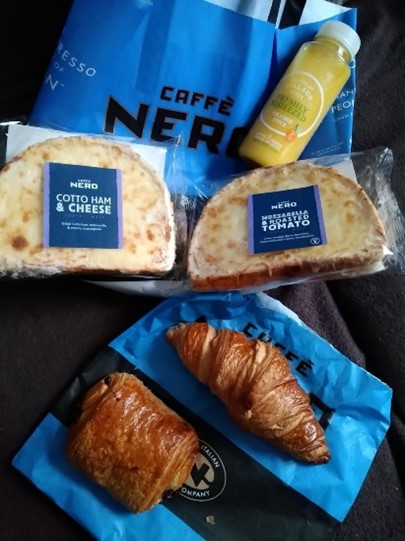
I was able to test Magic Bags from 4 outlets near Aylesbury. Although certain suppliers do have healthier options (e.g. fresh goods) rather than just bakery items, as a vegetarian, I did wonder if I would find myself with meat products, thus left disappointed and with items I wouldn’t personally use. And indeed, I did receive some meat-based products.
This gave me the perfect chance to try OLIO and see how the ‘giving’ process works and whether anyone would be interested locally. Within an hour of listing items, I had arranged for ‘contactless’ collections to take place.
In conclusion, Too Good To Go, will obviously be more beneficial in town centres or places near listed outlets. OLIO is also a great scheme to be used in urban and rural areas, as long as people actively use it! We still need to challenge supermarkets to waste less in their supply chains and help us to only buy what we need, but these apps can help make sure good food isn’t going to waste. So what are you waiting for? Get to know your cupboards and, if in doubt, why not donate it to someone who could use it!

Growing skills, connection, and resilience through food and farming
See the issueMany of us have found solace in gardening and food growing during lockdown. We want to celebrate this on International Women’s Day with a ‘Cultivating Conversations’ event.
The theme this year is “Choose to Challenge” and we want to challenge beliefs around food growing and land access. Join us for an inspirational panel and discussion facilitated by Helena Appleton from our Alchemic Kitchen.
This event is supported by the Food Citizens Project run by Foodrise in Buckinghamshire.
You can view a recording of this event here: https://www.youtube.com/watch?v=o_dOysAwvys
Our wonderful panel is:
 Judy is a painter, poet and environmentalist, best known as the Honorary President of Black Environment Network (BEN). For 27 years she was the UK Director of BEN, with an international reputation as the pioneer and creator of the field of multi-cultural participation in the built and natural environment. Judy is a major voice on policy and practice towards social inclusion. She is recognised as a visionary advocate for diversity and equality. She was awarded an OBE for pioneering multicultural environmental participation in 2000, and a CBE for services to heritage in2007. Recently, she was included in the BBC Power Women List, and the Forbes List of 100 Leading Environmentalists in the UK.
 Joy is an inclusion expert, educator and green care researcher. In 2018, while supporting young people at risk of exclusion from education, she made a visit to a care farm and was ‘hooked’ on the approach. Since then Joy has been working with green care, community growing and care farming organisations across the UK, Australia and North America. In 2020 Joy was awarded a Churchill Fellowship to research care farming in Europe.
 Ruby Radwan has always been interested in the relationship between health and the environment. Ruby previously studied Psychology, trained as a holistic therapist and worked as a reflexologist at the Acland hospital, whilst also applying her academic and spiritual principles in seeking to raise her children in a healthy and natural environment. Eighteen years ago, Ruby and her husband Lutfi took their young family on an adventure. They gave up their jobs and established Willowbrook Farm where they sought to rear animals ethically, nurture the environment on the farm and live sustainably. They now live in a house made of mud which they built and deliver ethical and sustainable produce to customers in Oxfordshire and beyond.

Freya stumbled upon organic vegetable growing by chance from a low point in her life and has never looked back. She is driven to help others find connection to their food and subsequently the planet through farming. Since finding passion in food Freya has studied horticulture, soil health, composting and naturopathic nutrition. Freya believes that personal health, plant health, soil health and planet health are intrinsically connected and is evolving her first business Old Tree Market Garden to explore and inspire others to see the links between these often isolated subjects, as well as to grow delicious food!
“
Growing skills, connection, and resilience through food and farming
See the issue


How do we dismantle food corporation’s hold on the food system? How do we ensure that our actions meet the scale of the injustices perpetuated by industrial meat and dairy production?
These are questions that we grapple with daily at Foodrise. As the outside world grows distant and disconnects us from those face-to-face moments for activism, it is increasingly important for those of us who are concerned about the climate, deforestation, and systemic racism in the food system to come together to hold food corporations to account.
As campaigners, we find ourselves alternating between being angered and frustrated by the next corporate scandal, the next worker death in the food system, or the next community exploited for their land. If the past year has taught us anything, it’s that this anger is justified. Take giant meat and dairy corporations for example, companies like Tyson Foods, Smithfield, JBS and Arla (we call them Big Livestock): to date there have been at least 56,000 positive Covid-19 cases tied to meatpacking plants and at least 277 worker deaths in the United States. Here in the UK, the BMPA has denied claims from unionised workers in the industry that low-paid, migrant meatpackers are being treated as “disposable assets” despite the virus’ deadly spread. Just recently we witnessed the 1000th day of ongoing struggle in Turkey to bring justice to The Cargill 14 – 14 workers who were unfairly dismissed for trying to unionise at a Cargill plant in Turkey.
This isn’t a case of a handful of companies handling the pandemic badly. It’s evidence of what we’ve known all along: that extracting profit from people and the planet is at the core of industrial meat and dairy’s business model. Without low-paid migrant workers baring the brunt of this crisis in slaughterhouses, without indigenous communities being stripped of their land and livelihoods, rich consumers in the UK, US and Europe simply wouldn’t have the possibility to consume so much meat.
To dismantle this toxic industry we must turn to the systems that brought it into being in the first place which is why at Foodrise we’re launching workshops for activists, students, and everyone concerned about giant meat and dairy corporations but find themselves feeling powerless in the fight against them. Through critically examining the food on our plates and questioning the systems of power that give rise to the biggest failures of our food system, together we are reimagining what food activism in the UK, for food justice globally, looks like.
Our divestment campaign calls, not for a reform of these companies, but a complete end to them. Corporations processing meat and dairy produced at an industrial scale will always be driven by extractive forces. When an industry is rotten to its core, there is nothing else to do but uproot it. By imagining a world without exploitation and extractivism in the food system, we’re equipping campaigners with the skills and tools they need to call for their banks, institutions, and pension funds to divest from Big Livestock – will you be one of them?
To find out more about our campaign or to organise free workshops, get in contact with Big Livestock Campaigner Mia here.


Every January, many Foodrise staff travel to the Oxford Real Farming Conference for a chance to connect with others working towards building a better food system. This year, things were a little different: like most things, the conference went virtual. Despite not being able to connect in person, the conference provided inspiration and hope. Below are some reflections from Foodrise staff.
“ORFC 2021 has re-inspired me and reconnected me. In the breakout rooms from workshops, I met people from all over the world and I even have a pen pal from another continent. However, the highlight for me was when Pete Ritchie, of Nourish Scotland, invited us to imagine a day in 2030, at which point our dreams of our perfect lifestyle and food system have been achieved. Over the weekend, and with the help of Rob Hopkins’ time machine, I fleshed out this vision – adding details to the cooperatively owned farm, until I could smell the flowers, hear the birds singing and the children laughing. I could even feel the weight of the veg bags as we hand them out to our diverse CSA co-owners. With help from Frances Moore Lappe, who has taught me that democracy is something we do, not something we are given, and from a panel about making CSAs more accessible to run and to eat from, I can start to translate my vision into changes and policy asks that we can work on achieving over the next few years.” Krysia Woroniecka, Project Manager Soil Depletion and Land Use
“Solidarity, innovation and perseverance were the underlying themes of this year’s ORFC Global. Whilst the ORFC has always had a global presence, this year’s online conference was a revelation. Participants from across the globe took part in the 7-day meeting of minds. Particular highlights included the ‘food justice, not food aid’ talk, which highlighted the work carried out in South Africa and Kenya to establish grassroots movements, and the Community Supported Fisheries seminar, a concept which is thriving in countries such as the USA, Turkey and France but is yet to take off in the UK. Inspiring talks from closer to home included the captivating Merlin Sheldrake, talking about the lessons we can all learn from mushrooms and mycelial networks; a discussion hosted by Baroness Rosie Boycott on post-Brexit trading relations; and an ORFC favourite, the need for small abattoirs in the UK, hosted by Patrick Holden from the Sustainable Food Trust. Missing from the conference was a wider debate on the future of sustainable meat. A discussion around animal feed failed to take into account the land requirements for increased soy production in Europe and there were very few mentions of protein alternatives. Indeed, the main innovation of the conference was the global platform; many of the panellists and viewers appeared to be united in their outlook and practices. Hopefully the momentum and vibrancy of this year’s conference will be carried over to ORFC 2022.” Helena Appleton, Project Officer Regional Food Economy
“I felt honoured (and a little intimidated) to have been invited to attend such an unusually international event from the comfort of my bedroom during a pandemic. As someone who is just beginning to dip my toes into the world of agroecology I really tried to make the most of the global expertise on offer. I came away overloaded with new knowledge, as well as inspiration and ideas for my own projects.
I was particularly motivated by the session run by the International Federation of Organic Agriculture Movements showcasing good policy practices across 3 continents. It was incredible to learn about the differences in what is tried and test in different places, but also the commonalities. It left me with the decision that aside from prioritising rescued veg, I will try to only buy organic produce.
I wanted to learn about the global food system; how and why much of farming has become so horribly unsustainable and some ideas on ways people are trying to change it. To gain some background information I attended a great talk about the neo-colonial hold on farming systems worldwide which detailed some of the ways that the international farming trade is rooted in colonial ideology. The talk confronted some of the false ‘solutions’ that have been implemented over the years and their impacts, as well as the bureaucratic and at times negligent teamwork by AGRA (Alliance for a Green Revolution in Agriculture) and the UN itself (among others) to hide evidence of the damage of the false promises they have made. However, despite some negative aspects, overall, I was uplifted by a workshop run by Sustain about ways that the UK’s supply chains and infrastructure for supporting agroecology is improving. I was particularly interested in how we can encourage the use of Dynamic Procurement Systems to help smallholder farmers access mainstream public sector contracts (e.g universities, hotels etc). my takeaway sentiment was: What an opportunity!” Abi Itkin, EcoTalent Intern working on Foodrise’s Flavour Project Pilot, Sussex Surplus
All the sessions are available on YouTube and can be viewed here: https://www.youtube.com/c/OxfordRealFarming/videos


I love to cook and get excited about what I can make from my weekly veg box but I would be lying if I didn’t admit that sometimes I feel like screaming ‘Cabbage – again???’
Eating seasonally means we often have to deal with gluts (an abundant amount of a certain fruit or vegetable). Thankfully our Food Citizenship project in Buckinghamshire along with Empower to Cook has created a cookbook to showcase all the wonderful things you can do with seasonal gluts. We also have created short videos to show you how to cook frittatas, soup, risotto and crumble.
Growing skills, connection, and resilience through food and farming
See the issue
Last month, with much fanfare, the government announced its intention to legislate for ‘world leading new measures to protect rainforests’. The law, enshrined through an amendment to the Environment Bill, will require large businesses to ensure that they are not using products that drive deforestation considered illegal in the country where they were harvested.
Just two weeks after the announcement, an investigation by The Bureau of Investigative Journalism showed how flawed the governments approach is. The Bureau and its partners tracked soya grown on land owned and deforested by farm conglomerate SLC Agricola, sold to the ‘worst company in the world’ Cargill, who then shipped it to Liverpool, turned it into animal feed and fed it to chickens to supply to Tesco, Asda, Lidl, Nando’s and McDonalds. Because Brazilian legislation permits clearance of forest and other natural areas outside of the Amazon, all of this was perfectly legal, and the new forest law will do nothing to stop it.
As Foodrise and many others argued in our response to the government, this is a terrible oversight, especially because the government’s consultation earlier this year recognised that half of global deforestation is legal where it takes place. The law is further flawed; while the new rules will require companies like Tesco to perform robust checks for illegal deforestation, shockingly, those who bankroll deforestation will get off scot-free. They will not be required to perform any checks.
So, how big a problem is this – just how much money from UK banks and investors goes to Brazilian soya mega-farms?
Brazil’s soya trade is hourglass shaped, with a huge number of producers, a small handful of soya traders/exporters and many end users. Over 80% of UK soybean imports come from South America, covering the hugely important Amazon, Chaco and Cerrado biomes, and nearly all of this is used as animal feed[a].
Usually, investigations into soya focus on the big-player traders, processors, and exporters (Amagi, ADM, Bunge, COFCO, Cargill and Louis Dreyfus). But a small number of mega-farm companies wield considerable influence and attract heavyweight billionaire backers. The billionaire owner of Brazil’s largest soybean producer, Grupo Amaggi, was once Brazil’s agriculture minister and is a former governor of the Brazilian state of Matto Grosso. His cousin runs another major player, Grupo Bom Futuro. Major player Adecoagro is George Soros’ farmland speculation vehicle. Farm company Fazendas Bartiras is owned by the secretive $500 billion-dollar Canadian investment firm Brookfield Asset Management. The list goes on.
Foodrise commissioned research firm Profundo to map the financial backers of Brazil’s largest soya producers. Through Bloomberg and Refinitiv databases, and by trawling company reports and websites, we used this data to shed light on the UK money behind the secretive players expanding Brazil’s soya monocultures. For a full methodology see our landmark report exposing the scale of international finance behind Big Meat and Big Dairy: ‘Butchering the planet’.
As of April 2020, 11 UK investors invested US$155 million in Brazil’s 3 largest publicly listed soya producers, Adecoagro, BrasilAgro and SLC Agricola. The largest shareholders of two of these businesses are British investors.
Odey Asset Management tops the list with its’ stake in SLC Agricola – the largest of any investor. Crispin Odey, the fund’s former manager dismissed SLC Agricola’s fines from the Brazilian regulator as “a parking fine” earlier this year. Autonomy Capital’s is the largest shareholder in BrasilAgro and invests in Adecoagro earning it second place – its founder has been vocal about the importance of climate change, and its importance in every investment analysis. Given the impact of Brazilian soya on the climate, both due to its deforestation footprint, and it’s propping up of greenhouse gas intensive models of industrial animal agriculture, as well as the industries vulnerability to the climate breakdown it helps drive, these investments seem like an odd choice. We also found two loans totalling $260 million from HSBC to Adecoagro both of which matured in 2018.
Table 1: Investors in Adecoagro, BrasilAgro and SLC Agricola as of April 2020
| Investor | Bondholding | Shareholding | Total ($mln) |
| Odey Asset Management | 115.82 | 115.82 | |
| Autonomy Capital | 24.33 | 24.33 | |
| Kirkham Capital | 5.24 | 5.24 | |
| Aviva | 2.44 | 2.44 | |
| Colchester Global Investors | 2.05 | 2.05 | |
| Standard Life Aberdeen | 1.97 | 1.97 | |
| HSBC | 1.37 | 1.37 | |
| Montagu Private Equity | 0.67 | 0.20 | 0.87 |
| Legal & General | 0.54 | 0.54 | |
| GSA Capital | 0.06 | 0.06 | |
| Schroders | 0.02 | 0.02 | |
| Grand Total | 2.72 | 151.99 | 154.71 |
Adecoagro, SLC Agricola and BrasilAgro are high deforestation risk businesses, with an average score of 31% on Forest 500’s assessment of their deforestation policies.
Brasilagro and SLC Agricola have business models geared towards the transformation of native Cerrado vegetation into “productive” farmland, combining extractive land speculation with extractive agriculture to form a toxic business. Since 2015 over 50,000 acres of deforestation has been recorded on SLC Agrícola farms, that is an area nearly 150 times bigger than Hyde Park. And this year acquisitions by BrasilAgro have raised concerns of thousands of hectares of forest land on their new properties, given the organisations track record of clearances. Adecoagro is no different, called out by our allies at the Global Forest Coalition for their capturing of “financial incentives for deforestation” in Argentina, including from the International Finance Corporation, who have a deeply troubled approach to agriculture.
The Bureau’s investigation showed the direct link between deforestation on an SLC Agricola owned farm and the UK animal feed supply chain putting chicken on the shelves of major retailers and restaurant chains. Prior to this, Chain Reaction Research estimates that SLC Agricola had deforested nearly 25,000 acres during the first 5 months of 2020 alone. And while SLC says it will stop deforestation Cerrado by the end of 2020, and move to increasing productivity on already deforested land this new target will not happen immediately.
To ensure that due diligence legislation truly prevents British supply chains and British stakeholders’ risk of complicity in deforestation, we call on the government to ensure that such legislation:
| Company | Headquartered | Soy area (ha 2019, A) |
| Grupo Amaggi | Brazil | 275,000 |
| Grupo Bom Futuro | Brazil | 270,000 |
| SLC Agricola | Brazil | 243,139 |
| Bom Jesus | Brazil | 133,500 |
| Terra Santa | Brazil | 91,063 |
| Adecoagro | Luxembourg | 247,000* |
| Grupo Los Grobo | Argentina | |
| Fazendas Bartira | Canada | 150,000 |
| Brasilagro | Brazil |
*Includes Argentina and Uruguay
Back in March the government introduced a 12-month break on business rates to help struggling retailers, fearing that the effects of the Covid crisis could hamper their ability to feed us. In total, nearly £2 billion in public funds have been handed to the ‘big six’ – Tesco, Sainsbury’s, Asda, Morrison, Lidl and Aldi – while at the same time they’ve made major pay-outs to their shareholders.
Supermarkets are one of the few businesses who have done well during the lockdowns. In fact, their sales have boomed while local cafés, pubs and restaurants have gone bust. The result has led to supermarkets paying dividends to shareholders even while receiving state aid. Earlier this year Sainsbury’s disclosed business rates relief of £230 million – suspiciously, this is the same figure that they’ve paid out to their shareholders. If public funds are going directly into the pockets of supermarket shareholders instead of the thousands of hungry people and small businesses that need it the most, we must question whether there is any integrity to this financial aid at all. We’re demanding that supermarket CEOs do the right thing and hand back the cash.
Sign the petition and demand that supermarkets hand back the cash!
Supermarkets will inevitably claim that the money they’ve received is compensation for all their hard work “feeding the nation”, but when we clapped for careers and other essential workers, we weren’t thinking of supermarket CEOs or shareholders. We were thinking of the thousands of people working tirelessly to look after and feed our communities, including those working on shop floors around the country who took the greatest risks to keep the rest of us safe and well-supplied.
Food growers, packers, and those who work in the hospitality industry (including those who support them, such as beauticians and cab drivers) have been systematically undervalued for the work that they do. Many of these workers, many of whom are migrants, have endured poor working conditions, little to no sick pay, insufficient salaries, leaving some of them turning to food banks themselves. These people are the backbone of our food system, our communities, and our support networks.
Now, more than ever, small, independent and struggling businesses need the support to get them through the crisis. 72% of pubs and restaurants predict that they won’t survive the impacts of Covid – but isn’t this inevitable when the money that’s supposed to help them is going to wealthy shareholders instead of the small businesses who are being left behind?
In a time of crisis, £2 billion could be put to far better use than to simply line the pockets of the wealthy. This could be spent protecting jobs at our local cafés and pubs, supporting small-scale producers who are keeping our communities fed. It would even pay for free school meals for kids ten times over.
Sign the petition and demand that supermarkets hand back the cash!
Growing skills, connection, and resilience through food and farming
See the issue
This is the second in a series of blog posts exploring the findings of our new report Bad Energy.
The UK’s food security has never been a higher priority – with Brexit looming, the question of how we’ll ensure we become less reliant on imports for what we eat has become a key question. The climate and biodiversity crises means we urgently need to reverse decades of deforestation and start restoring woodlands and habitats to draw down carbon from the atmosphere and create space for nature to regenerate – but whilst also ensuring everyone is fed. In this context, it seems mad to use valuable land to grow crops to burn them for energy. Anaerobic digestion (AD) – the process of producing “biogas” from organic matter like crops and wastes – has presented itself as the silver bullet to everything from producing green gas for heating and transport, to producing fertiliser for our crops. In this second part of our series on AD, we turn to the purpose-grown “bioenergy” crops which are grown especially for AD, and show that they have no role to play in a sustainable future.
 Bioenergy crops, like maize and grass, are currently the most controversial feedstock processed by AD plants. The Soil Association has previously highlighted that 75% of sites with late harvested maize used for AD showed high or severe levels of soil erosion – concluding that maize has a “singularly harmful impact” on soils. Nearly a third of maize grown in England is grown as a bioenergy crop for AD. Our report shows that there are far better uses of land than bioenergy crops from almost every perspective. From the perspective of energy generation, we found that solar PV generates 12–18 times more energy per hectare than maize or grass grown for AD.
The AD industry aims to expand bioenergy crops to cover 282,900 hectares – this land could instead be used to grow enough peas to feed 1 million people per year. Grown in rotation, planting vining peas would be much better for soils than maize. Growing peas would also contribute to the UK’s vital shift away from meat intensive diets to eating more plant-based proteins. So from the perspective of food security and soil health, it makes more sense to use valuable cropland to grow food to feed people. The AD industry claims that land spared by preventing food waste could be freed up for bioenergy crops – but this would be a disaster, since this land too would be better used for planting trees, growing plant-based proteins, or for solar PV energy generation.

Growing grass as a bioenergy crop is particularly bad use of land – generating very little energy per hectare, and covering a large area resulting in indirect land use change. Grasses used for AD are often monocrop grasses grown on land which usually requires lots of synthetic fertiliser. Grass leys can increase soil carbon in depleted soils, although long-rotation perennial crops and forests do this more effectively. We found that planting trees saves 11.5 times more emissions per hectare than growing grass as a bioenergy crop, even in today’s context where energy from AD displaces some fossil fuels. In a net zero context, where we have transitioned to more renewables in our energy mix, using grass to feed AD plants actually causes net positive (extra) emissions, not savings:


You can also see from the above that growing maize for AD results in very low emissions savings per tonne by the net zero context. Since we will need to urgently shift to other renewable energy sources like wind and solar to avoid climate crisis, we will need to shift to this net zero context as soon as possible. Subsidies to AD would, therefore, be far better spent on alternatives. From every perspective – energy generation, food production or emissions mitigation – there are better alternative to bioenergy crops. Rather than locking in green gas, we need to focus on faster electrification of heat and transport wherever possible. A recent report found that the UK’s Heavy Goods Vehicles could be completely electrified by the 2030s, at an affordable cost of £19.3 billion. Despite this, the UK government continues to subsidise bioenergy crops for AD – albeit at a lower rate than for wastes (like food waste and manure) – paying out millions of pounds a year to some AD plants. These subsidies are generally locked in for 20 years after they are accepted – the only way for most AD plants to remain financially viable. This is a huge problem, as it effectively locks in subsidies for bioenergy crops for decades, despite the fact that their effectiveness at emissions mitigation is likely to drop dramatically during that time as we decarbonise the economy, and is already far worse than other alternatives. Worryingly, it seems like the government are poised to announce a massive increase in support for biomethane from AD plants. It is essential that public money should not go to support bioenergy crops – the government should focus its money on accelerating tree planting, plant-based proteins and solar PV construction, so that we all have enough to eat in a world safe from climate crisis. A better future demands it.
Carlota Morais did a paid internship at Be Enriched as part of our EcoTalent project.
EcoTalent is one of 31 Our Bright Future projects across the UK. Each one is equipping 11-24 year olds to make a difference in their local community and for the environment. Our Bright Future is a £33 million programme funded by the National Lottery Community Fund.
In December 2019 Wuhan, capital of China’s Hubei province, was the heart of the Covid-19 outbreak that has since turned the world upside down, making us revisit our priorities and quickly adapt to a new normal. Reaching official pandemic status on the 11th of March 2020, countries around the world swiftly implemented measures in order to contain the spread of the virus, such as nationwide lockdowns.
In the United Kingdom specifically, lockdown was implemented on the 23rd of March, which led to the closure of all businesses that where not considered essential, social distancing was reinforced and people were advised to work from home. The only four justifiable reasons to go outside where for food shopping, medical needs, exercising once a day or to provide care to vulnerable people. Those who qualify as vulnerable are the elderly, anyone with an underlying health condition regardless of age and those who are pregnant. An exceptional category was created for the 1.5 million considered clinically extremely vulnerable who where advised to shield for at least 12 weeks. In short, all non-essential contact with others was to be avoided. Emergency state support packages were issued in order to support and protect people and businesses from the predictable negative impacts of the coronavirus pandemic. However, even these could not, and did not, address some pressing issues that bubbled up to the surface during lockdown, as it became evident that the pandemic was affecting people differently.
The subsequent socio-economic crisis associated with the coronavirus pandemic and national lockdown has amplified certain inequalities within society. In the UK structural violence persists, as it’s visible in the systematic ways in which some humans are hindered from equal access to goods, opportunities and services that enable the fulfilment of basic human needs. Some forms of structural violence are deeply embedded and lead to marginalisation and allow for discrimination that can be based on age, class, sex, race etc. For example, the virus has been disproportionally affecting not only the vulnerable and extremely vulnerable but also BAME communities, people with disabilities, homeless as well as those from low income households or employed in certain occupations, such as public-facing ones. Some reasons presented as explanations are all variants of structural violence: structural racism, existing health inequalities as well as housing conditions.
Nonetheless, beyond disproportionate confirmed cases and death rates, there is a huge issue that the pandemic and lockdown have exacerbated, but because its silent and rarely mentioned by the media, people are not as aware of it. The issue is loneliness and how it can take a huge toll on mental wellbeing. The aforementioned vulnerable or extremely vulnerable, as well as those who live alone, have been tremendously impacted by the sudden mutation of human contact into something abnormal, scary and ultimately to be avoided. By depriving people from the simplest of human interactions, such as thanking the cashier at the supermarket, saying hello to a bus driver, or walking to the corner shop to buy a newspaper, some where left without their only or main social interactions. Also, due to the fact that social gatherings where prohibited, friends and family could not fill in that gap.
Now that we are somewhat returning to business as usual and as restrictions lift, we need to remember that loneliness, as an invisible ramification of Covid, will linger. It is essential that we hold-on to the community spirit that sparked at the beginning of lockdown, remember the simple acts of kindness, fundraisers big and small and the clapping sessions on Thursday evenings to thank the NHS and essential workers. A sense of a tight-knit community can be maintained through 3 simple steps. First one being to make every single social interaction from now onwards meaningful. Appreciate every single one you get, for example, make sure to greet and thank every single essential worker that allows you to maintain a sense of normalcy, and if you are up for it, if you didn’t do it before, start greeting your neighbours. A second tip is to take the time to teach those within your circle how to properly use social media and technology such as smart phones, tablets and such, as it can be intimidating for some, especially the elderly. This way, they can be better connected with friends and family and reach out regularly. Additionally, take your time to make calls yourself, as something as small as a 5 minute check-in can make someone’s day. Finally, get involved in community engagement and outreach in order to strengthen your own community’s social fabric. This can be done by volunteering, pushing for the re-establishment of community centres and hubs, as well as Neighbour Schemes. Above all, it’s important that we remain mindful in order to safely and better reconnect with those around us and maintain our families and communities united.
I have a confession to make.
I’m a shareholder in Barclays Bank.
Earlier this year, alongside 130 other people, I bought one share in Barclays and signed ShareAction’s shareholder resolution calling for the bank to stop funding coal and tar sands. Barclays and its major backers, such as the investment behemoth Blackrock, did not listen.
Barclays has provided 85 billion to fossil fuel corporations over the past three years. Now is the time to act! It is time to divest and defund.
On Friday, I turned up at Barclay’s to make the point again. And this time a little bit louder – my small act of solidarity with those on the frontlines of the climate crisis. I had tagged along to a protest led by Animal Rebellion who – inspired by Foodrise’s research – were highlighting the finance behind another set of corporations with climate footprints that will, unchecked, rival the annual emissions of Big Oil: Big Meat and Big Dairy.
The focus was Barclay’s, because as well as it’s big investments in oil and gas infrastructure Barclays funds a who’s who of industrial agriculture:
over the past five years, Barclays provided $3.7 billion to the Brazilian butchers JBS – accused of destroying the Amazon, convicted of bribing politicians. It has funded WH Group to the tune $713 million, which at the height of the pandemic ramped up exports, and rather than addressing concerns about it’s handling of the Coronavirus pandemic – where a single slaughterhouse became America’s biggest outbreak, lashed out at reporters and ‘critics’ instead. Barclay’s has financed meat giant Tyson to the tune of $2 billion – a company whose lobbying enabled Big Meat to continue to operate during the pandemic as Trump classed meat processing as an ‘essential industry’, while the same employers treated their predominantly Black, Latino and Asian workers as expendable: “a choice made in pursuit of additional profit, not to ameliorate any domestic food supply issue”. As of writing there are over 40,000 cases of Coronavirus in US meat processing plants. And it has provided over $3.2 billion Cargill – the ‘worst company in the world’ – whose billionaire family owners paid themselves a record dividend. The list goes on. Barclay’s has even lent and invested over 90 million in Spam producer Hormel.
Animal Rebellion’s protest was outside a temporarily closed high-street bank: but as our Executive Director Carina Millstone pointed out in her speech, Barclay’s branch managers, cashiers and customers have little to do with this. Like you and me they are caught up in a system. A system that prioritises shareholder dividends over our environment and over human and animal lives. Barclays, HSBC, Santander… barely any of the UK’s high street banks are not tied up in financing factory farming corporations.
But just like Big Oil there is no sustainable future for Big Meat and Big Dairy. It’s time to divest and defund.
I am far from an enthusiastic supporter of Extinction and Animal Rebellion, and while we may not agree on everything regarding the future of the food-system and how to get there, surely we all can agree on this: There is no version of climate and ecological justice that involves factory farming.
The Big Livestock industry is causing global heating and destruction of biodiversity. This needs to stop. Will you help us by making a donation to support our independent campaigning?
These pieces cover our areas of work ranging from Big Livestock to farmed fish and envisioning a better food system. If you want to take a deep dive – check out these books written by Foodrise staff.
We are also continually trying to make our content more accessible – for some of these blogs you can listen to an audio recording.
Why growing food is not the same as making cars (audio available)
It’s Big Livestock versus The Planet: Whose side are we on?
Can thinking regionally can transform the food system? (audio available)
What does Covid19 mean for the UK food system?
What food campaigners can learn from fossil fuel divestment
The dark truth about sugar beet
Households alone can’t fix the food waste problem (audio available)
Ugly produce and food waste on farms (audio available)
Farmed Scottish salmon: can we have our fish and eat it?
Apocalypse cow and techno saviours? Time we thought about people and planet not products
One small step for Foodrise, one giant leap for the Gleaning Network
Why industrial agriculture is next divestment target
Hannah White did a paid internship on Sutton Community Farm as part of our EcoTalent project.
EcoTalent is one of 31 Our Bright Future projects across the UK. Each one is equipping 11-24 year olds to make a difference in their local community and for the environment. Our Bright Future is a £33 million programme funded by the National Lottery Community Fund.
Read Hannah’s reflections on working through the ‘Hungry Gap’.
The months of April through July on the farm have proved challenging and certainly action-packed. The dynamic shift from winter into the spring/summer season was framed by the great turnaround of crops in the fields and tunnels; swapping out spinach and pak choi for fresh courgettes and juicy tomatoes. However, with the excitement of planting new life and new crops comes the great dip in harvestable produce and thus the onset of the ‘hungry gap’.
Having worked through this time (and to come out relieved on the other side) I have seen the effects this period has, the work that goes into transitioning production throughout, and the methods used to deal with the challenges this time brings for a small farm. One consequence that appears most prevalent throughout this ‘dry spell’ is an increase in the level of food waste created. Old produce, apparently deemed ‘unfit’ for retailers and consumers, is cleared out to make way for new season crops, leaving it, along with all resources, time and money involved, to go to waste. A slapdash system which is ultimately leading to severe environmental consequences.
 Throughout this internship we have learnt and discussed the biggest impacts of climate change today, with food waste being one of the significant leading causes. Not only is this due to the physical GHG emissions released through poor food waste management but also because all those resources used, from growing processes through to transporting food, also go to waste as well. The UN Food and Agricultural Organisation (FAO) estimates that over 1.3 billion tonnes of food are wasted each year, equating to around a third of all food and in turn an area of land wasted equivalent to the size of China! This is consequently directly associated with increasing food shortages, water stress, biodiversity loss and increased greenhouse gas emissions. This hungry gap therefore poses a serious environmental threat.
However, despite these scary realities, food waste has also been identified as one of the most effective areas, and arguably one of the easiest, to target to reduce emissions contributing towards global warming and climate change, both at an individual and industrial level. In fact, it was listed by Project Drawdown as the 3rd most effective action we can take to reduce global emissions. Targeting these impacts throughout the hungry gap would make a significant impact on reducing the pressure on our environment.
During my internship, I have been impressed with the lengths that Sutton Community Farm go to combat food waste in their environment. Their  most impactful initiative, the treasured ‘Elf-Shelf’, allows volunteers and the community to take home free surplus or otherwise deemed unsuitable produce, harvested from the farm and external suppliers, which would ultimately have gone to waste. The creativity of the community with this ‘food waste’ never ceased to amaze me; whether it was making 20 jars of kimchi from leftover pak choi, birthdays cakes from excess beetroot or dying clothes from an abundance of onion skins – there’s definitely a big leaf which we should be taking out of their book! Where some food waste and loss is inevitable however, this small farm is ready to combat it with its home-grown compost teaming with an abundance of life to sustainably break it down ready to feed the produce grown throughout the following year. There’s no escaping, this farm had food waste covered!
Overall, this internship has taught me that a time of great transition like the hungry gap can have detrimental effects for food waste and the environment but when managed effectively and conscientiously, businesses and communities can thrive and succeed through it. It has also promoted the importance of taking responsibility in limiting our food waste where we can – shop locally and sustainably – never underestimate our power as a consumer!
You can listen to an audio recording of this blog here
In these weird times, I have been turning to my kitchen for comfort. It seems that I am not alone, more than 19 million people saying that they are cooking more from scratch. The recent National Food Strategy report highlighted that around 26% of people surveyed were eating more with their families. It is clear that the Covid-19 crisis has impacted how we buy, cook and consume food. At Foodrise, we have been reflecting on how our cooking habits have changed during this time.
Just add time
For me personally, I found I finally had time to make some of the things on my ever expanding to-cook list. A combination of working from home and crossing out social events in my day planner led me to my kitchen. I along with many others acquired a sourdough starter (Keith and I are still very happy together) and I spent many weekend afternoons with my housemate making delicious feasts for us to share.
 The highlight was Samin Nosrat’s tahdig – something I had been meaning to make since watching her make it with her mom on Salt Fat Acid Heat and despite my housemate owning the cookbook and our best intentions we had never found time to make it. This dish is for me what the best recipes are – a combination of simple ingredients to make something greater than the sum of its parts. It’s just rice, butter and yoghurt but you need to really wash the rice and take your time with the cooking – but when you flip it and see that golden crust *chef’s kiss*.
“Cooking shows us over and over again that we can make things happen, we can make change happen, with just our own hands. Food is metaphor personified and within that there is reaffirmation of what we can accomplish.” Julia Turshen, Feed the Resistance
Cooking has reminded me in these difficult times that things can change. For me, the power of cooking extends beyond producing good food. It itself presents a form of activism – it reminds me that I have agency and control. That even when it feels like the world is falling apart, I can still make bread rise (most of the time). Cooking provides me with a perspective that change is possible, that with some imagination I can transform simple ingredients into a nourishing meal. If there ever has been a time for transformative thinking it is now.
 I’m a baker. Every week I make a sourdough loaf, using a starter gifted to me by Vanessa Kimbell (queen of sourdough) that I’ve kept going since 2013. Cake is my way to show love and get things done (did someone say bribery?). When the Covid-19 restrictions kicked in, along with the extra stocking up, the first thing to disappear from the shelves of supermarkets was flour. In all its forms. Twitter was full of frantic appeals from regular bakers suddenly unable to source flour. Without wishing to sound too Soprano, I have connections. And used them to bulk buy flour from Shipton Mill and other catering suppliers. 16 kilo sacks of flour came to the house. I parcelled them up into kilo boxes, and passed it out to my neighbours and friends whilst maintaining strict social distancing parameters and precautionary gloves. Yeast had also disappeared from the shops, so I kept making more sourdough starter and passing that out as well. I continued to bake, and enjoyed connecting IRL with Twitter friends – dropping by to pick up the “white gold” and have a socially distanced shout across the garden fence. It reminded me of the way that food is a connector, a way to break down social barriers and a source of comfort in difficult times. I shared hot cross buns at Easter with my neighbours, and got Easter eggs in return. We have become friends.
“Good bread is the most fundamentally satisfying of all foods; and good bread with fresh butter, the greatest of feasts.” – James Beard
A sense of familiarity
Other Foodrise staff members have commented that they found themselves making familiar food such as vegan chilli in the slow cooker. Familiar meals can provide comfort in unusual times – the sound of my dal dancing on the stove always makes me feel a little better.
Simple pleasures
People also noted that they appreciated simple pleasures again such as a trip to their local chippy. Food is nostalgic – the tantalising smell of salt and vinegar can transport you to the beach, even when you are in lockdown in London. Gelato on sunny days has reminded me of trips to Italy and reminded me that life exists beyond the isolation of lockdown.
Finding solace in cooking – Mia Watanable, Big Livestock campaigner
The kitchen has been a place of respite for me. It has taken me away from my worries about the wider world and towards the intricacies of baking bread, pickling veg and cooking with more resourceful ingredients. Like therapy, my kitchen has kept me grounded in my physical presence and helped stop me from getting caught up in my anxieties. Through kneading dough and mixing batter, I’ve discovered a physical outlet for all that adrenaline that’s been filling me with dread. When everything outside the kitchen was tough, it was the stuff that was inside the kitchen that gave me a sense of comfort and control.
I would love to hear from you – what have you been cooking?
Last month Foodrise published ‘Butchering the Planet’, showing for the first time the banks, pension funds and asset managers providing financial fodder to the world’s biggest factory farming corporations.
Today, we are sharing the underlying dataset. Compiled through meticulous research by the Dutch not-for-profit Profundo from a range of financial databases,the data documents the money pouring into the world’s thirty-five biggest meat and dairy companies.
These aren’t Devonshire dairy farms, or smallholders in Somaliland with a few chickens. These are the Brazilian butchers linked again and again to Amazon deforestation and the US meatpacking giants, facing racial discrimination claims for the suffering and death of their workers made in pursuit of profit.
And we need your help in tracing their financial fodder.Whether you’re a journalist, campaigner or activist – there is a wealth of information to help you uncover the pensions telling porkies about their sustainability policies, the investors who think factory farming will be a long-termcash-cow, and the piggy banks getting greedy for industrial meat.
Find the data here and reach out at hello@foodrise.org.uk, if you’d like help in using it!
The Big Livestock industry is causing global heating and destruction of biodiversity. This needs to stop. Will you help us by making a donation to support our independent campaigning?
We use cookies where necessary to allow us to understand how people interact with our website and content, so that we can continue to improve our service.
We only ever receive anonymous information, and cannot track you across other websites.
