
Donate
Support us in the fight for a better food system.
In building our Feeding the 5000 campaign in the US, we developed a four-course menu of actions to take #FoodWaste #OffTheMenu. Our first course in this pledge is for simple date labels that don’t confuse people into throwing away food unnecessarily. On Monday July 18, we launched a petition to make this happen in the US, as part of Huffington Post’s #Reclaim campaign.
The one missing ingredient is a resounding public voice creating a mandate for this common-sense reform.
The US has seen a lot of noise on date label reform lately. See this article in the Economist, this video by the Harvard Food Law and Policy Clinic, and this article about our petition in Huffington Post. In addition to this increased awareness, concrete action is in the works on various fronts:
– Walmart has asked its private brand suppliers to adopt a standardized date label for all foods that do not require date labels for safety reasons.
– There are moves to pass federal legislation on this bipartisan issue of standardizing date labels to clear up the confusion
– Behind the scenes, the two key industry groups on this issue – the Grocery Manufacturers Association and the Food Marketing Institute – have organized a working group with experts from manufacturing and retail companies to develop a voluntary industry standard for date labels.
We’re excited by all this noise and action. The one missing ingredient is a resounding public voice creating a mandate for this common-sense reform. Our hope is that this petition helps create this public mandate.
We’ve put together some sample tweets:
Supermarkets’ confusing date labels cause #FoodWaste. Take it #OffTheMenu with simpler #DateLabels change.org/datelabels
Sell by, best before, use by, consume by — no one agrees what these phrases mean. Reduce #FoodWaste, confusion change.org/datelabels
Support @Feedbackorg #reclaim petition calling for simpler #DateLabels to reduce #FoodWaste change.org/datelabels
Please also tweet @ the supermarkets themselves, especially if you are their customer:
Seen an especially weird, silly, or downright comical date label? Please email it to us or hit us up on instagram or Twitter.

Feedback have signed a letter alongside 83 other organisations to David Davis and Theresa May to stress the important implications of Brexit on food and farming.
With many of the UK’s food and farming policies and subsidies being defined at EU level, the UK government now has an opportunity to reshape these to ensure that taxpayers money is spent for public good.
Organisations representing the health and long-term interests of millions of British citizens have called on government to adopt common-sense food, farming and fishing policies that are good for jobs, health and the environment, when they plan for the UK’s exit from the European Union.
Concerns are expressed in a letter to Prime Minister Theresa May and David Davis MP, the Minister appointed to oversee a new Unit advising the Government and PM on the post EU Referendum strategy. The letter, co-signed by over 80 food, farming, fair trade, poverty, animal welfare, wildlife and environmental organisations, argues that good food, farming and fishing policies must be central to any post EU Referendum strategy for the UK.
The organisations point out that better food, farming and trade policies can help to cut greenhouse gas emissions from farming and food industries by 80% by 2050, and promote healthier diets to combat heart disease, cancers, diabetes and obesity, saving the NHS, and ultimately taxpayers millions. Such policies can also support a vibrant and diverse economy, supporting good jobs and working conditions, in the UK and overseas. Further, the UK could prioritise ethical and sustainable production methods, improved animal welfare, more farmland and marine wildlife, a healthy future for bees and other pollinators, as well as enhancing the beauty of the countryside and protecting the environment, whilst also providing a safe and traceable food supply.
Kath Dalmeny, head of Sustain, an alliance of food and farming organisations, who coordinated the letter, said: “The British public has given no mandate for a reduction in food and farming standards, a weakening of protection for nature, nor a reversal of the UK’s commitment to lifting millions of the poorest people in the world out of poverty through trade. We are seriously concerned that such vital considerations may be over-run by a drive for new trade deals at any cost.”
The full letter can be read online here.
Organisations that have signed the letter include:
Action on Sugar, Agricultural Christian Fellowship, Alexandra Rose Charity, All Party Parliamentary Group: Agroecology, All Party Parliamentary Group: School Food, Alliance to Save Our Antibiotics, Baby Milk Action, Banana Link, Belfast Food Network, Beyond GM, Biodynamic Association, Blood Pressure UK, Campaign for the Protection of Rural England, Concern Universal, Consensus Action on Salt and Health, Compassion in World Farming, Eating Better Alliance, Econexus, Environmentalists for Europe, Faculty of General Dental Practice (UK), Royal College of Surgeons, Faculty of Public Health, Fairtrade Foundation, Family Farmers’ Association, Federation of City Farms &Community Gardens, Feedback, First Steps Nutrition Trust, Food Ethics Council, Food Foundation, Food Matters, Food Research Collaboration, City University, Food Systems Academy, Forum for the Future, Friends of the Earth , Fun Kitchen, Future Sustainability, Garden Organic, Global Justice Now, GM Freeze, Greenpeace, Green Party of England and Wales, Harper Adams University (Food Science & Agri-Food Supply Chain Management), Health Equalities Group, Institute for Food, Brain and Behaviour, Institute of Health Promotion and Education, International Pole & Line Foundation, Keep Britain Tidy, Landworkers Alliance, London Food Board, Low Impact Fishers of Europe (LIFE), New Under Ten Fishermen’s Association , Magic Breakfast, Marine Conservation Society (MCS), National Obesity Forum, New Economics Foundation, Nourish Scotland, Organic Growers Alliance, Organic Research Centre, Organic Trade Board, Pasture Fed Livestock Association, Pesticides Action Network UK, Real Farming Trust, Royal Academy of Culinary Arts, School of Artisan Food, School Food Matters, Schumacher College at Dartington Hall Trust, Scottish Cancer Prevention Network, Scottish Crofting Federation, Send a Cow, Soil Association, Soil Association Scotland, Sole of Discretion, Slow Food in the UK, Sugarwise, Sustain: The alliance for better food and farming, Sustainable Food Cities Network, Sustainable Food Trust, Traidcraft, UK Food Group, UK Health Forum, Unite the Union, UNISON, University of Cardiff, Geography & Planning & Development, War on Want, Wildlife Trusts.
In a speech yesterday at the Global Summit of the Consumer Goods Forum, Tesco CEO Dave Lewis called for other retailers to follow Tesco’s example and openly publish their food waste data.
In 2013, Tesco responded to pressure by Feedback’s longstanding campaign and our direct challenge to the retailer and published third party audited figures of how much food it wastes in its UK operations as well as identifying food waste hot spots in its supply chain.
Disappointingly, none of the other retailers has taken up our challenge to follow suit. Retailers continue to report their food waste data secretively, with the British Retail Consortium only publishing an annual aggregate figure for the whole industry, which does not include data on supply chain food waste.
Any retailer that is serious about tackling food waste can no longer afford to be secretive about how much they waste.
In the latest voluntary agreement by the food industry to tackle food waste, known as the Courtauld Commitment 2025, we were disappointed to see that retailers had only agreed to publish one aggregate food waste figure for the whole industry instead of reporting company-specific food waste figures. Noting this move by Tesco, a signatory of the commitment, we wrote: “Other retailers should follow suit and openly publish how much food they individually waste so they can be held accountable to public scrutiny and begin a race to the top to prove which supermarket is least wasteful.”
Supermarkets play a pivotal role in the food supply chain. They drive food waste upstream by imposing strict cosmetic standards on suppliers and by using outsize market power over suppliers that encourage overproduction in order to meet last-minute order changes. Supermarkets also cause consumer food waste through portion sizing and marketing techniques that cause consumers to buy more than they use.
We can only change behaviour when we measure it accurately and transparently. This logic applies to entities other than supermarkets, too, such as individual countries. For this reason, we have formed a coalition with eight other environmental groups asking the EU to standardise food waste measurement across member states.
Partly because supermarkets consistently refuse to be forthright about their food waste, we worked with Kerry McCarthy MP on a food waste reduction bill that included the requirement of large supermarkets and manufacturers to publish and transparently report their food waste across their supply chains. (Read more here.)
The government shelved the bill, but the need to push supermarkets on this issue remains. This is a wake up call for the retailer industry in the UK and around the world. Any retailer that is serious about tackling food waste can no longer afford to be secretive about how much they waste.
It might well make sense to turn sewage sludge or manure into energy, but using food waste to make biogas through anaerobic digestion is a different kettle of fish. In short: the energy and resources required to grow, process, package and transport food that ends up wasted can never be recovered through anaerobic digestion.
The Pig Idea continues to advocate the environmental and financial benefits of repurposing food waste to feed livestock. It is important to note that on the subject of feeding pigs, we’re not talking about the kind of supermarket or manufacturing surplus that can go to food banks and feed people, but rather about what most people really would consider waste: restaurant left-overs, plate scrapings that go into your food waste caddy, or manufacturing by-products that have no other purpose.
New Research
In the most comprehensive study to date on the issue, researchers at Cambridge University conclude that turning this kind of food waste into pig feed has significantly more environmental benefit than biogas or composting. Pig feed – produced in well-regulated, sophisticated waste to feed conversion systems in South Korea – was compared to biogas and compost in terms of 14 health and environmental impact indicators, and pig feed did better than both biogas and compost in all but two:

From Salemdeeb, zu Ermgassen et al. 2016.
The reason the results are so clear-cut is that the study accounts for reduced demand for soya and other virgin crop ingredients of conventional feed as it is replaced with food waste-based feed. Currently, 88% of UK soya is imported from Brazil where soya production has devastating consequences on biodiverse eco-systems such as savannahs and the Amazon rainforest.
Composting and anaerobic digestion have disproportionate impacts through eutrophication (water pollution caused by a harmful excess of nutrients), environmental toxicity (eg heavy metals) and acidification. With regard to global warming potential, wet pig feed also scores better than biogas and compost. And in spite of the extra energy needed to dry food waste, dry feed still beats compost too.
Most industrial pig farms in the UK currently use dried feeds; wet feeding is more common in other EU countries, such as the Netherlands, where it is favoured because it permits the use of wet agricultural wastes, such as distillery wastes or beet tails and because of reported nutritional benefits of wet feeding. Dry feed or wet is still open for debate, but what is certain is that converting unavoidable food waste into pig feed makes more sense than ever.
We need to challenge any policy or subsidy that supports food waste diversion to biogas in such a way that there is no incentive to avoid waste in the first place. And since Salemdeeb and zu Ermgassen at Cambridge have removed all doubt on the greater benefits of converting unavoidable food waste to pig feed instead of biogas and compost, the path forward for unavoidable waste is clear. So let’s lay that debate to rest once and for all, and concentrate on setting up the right regulations and systems to replicate the South Korean and Japanese examples safely in the UK and Europe.
More protection for farmers urged as EU resolution calls for legislation to cut down on abuse of power within the food supply chain
07/06/2016
Yesterday morning, Members of the European Parliament (MEPs) sent a clear message to the EU Commission to take immediate action and enact EU-wide legislation that protects farmers and food suppliers who are mistreated by supermarkets’ unfair trading practices (“UTPs”).
The resolution (approved by 600 votes to 48) calls on the Commission to establish a network of enforcement authorities to address power imbalances in the food supply chain that generate increased risk and uncertainty for suppliers and can lead to overproduction and food waste.
Europe’s food supply chain suffers from endemic and persistent problems from UTPs, with suppliers subjected to a range of issues including delayed payments, sudden and unjustified order cancellations, forced involvement in promotions and imposed charges for fictitious services.

Feedback’s research in Kenya has shown how farmers who export their produce to Europe are forced into cycles of debt when orders are cancelled at the last minute or supply agreements are changed retrospectively. Farmers are often left with no market to sell their food to meaning they are not paid and end up wasting perfectly good produce.
The resolution comes after the Commission published a disappointing report earlier this year favouring voluntary agreements to prevent UTPs over legislative measures. In its report the Commission stated that the industry-led Supply Chain Initiative (SCI) was a sufficient measure to prevent UTPs.
The European Parliament have also criticised the Commission’s preference for the SCI, with MEPs agreeing that the voluntary initiative “cannot be used as an effective tool to combat UTPs” given that it lacks financial penalties and mechanisms to allow for confidential complaints to be made by suppliers. This issue is compounded by the fact that Tesco, despite being a member of the SCI, was recently found guilty by the UK’s Groceries Code Adjudicator (GCA) of using unfair trading practices against suppliers and producers in an attempt to overstake its profit margins.
Suppliers currently operate in a ‘climate of fear’, too scared to speak out about against unfair trading practices, and require anonymous complaint systems such as the UK’s GCA in order to speak freely. However, the GCA currently only regulates the relationship between retailers and their direct suppliers, meaning that many suppliers are left without protection. The European Parliament recommend that the GCA should be used as a model enforcer against UTPs, but goes further by recognising that UTPs can occur across the supply chain irrespective of geographical location.
Voluntary initiatives such as the SCI and the Supermarkets Code of Practice that preceded the GCA are structurally unsuitable for preventing unfair trading practices. Legislation is necessary to effectively deter retailers from using these practices and to effectively change the behaviour or purchasers within these companies. There is clear public support for this, as a petition started by Feedback calling on national leaders to establish authorities to investigate supermarkets’ unfair treatment of suppliers received over one million signatures last year.
“Unfair trading practices exist because they are profitable in the short-term for retailers, yet in the long run they threaten the sustainability of our food system by placing additional pressures on increasingly squeezed suppliers,” said Edd Colbert, Campaign and Research Manager for Feedback, “the call for EU-wide protection against unfair trading practices is a significant step forward in the fight against food waste and Feedback join the European Parliament in demanding that the Commission takes action urgently”
Feedback have been working with allies in the European food movement to make sure unfair trading practices are recognised as a major contributor to food waste in the supply chain. As an organisation we have engaged with key policy makers in the Commission and Parliament to put this issue on their agenda to create a fairer food system for all. Read more about Feedback’s Stop Dumping campaign that aims to stop unfair trading practices that lead to good food being wasted here.

A new study published today (17 May 2016) by the Waste and Resources Action Programme concludes that over a million tonnes of food wasted by UK manufacturers and retailers, worth £1.9bn, is avoidable.
Feedback welcomes this new report as it provides a more granular picture of the amount and types of food wasted in the retail and manufacturing sector. It also presents significant economic opportunities in food waste reduction waiting to be seized by avoiding surplus in the first place, redistributing to charities ,and using food not fit for human consumption for livestock feed.
WRAP’s findings are not only significant in terms of the total figures – over half of the supermarkets and food producers’ waste is avoidable – but because they shed light on individual food categories. It is notable that so much of supermarkets’ avoidable food waste is meat, poultry, fish, and dairy – by far the most carbon-intensive food products on supermarkets’ shelves.
The report also shows that over 10% of supermarket waste could be rescued by food redistribution charities like Fareshare and Foodcycle, which would represent a four-fold increase in food redistribution, compared to the current suboptimal use of total surplus. This increase would equal at least 360 million meals per year.
Nevertheless, the data published today suggesting that the retail sector is the most efficient part of the supply chain still give an incomplete picture of the food wasted in the UK today. The figures do not include the substantial amounts of food wasted further up the supermarket supply chains on farms and in packhouses. It also does not consider waste occurring in overseas supply chains, which happens as a direct result of buying decisions of the UK’s supermarkets.
Feedback’s Gleaning Network works with farmers across the UK to salvage surplus produce and donate it to charities like Fareshare. Our work with these farmers has shown us just how wasteful supermarkets can really be outside of their own stores. Supermarkets drive high farm level food waste by imposing strict cosmetic specifications, cancelling orders at the last minute, and making order increases that force farmers to hedge by consistently over-producing.
Our investigative work abroad via our Stop Dumping campaign, from Kenya to Guatemala and Peru, shows an even bleaker picture, where supermarket policies cause high levels of food waste for small- and medium-plot farmers. The UK is viewed across the world as the most difficult country to supply to because of its supermarkets’ strict cosmetic specifications.
WRAP have previously estimated domestic agricultural food waste to stand at 3 million tonnes, and waste incurred by farmers and exporters abroad delivering food for UK markets at 4 million tonnes. While these figures are provisional estimates and a lot more research is needed, it is important to consider them alongside the 1.9 million tonne figure calculated in the report released today.
We cannot ignore waste occurring outside of supermarkets’ four walls, whether in the UK or abroad. We therefore welcome WRAP’s initiative to establish a working group that will attempt to quantify on farm food waste levels and increase collaboration between retailers and farmers to tackle the problem and look forward to seeing ambitious action by the industry as a result.
The opportunities in tackling farmer level waste are also substantial and easy to act on. Already, some retailers in the UK and Europe have started to respond to public pressure and have taken measures to address food waste in their supply chains. For example, in response to Feedback’s years of investigations and campaigning, Tesco recently desisted their wasteful policy of trimming beans. Likewise, in response to Feedback’s challenges, Tesco and Carrefour audited and significantly reduced waste in their banana supply chains. Other retailers have also started to slowly relax their policies on cosmetic standards.
However, if the UK food industry is to achieve the ambitious targets set by the Sustainable Development goal of halving food waste by 2030, we need to see much more ambitious steps by UK retailers to address food waste in their domestic and overseas supply chains and tangible measures of much larger scale of what we have seen today.
Importantly, WRAP’s findings also show that unavoidable food surplus which can be diverted to animal feed could increase by 20%. We welcome and applaud WRAP’s commitment to work with the FSA and enforcement bodies to encourage businesses to divert more food surplus to animal feed. The guidance published today alongside the report is an important step to support manufacturers and retailers in doing so.

We also welcome WRAP’s continued emphasis on diverting unavoidable food surplus that is no longer fit for human consumption to animal feed, recognising its significantly greater environmental benefits as opposed to anaerobic digestion. It is crucial that UK and EU authorities remove perverse incentives on anaerobic digestion to ensure this potential increase of 20% can be achieved.
Furthermore, given the plight of EU livestock farmers and the EU feed protein deficit, the findings on meat and fish waste reinforce the need for the re-legalisation of feeding unavoidable surplus meat and fish to omnivorous livestock, such as chickens and pigs.
 Last week 400 pigs were found starved to death in the Netherlands as it appears their bankrupt farmer had given up on them. This is just one example of many, alarming animal welfare and farmer organisations alike.
In the first three months of 2016 alone, five Dutch pig farmers went bankrupt, almost as much as the total figure for 2015. Earlier this year, agriculture experts warned that Britain’s pig farmers are also braced for a horrendous year, as a glut of pork on the global markets sends prices plunging.
In addition to the impact on farmers themselves, animal welfare suffers too. The need to keep costs down results in terribly overcrowded and stressful conditions which in turn lead to antibiotics overuse.
The cost of feed is a major issue. In 2015, feed made up 56% of total expense for pig farmers in the UK (and as much as 65% in Ireland). At the same time, our friends at the Japan Food Ecology Centre produce nutritious and safe pig feed from food waste at half the cost of conventional feed.
What more incentive do we need to urgently create centralised industrial treatment systems to safely convert kitchen left-overs to pig feed? These systems need to be underpinned by sound legislation guaranteeing the microbiological safety of the resulting feed, and incentives to ensure the enormous environmental benefits are realised too.
At Feedback, together with our research partners of the REFRESH programme we are working hard to clarify existing guidance, so that more currently permissible surplus food and by-products replace expensive virgin feed crops like soya.
We are also furthering collaborations with scientists to confirm the exact treatment specifications to guarantee the safety of feed made from catering waste. We hope that the plight of farmers and pigs alike will encourage governments and the industry to urgently prioritise this work themselves. We’d be all too happy to join forces.
After years of public campaigning and direct challenges to its practices, Tesco has announced changes to its rules on Kenyan green beans. From now on, they will stop forcing their suppliers to “top and tail” their produce. Tesco estimates that this change will save more than 135 tonnes of food waste per year. Foodrise had uncovered this wasteful practice through its investigations in Kenya in 2013, the findings of which we outlined in a report that we published in 2015. Since our inception, Foodrise has publicly campaigned against cosmetic specifications for produce that outgrade outrageously high percentages of nutritious crops. Tesco was no exception, and we directly challenged them to stop their wasteful “topping and tailing” practice.
In the fight to relax cosmetic standards, green beans have been a particularly potent symbol of these standards’ causal link to food waste. Supermarkets like Tesco mandated that suppliers “top and tail” their produce — the idea being to make sure all green beans were the exact same length. Unfortunately, that’s not the way green beans grow, and topping and tailing led to an estimated 30% of the crop being lost before it even arrived in the aisles of British supermarkets.
In 2014, our public campaigning led Tesco to make a change to this system, trimming only one side of the green beans. This change alone saved one supplier whom we interviewed 1/3 of her harvest. We continued working directly with Kenyan farmers over the next two years. We found that cosmetic specifications were often used by retailers and importers as a front for cancelling orders at the last minute, that over 30% of food was being rejected at farm-level, and that exporters reported nearly 50% of produce is rejected before being exported. Our work in Peru has shown similar shocking levels of supply-chain waste driven by importers and retailers’ buying practices.
After years of publicly campaigning on this issue as well as directly challenging Tesco to make this change, we celebrate Tesco’s recent buying policy change as a victory for Kenyan farmers, British consumers, and the environment. Come this May, we host major Feeding the 5000 events in New York City and Washington D.C., where we will be asking US supermarkets to follow Tesco’s lead on this issue. The goal is for retailers to relax cosmetic standards dramatically and use farms’ whole crop. Tesco says it will begin doing this: “If there is a surplus, we will work with suppliers to find an outlet – for example, by connecting our growers with our fresh and frozen suppliers for it to be used in foods such as ready meals,” said Tesco Commercial Director for Fresh Food Matt Simister. This should be the norm across all retailer-supplier relationships.
We want all retailers around the world to make simple changes like this to create a more sustainable food system. At the same time, we continue fighting for more just and less wasteful supply chains worldwide. Green beans are just a start.

 Today’s announcement of the third phase of the Courtauld Commitment, the UK’s voluntary framework for addressing waste in the food industry, is a welcome step in the fight against food waste in the UK, committing the industry to reducing its food waste by 20% by 2025. The announcement comes after the United Nations established its new Sustainable Development Goals (SDGs), which included a target of halving food waste by 2030.
Whilst the current food waste reduction commitment does not include the colossal amounts of food wasted on UK farms, Courtauld 2025 does include a plan to work on the measurement of pre-farmgate food waste by 2018. Having campaigned on the issue of farm level food waste since 2009, Feedback welcomes this step but more work needs to be done to address waste across the supply chain that the UK’s retailers are ultimately responsible for.
It is clear that when it comes to food waste citizens are fed up with supermarkets’ routine mistreatment of their suppliers and their disregard for ‘ugly’ fruit and vegetables. Over a million people have signed Feedback’s petition calling on national action plans to force supermarkets to reduce their food waste by redistributing surplus food, relaxing cosmetic standards for fruit and vegetables and treating their suppliers more fairly.
 UK households have also been leading the way in reducing waste and have shown just how much is possible, having achieved a 21% reduction in food waste in just seven years between 2007 and 2014. Today’s commitment is a welcome starting point for the industry to start matching this ambition and respond to the overwhelming public demand for action to end waste across our food system.
To really start addressing food waste in their supply chains, retailers must relax cosmetic specifications to ensure more ‘imperfect’ fruit and vegetables reach consumers and that all food grown for them finds a market. They must also end unfair trading practices – cancelling or modifying orders or agreements at the last minute without compensation and at the expense of the farmer. Retailers can achieve this on a voluntary basis by improving forecasting and communications with their suppliers; offering them guaranteed prices and volumes or whole crop purchasing; and stop using cosmetic specifications as an excuse for last minute changes in orders. The Groceries Code Adjudicator has the power to investigate such practices and even fine supermarkets that are found to break competition law by treating their suppliers unfairly.
 Today’s Courtauld Commitment announcement is a strong statement of intent from the food industry with a welcome emphasis on collaboration. But there is clearly plenty of room for competition to raise the ambition for action against food waste. Retailers continue to report their food waste figures in an untransparent way by publishing one aggregate food waste figure for the whole industry. However, Tesco – one of the Commitment’s signatories – responded to pressure by Feedback’s campaigning by publishing third party audited figures of how much food it wastes in its UK operations as well as identifying food waste hot spots in its supply chain. Crucially, other retailers should follow suit and openly publish how much food they individually waste so they can be held accountable to public scrutiny and begin a race to the top to prove which supermarket is least wasteful.
The UK wastes more food than any other country in Europe but it’s also leading the way working on the solutions to tackle the problem. The rest of the world will be looking to the UK as a leader to learn from its lessons in dealing with waste to achieve the SDG goal of halving food waste by 2030. It is therefore crucial that action in the UK is up to the task and that the industry accountable to its promises.
 We have been sitting on this for a little while, so we are absolutely over the moon to officially announce we are teaming up with FoodCycle on the new From Farm to Fork project.
Together the programme will train over 4,000 young people to reclaim surplus food through gleaning and to cook this food for vulnerable people.
The initiative, funded by the Big Lottery Fund’s ‘Our Bright Future’ programme, will support 18-24 year olds to get involved and make a difference in their local area.
Through Feedback’s Gleaning Network, young people will collect some of the thousands of tonnes of fresh fruit and vegetables that are wasted on farms every year across the UK because they do not meet strict cosmetic standards.
Young people then volunteer with FoodCycle, a national charity that uses surplus food to cook three-course nutritious tasty meals for people at risk of food poverty and loneliness. Volunteers and guests sit down together to share a meal – and for many guests, this is the one chance they have each week to eat with and have a conversation with others.
 Who is FoodCycle and what do they do?
FoodCycle runs volunteer-powered community projects across the UK – all working to reduce food poverty and social isolation by serving tasty, nutritious meals to vulnerable people. The charity combines volunteers, surplus food and spare kitchen spaces to create tasty, nutritious meals for people at risk of food poverty and social isolation. With 24 projects across the UK now, FoodCycle operates under the simple idea that food waste and food poverty should not coexist.
Since starting cooking in May 2009, FoodCycles’ incredible volunteers have served over 125,000 meals made using over 146,000kg of surplus food – the equivalent saving of 657,000kg CO2 emissions. Find out more about FoodCycle on their website.
Are you aged 18-24 and looking to make a difference? Through From Farm to Fork, you will develop important skills, reconnect with farmers and the countryside, create positive social and environmental change and play an important role in supporting your local community. Stay tuned as we’ll be updating our Facebook page and this space with more details. 

Food waste is on the march cover of the world-renowned National Geographic magazine. After visiting food producers in Peru, Feedback founder Tristram Stuart found this 1000-tonne heap of delcious Tangelo – a kind of ultra-juicy tangerine – rotting in the desert. So, what would Paddington Bear have to say?
Paddington could have made an awful lot of his favourite marmalade, but the producer of this citrus crop routinely wastes over a thousand tonnes of fresh fruit and vegetables even while 3.6 million of his compatriots are malnourished. It’s not his fault that so much food is wasted – so who’s responsibility is it?

Feedback has so far conducted research trips to Kenya, Colombia, Guatemala and Costa Rica: in most of these locations, producers growing for export regularly waste between 10 and 50% of their harvests thanks to the unfair and unnecessary policies of powerful European and American buyers. In the case of these oranges they were being wasted because of minor unavoidable skin blemishes that mean they fail European supermarkets’ ultra-strict cosmetic standards. Can hardly see the blemish? That is the point: it’s nearly invisible. The fruit on the inside is perfectly good; supermarkets could sell it to willing consumers; but instead, anything that the local markets in Peru can’t absorb, simply goes to waste.
It doesn’t need to be this way: if supermarkets relaxed their standards, and helped their producers find other less fussy buyers, and the remainder were donated to local charities, there wouldn’t be anything like this kind of waste. Importers often try to wriggle out of paying for produce by claiming it failed to meet cosmetic standards, when in reality the reason they are cancelling the order is because they’ve failed to find a market for it themselves, or sometimes it’s just a fraudulent way of exploiting relatively powerless suppliers in far-off countries. Feedback has already shown it’s possible to design waste out of these systems, when supermarkets take responsibility for the waste they cause. If you want supermarkets to Stop Dumping waste on their suppliers, sign up to our Stop Dumping campaign.
Needless to say, while Tristram was in Lima he saved a token few hundred kilos of food from going to waste and with that brought together a range of local partners (and an array of local and international media) to celebrate the delicious solutions to food waste at Lima’s second ever Disco Sopa. Dozens of volunteers came together to chop and prepare an absolutely mouth-watering feast under the awe-inspiring guidance of top Lima chef Palmiro Ocampo. With the collaboration of of Lia Celi Castro, General Manager of Banco de Alimentos Peru (the Peruvian Food Bank) a group of local orphans joined in the food prep, including one young trainee chef, and they took away enough quality food to feed a couple of hundred orphans – and the contact details of farmers willing to donate tonnes more in the future. Tristram also organised a meeting in Parliament between MP Jaime Delgado and Managing Director of the Peru Food Bank to discuss support for the food bank’s campaign to change the tax regime around donations to stop the perverse incentive to destroy that exists at the moment.
A massive thank you to Jean Tromme and Alejandra Baruch, the organisers of the Mistura & Qaray food festival, who first invited Tristram to Peru – thus making possible a trip that became much more than just giving a talk.
Read the National Geographic article here.

A new European Commission (EC) report into unfair trading practices in the food supply chain published on 29/1 falls short in calling for mandatory action to ensure food suppliers such as farmers and small businesses are protected against abusive trade practices. The report comes off the heels of a recent UK Grocery Code Adjudicator (GCA) investigation that found Tesco guilty of of employing unfair trading practices by knowingly delaying payments to suppliers.
The EC report entitled, “Unfair Business-To-Business Trading Practices (UTPs) in the Food Supply Chain” is being described as a ‘missed opportunity’ by trade and food campaigners. Rather than take the lead in stopping abusive business practices that impact many hardworking farmers, workers and businesses in Europe and beyond, the EC has passed responsibility to a voluntary initiative set up by the private sector and to EU Member States – known as the Supply Chain Initiative (SCI).
Feedback have been campaigning on this issue alongside organisations like TraidCraft and Fair Trade Advocacy Office, who are part of the Make Fruit Fair consortium. Fiona Gooch, Traidcraft Senior Policy Adviser said: “Just earlier this week, UK supermarket watchdog the Groceries Code Adjudicator found Tesco guilty of consistently under-paying suppliers or paying late in order to artificially inflate their profits. Tesco operates across Europe and their early membership of the voluntary Supply Chain Initiative did not deter these outrageous practices. Market information suggests that it is likely that other retailers have acted in a similar way to remain competitive. Inaction by the European Commission leaves suppliers exposed to unfair trading practices that include late payments, unilateral changes to contracts and the unfair shifting of risk onto suppliers.”
“Research shows that when supermarkets dump risk onto their suppliers in the form of delayed payments or additional costs, these risks are often passed on down the supply chain. This can ultimately lead to the exploitation of workers and producers in developing countries. For consumers, the effect of cut corners is less product innovation and a greater risk of things like the horsemeat scandal happening again.”
Feedback’s own investigations in countries like Kenya, Guatemala and Peru have uncovered how unfair trading practices practiced by retailers and their direct suppliers often have significant impacts on farmers in the Global South. When orders are cancelled at the last minute, or supply agreements are varied retrospectively farmers are often left with no market to sell their food to. Instead much of the food is wasted, and the farmers don’t get paid. Unfair trading practices like this are making it increasingly difficult for farmers to invest in their businesses as many are pushed into cycles of debt just so that they can pay their workers.
Rather than simply encouraging some improvements in the SCI, the EC should be taking concrete measures to protect indirect suppliers from gross abuses like last minute order cancellations. In order to effectively reduce UTPs we need a European directive to establish a minimum standard for enforcement bodies like the Groceries Code Adjudicator across Europe. These standards should include:
The ability for enforcers to initiate investigations to identify abuses within the supply chain and setting up anonymous complaints procedures;
Coordinated enforcement across the EU to discourage offenders from moving their purchasing department to low-enforcement countries to continue with UTPs;
The scope of enforcement should cover entire supply chain both inside Europe and overseas, from the sourcing of raw materials, to intermediate goods and the assembling of the final products and retailing. Access to complaint procedures must be made fully available to overseas suppliers, both indirect and direct;
Financial sanctions should be posed in the case of UTPs. Income generated from these sanctions should be ring-fenced to provide compensation to claimants for the financial losses incurred as result of the UTP.
—————————————————————————————————————————————————–
The GCA currently oversees the relationship between UK retailers and their direct suppliers. Feedback is part of the Groceries Code Action Network in the UK which is campaigning for the remit of this office to be extended to ensure protection for indirect suppliers.
The GCA is a landmark piece of legislation that was established to prevent unfair trading practices in the UK’s grocery sector. Crucially, the GCA and the code it oversees were created as a result of the inefficiency of a preceding voluntary code. The recent investigation by the GCA into Tesco’s mistreatment of its suppliers proves just how important this office is in uncovering and in due course preventing unfair trading practices from occurring.
The European Commission should learn from the UK’s experience with voluntary agreements and should move toward establishing legislative measures to prevent unfair trading practices, rather than solely relying on the SCI.
 Today at the World Economic Forum in Davos, Feedback Founder Tristram Stuart joined Champions 12.3 – a powerful new coalition of food waste fighters inspiring and leading action to reduce food waste around the globe.
Champions 12.3 aims to speed up action on meeting UN Sustainable Development Goal (SDG) Target 12.3, which specifically seeks to halve per capita food waste and reduce food losses by 2030. Having first proposed a 50% reduction target for food waste in his 2009 book, Waste: Uncovering the Global Food Waste Scandal, Tristram thinks:
“It is immensely satisfying that the global outcry against food waste, echoing throughout the supply chain, from farmers down to citizens, has now been amplified and crystallised by the United Nations in the framework of the Sustainable Development Goals. It is ambitious; it will be challenging but achievable; above all else, if we strive to work together, we can make the solutions to this colossal problem delicious and nutritious, helping to feed the world and save the planet in the one swoop.”
The coalition brings together an array of government ministers, global institution executives, civil society leaders and 30 CEOs. Champions 12.3 has an inspiring line-up of leaders such as:
Achim Steiner –Executive Director, United Nations Environment Programme
Eva Kjer Hansen – Minister of Environment and Food, Denmark
Sam Kass – Senior Food Analyst at NBC News and former U.S. White House Chef
Liz Goodwin – Chief Executive Officer, Waste and Resources Action Programme.
Together these food waste fighting heroes will inspire ambition, mobilise action, and accelerate progress toward achieving SDG 12.3, creating more sustainable consumption and production habits around the globe.
The excitement of Champions 12.3 also takes place alongside the launch of a new food waste project – YieldWise – by The Rockefeller Foundation. YieldWise is a seven-year, $130 million initiative to demonstrate how food loss and waste can be cut in half globally. The Foundation’s President, Dr. Judith Rodin, is also a Champion 12.3. Feedback was an early grantee of the Rockefeller Foundation’s food waste initiative. Tristram adds, “we are immensely proud and extremely pleased that this has come to fruition in such a spectacular and thrilling way. We look forward to working with the Rockefeller Foundation to bring about their ambitious program to turn wasted harvests into a resource available to feed people and protect the planet”.
Food loss and waste has significant economic, social, and environmental consequences. Globally, a third of all food is lost or wasted from farm to fork. According to the Food and Agriculture Organization of the United Nations (FAO), food loss and waste amounts to $940 billion in global annual economic losses. Food waste also consumes about one quarter of all water used by agriculture, requires cropland area the size of China, and generates about 8 percent of global greenhouse gas emissions. Reducing food waste has an array of benefits from decreasing the negative impact of food production on the environment to saving money for farmers, companies, and households.
Please follow Champions 12.3 to keep up-to-date on their fight against food waste.
 Toast Ale is a new craft beer created by Feedback Founder Tristram Stuart specially brewed using fresh surplus bread. Toast Ale has contracted the expert beer craftspeople at Hackney Brewery to make the initial batches.
Toast sources beautiful, fresh bread that would otherwise be wasted. The beer gives new life to artisan breads that are unsold by bakeries at the end of the day. The beer also finds a loving home for crust ends of loaves that are automatically discarded by sandwich manufacturers. Perhaps the best part about Toast Ale is that all profits from the sale go to us, Feedback!
Toast slices, toasts and mashes the bread to make breadcrumbs ready for the brewing process. It’s brewed with malted barley, hops and yeast by master brewers in Hackney. The toasted bread adds caramel notes that balance the bitter hops, giving a malty taste similar to amber ales and wheat beers. Simply put, Toast is delicious.
Toast Ale is on a mission to prove that the alternative to waste is delicious.
 To find out more about Toast watch the premier on Jamie and Jimmy’s Friday Night Feast.
You can read further about Toast in: Vice Munchies, The Guardian, and The Independent.
You can get your hands on this delicious new craft brew by ordering directly from Toast. Toast is also available online from Craft Metropolis and Craft Rebellion.
If you’re in London, try it before you buy it. You can find Toast at the following London locations:
Clapton Craft E5, E5 Bakehouse, Hackney Brewery, The Cock Tavern, Mother Kellys and Earth Natural Foods.
Toast the best thing since… well, you know!

 We are happy to present the following guest post by Rob Greenfield, America’s food waste hero and Author of the recent book – Dude Making a Difference.
Rob will be in London presenting his TEDx talk, The Food Waste Fiasco, at the O2 on 16/1 and again at the Tiny Leaf on 17/1.
You may have already heard a few appalling facts about food waste but just in case you haven’t, here are a few tidbits of information to catch you up on the issue:
Even with these mind-blowing statistics you probably still need to see it to believe it. That is where I come in.
This weekend I arrived in New York City from my second bike ride across America living on food from grocery store dumpsters. On my first ride dumpster diving across America, about 70% of my diet came from dumpsters, totaling up to about 280 pounds of food over 4,700 miles of cycling.
This is what a typical dumpster score looked like:

This time around, halfway across the country, I vowed to eat exclusively out of grocery store dumpsters until I reached New York City. For the 1,000 miles and seven weeks of riding from Madison, Wisconsin to New York City you could have spotted me in any of 300 or so dumpsters across America. I admit I slipped up on my vow a few times. Once when a brownie was set down in front of me in Baltimore, another time over some freshly popped popcorn, and a few times I picked a fresh tomato or leafy green out of a garden. Plus I used oil and some herbs for cooking when visiting friends in their homes. Other than that I ate like a dumpster king and gained five pounds even with all of the time spent on my bike.
Here’s what a guy who eats straight from the dumpster looks like:

I’m not just dining from the dumpster to meet my needs though. I’m doing this to inspire America to stop throwing away food. My interactions with whomever I crossed paths with helped them to see the food waste fiasco firsthand but still I said I would help YOU see it to believe it.
That is where photos from my public demonstrations come into play. In eight cities along the tour I went out dumpster diving, usually just for one night, and set up my find in a public park the next day. Many people were shocked by what I showed them and even more were angry, not at me, but at the waste of our society when millions of Americans are hungry.
I had just a few days at most in each city to pull these fiascos together. Here is what my friend Dane and I managed to scrounge up in Madison, Wisconsin in two days:

I found a volunteer via social media with a vehicle to help in each city since I couldn’t carry all of the food on my bicycle. This was is what we gathered in Chicago, Illinois:

None of the volunteers even had dumpster diving experience and I was completely new to the dumpster scene in each city. In Detroit, Michigan we started diving the morning of the event and the car was filled with this in 2 hours:

In Cleveland, Ohio we spent seven hours at the dumpsters the night before the event and brought this food to Cleveland Public Square. It was 90 degrees (32 degrees celcius) that day so much of the food we found in the dumpsters was spoiled. This is just the good stuff that we pulled out:

In Lancaster, Pennsylvania we had two vehicles and we hit about ten dumpsters between the two teams. This is what we took home in four hours.

Two days later I rolled up in Philadelphia, Pennsylvania at 9:00 PM, started diving an hour later, and was sound asleep with this score by 1:00 AM.

And finally I rolled into New York City where I was greeted by the people behind Freegan.info. In one night of walking around the streets of Manhattan we scrounged together this fiasco.

The food was still very high quality stuff but I never intended to even give it away. I just wanted to show people what we are wasting. But then people started to take the food and that made the mission all the better. Guys like David were so happy to eat and to share it with their friends:

Between all of the demonstrations that I hosted we ended up giving away over $10,000 worth of food and fed well over 500 people. To me that is proof of how good the food is that we are throwing away.
I’ve learned that I can roll up in nearly any city across America and collect enough food to feed 100’s of people in a matter of one night. The only thing that limited me was the size of the vehicle I had to transport it. My experience shows me that grocery store dumpsters are being filled to the brim with perfectly good food every day in nearly every city across America, all while children at school are too hungry to concentrate on their studies.
My intentions with these photos are to help you to get an idea of the scale of this issue. Even still these are just photos. Seeing it in person is a whole different story. So I encourage you to go to your grocery store and do something a little different from your normal routine. I want you to walk around to the back of the store, find their dumpster, and take a look inside. You don’t have to take any of the food home with you. You don’t have to get in the dumpster either. Just take a peak and see this problem for yourself. The dumpster may be locked or it may have just been emptied so check out a few places if needed. The first time you see a dumpster full of food your life could be changed forever. If you feel inclined to be a part of the solution I encourage you to photograph or video the wasted food you find and spread it on social media using #DonateNotDump. Tweet it at the store and let them know that we are not going to stand for their waste anymore.
With that action in mind you should be versed in this a little bit more before you hit the dumpsters. Our message to the grocery stores is that we want them to stop dumping their excess food and start donating it to non-profits so it can be distributed to people in need. Through my hands on experience and research I have found that it is a win-win situation for grocery stores to do this. They are protected from lawsuits by the Good Samaritan Food Act, they get tax write offs, they spend less on dumpster fees, and most importantly they are doing what is right for their community when they donate their excess food! The most common excuse for not donating is that they fear liability but they are protected and according to a University of Arkansas study not a single lawsuit has ever been made against a grocery store that has donated food to a food rescue program.
Thousands of food rescue programs, such as City Harvest, Feeding America, and The Food Recovery Network are already feeding people across America and thousands of stores are already donating to these non-profits and food banks. However it is a very small fraction of what could be done. We need more stores donating more often and we need them to compost what they can’t donate rather than sending it off to the landfill.
You don’t even have to peak into their dumpsters if you don’t want to. Share this article with supermarkets or simply talk to the manager while you are at the store and let them know that it is important to you, their customers. Humans with hearts run these stores and we can get them to change for the better! It’s up to us to hold them accountable to treat the environment and our hungry Americans with the respect they deserve.
I believe that we are at a tipping point for ending food waste and with citizen action we can solve this. The excitement inside me tells me that my generation will drastically reduce food waste in our time.
Start by telling your grocery store to #DonateNotDump!
EFFECT (Europe Figh ts Food waste through Effective Consumer Training) is a two year European project, made possible through an Erasmus + grant awarded by the National Office in Poland. The aim of EFFECT is to develop an innovative multifunctional platform, hosting informative and educational content to raise awareness of food waste and encourage citizens to actively reduce their food waste footprint.
Our objective is to develop ways for adults to easily learn about food waste, how it is caused and what they can do about it. We will do this through an innovative multifunctional platform, hosting informative and educational content to raise awareness of the food waste problem and encourage citizens’ involvement in the process of reducing their food waste footprint. The information will be tailored to individual adult learners and delivered through an innovative outreach strategy.

Follow us through our channels below and watch this space to keep updated…

Karen Luyckx from The Pig Idea takes us on a pig feeding tour at Stepney City Farm.
Yesterday I turned up for my first stint of open volunteering at Stepney City Farm. How wonderful to be doing health checks of soft happy bunnies and cheeky ferrets. But the best bit was to witness the food waste pyramid in full action.
Stepney farm gets regular donations of surplus fruit and veg from market traders which are used for topping up animal feed. In this case however the bananas they had been given were still perfect to eat for humans too. So ten bananas were happily munched during the volunteer break, and another ten were peeled and given to Stepney’s two pigs together with some apples. One of them got so excited by the sight of those bananas that she knocked over one of the volunteers in her eagerness to get to them. (Don’t worry, aside from muddy wellies and jeans, no harm was done)

We also prepared yummy pig porridge: brewers’ spent grains and okara (by-product from tofu-making) mixed with whey (by-product from cheese-making). What a joy to watch them eating with an eagerness and enthusiasm like only pigs can do. But more importantly, these lovely Stepney City Farm pigs are doing their bit for the climate because they don’t eat virgin crops like rainforest soya or barley. And you don’t need to take our word for it: just check out an important study by Cambridge University published this week.

Feeding the 5000 has had a tremendous 2015. Since 2009 we have held 34 events in 30 cities spread across 18 countries. Here’s a look at some of the highlights from this year:
To coincide with World Food Day, we held TWO Feeding the 5000 events in one day! At Feeding the 5000 Warsaw we served 5000 portions of the main meal and gave away 600 kg of food through Disco Chopping, workshops and grocery giveaways– all this despite torrential downpour!

Prague’s Kriva Polevk, or Wonky Soup, was organised in partnership with Zachraň jídlo, Feedback, FUSIONS and many others. The event had loads of information boards around the square to engage with passersbys and let them know about ongoing work such as Gleaning Network EU. There were also workshops such as carrot-top leaf pesto making. The event has helped expand the reach of the Gleaning Network in the Czech Republic and catalyse action.

Banquet des 5000 Paris was part of Alternatiba’s wider weekend festival on the 26th and 27th of September held at Place de la Republique. The festival aimed to show alternatives to addressing climate change and inequality that already exist. They brought together over 400 organisations and had over 60,000 people attending the event.
Over 250 dedicated volunteers took part and their enthusiasm created a celebratory two days of disco chopping and feasting. We even had an ugly fruit and veg demonstration to further spread the word around the festival. There was a special space for children where they made Disco Salad, food waste signs and sculptures from wonky veg.
The event was widely covered on large national media – including several key TV slots on Le Petite Journal, TV3 France and Canal+.

Saving Grace Perishable Food Rescue partnered with Feedback and other local organisations to organise Feeding the 5000 Omaha for US Food Day. It was the first event of its kind in the Midwest and the whole feast was made into a mini-festival with cooking demos and family activities such as making fruit waste smoothies powered by bike. Though food availability is ample in developed nations, the event highlighted how food is not being distributed fairly. There was a big apple gleaning that showed how food waste occurs at the farm level for reasons such as apples being oddly shaped or not meeting size requirements. We look forward to continuing the fight against food waste in the US in the future.

On the 10th October Feedback organized Feeding the 5000 Athens– the second in Greece. The event brought together a roster of partners including the British Council, Boroume, WWF, the City of Athens and FUSIONS. Following the event, Feedback went to a refugee camp and fed thousands more – in this time of difficulty for many, Feeding the 5000 Athens sent a strong message of solidarity. Press coverage was far reaching, with international media interest from the US and China.
We served Canada’s biggest free lunch ever using surplus food! Feeding the 5000 Vancouver put the topic of food waste on the table with a 3-course lunch served by culinary students and volunteers. The entire menu was composed of food that otherwise would have been wasted and was donated from industry donors.

At the heart of worldwide celebrations for World Food Day and to celebrate the launch of the Urban Food Policy Pact we held Milan’s Feeding the 5000 on Piazza Castello.

On the eve of World Environment Day, the food waste revolution hit Budapest where a coalition of 12 organisations came together to celebrate the delicious solutions to food waste. Give Food a Chance (Esélyt az Ételnek Nap Budapest) highlighted that 99% of surplus food is currently wasted in Hungary. The event also helped catalyse a pilot project in two Tesco stores to donate fruit and vegetables, in addition to baked goods. The pilot project is thought to mean a total of 100-200kg is being saved, per store, per day. The pilot plans to roll out to further Tesco shops this year across Budapest and goes to show how action against food waste is snowballing across Hungry.
From parsnip mountains to loads of luxury treats, here’s a list of Feedback’s top news stories of the year:
 1. Why are we wasting so much food?
Written and Narrated by Feedback Founder Tristram Stuart for AJ+, this short animated video argues that food waste is a global scandal of epic proportions.
2. Enough Is Enough: Challenging the chorus calling for dramatically increasing food production
In this article for Medium, Tristram Stuart discusses how food production is the single biggest impact humans have on the environment.
3. Food: How much does the world need?
This article for the World Economic Forum explores the notion that there is plenty of food to feed a growing population but more efficient consumption habits are needed to do so.
Hugh Fearnley-Whittingstall’s three part documentary series for BBC1 sets out to find out why we waste so much food, catapulting food waste into the national spotlight.
5. Supermarket’s #stopdumping your food waste on farmers
The short YouTube video highlights the staggering amount of waste that gets dumped on farmers due to strict cosmetic standards and last minute order cancellations.
Feedback’s Edd Colbert reveals the astounding amount of food that gets wasted in one Waitrose store.
7. Rejected: Almost half of food grown in Kenya for Europe is wasted
For Food Tank: The Food Think Tank, Edd Colbert shares his experience uncovering how far reaching the global food waste scandal is while on a trip to Kenya.
8. The UN Sustainable Development Goals set food waste reduction target
The UN adopts new SDGs including food waste reduction targets to “halve per capita global food waste at the retail and consumer level, and reduce food losses along production and supply chains by 2030”.
9. Meet the gleaners helping themselves to one Norfolk farmer’s crop of parsnips 
Follow a group of volunteer gleaners to a parsnip farm in Norfolk in this Guardian article.
10. “The beauty of this problem is that it has many solutions and those solutions are delicious.”
Feeding the 5000’s Global Campaign Manager, Dominika Jarosz, discusses the problem of foodwaste and how it is being addressed on BBCRadio5 Live at 2h 48m.
 A new study published by Cambridge University reports that “feeding our food waste, or swill, to pigs (currently banned under EU law) could save 1.8 million hectares of global agricultural land – an area roughly half the size of Germany, including hundreds of thousands of acres of South America’s biodiverse forests and savannahs – and provide a use for the 100 million tonnes of food wasted in the EU each year.”
There’s a whole lot of things we need to face if we’re going to stop ourselves from major environmental disaster. One of those things is the food waste scandal, it’s outrageous, immoral and catastrophic for the changing climate. Feedback can be proud of its part in creating the public outcry on food waste; everyone is talking about it.
But there is something else we are still sticking our heads in the sand about: meat. Without a reduction in global meat consumption, it will be almost impossible to keep global warming below the ‘danger level’ of two degrees Celsius. Chatham House puts it this way in their recent study: “a shift to healthier patterns of meat-eating could bring a quarter of the emissions reductions we need to keep on track for a two-degree world.”
While reversing the global appetite for meat is crucial, there is something a little easier that can be done at the same time, and Feedback has been leading the way here too: it’s the Pig Idea. Simply put, the Pig Idea challenges the fact that our current food systems prioritises the feeding of animals over that of people by feeding virgin crops such as soy, maize and wheat to livestock. The inefficacy of this system is crazy: 36% of the world crops harvested are used as animal feed, but animal based food only delivers 12% of the calories of the world’s population.
Pigs are the ultimate food recycling machine and have eaten humankind’s food waste for thousands of years. Indeed, during both world wars it was illegal to feed pigs any food that was deemed fit for human consumption. Yet now the reverse is true. The current EU ban on feeding catering waste to pigs is a major legislative block to making our food system truly sustainable.
As the new study from Cambridge University identifies, feeding pigs kitchen left-overs can not only prevent vast amounts of food being lost from the supply chain (the average restaurant wastes 21.5 tonnes of food per year – sustainable restaurant association), but it can also dramatically offset the impacts conventional livestock feed is having on our planet and global food prices.
While we need to reduce the amount of meat we eat, it makes environmental and economic sense for pigs to eat more of it, at least in the form of our left-overs. And you don’t need to take Feedback’s word for it: the Cambridge University study “Where there is swill, there’s a way” (zu Ermgassen, 2015) shows without doubt how important the Pig Idea is for tackling climate change. Changing the EU legislation on animal feed for non-ruminants (like pigs and chickens) is a safe and cost-effective way to help address climate change.
Have a look at Feedback’s Social Impact Report Here
Food waste poses a huge environmental and social threat on a global scale. At the same time it offers one of the biggest opportunities for reducing our environmental impact whilst increasing food availability where it is needed most. The Feedback team have built a reputation as global thought leaders and a hub of international mobilisation on the issue.
Our goal is to achieve significant and measurable reductions in food waste on a global scale and in this way dramatically reduce the environmental impact of our food system.
In the past year we have made progress against our goal in a number of ways; through galvanising public action, movement building, influencing policy, and supply chain investigations.
We have seen our reach grow across Europe, to countries including Poland, Hungary, Spain, Belgium, and Greece amongst many others. In the UK, we have held a number of successful Feeding the 5000 and Disco Soup events. Our Gleaning Network has gone from strength to strength, saving over 142 tonnes of food that would have been wasted, engaging over 8,000 volunteers and expanding across the UK and Europe.

Partnerships are at the heart of Feedback’s work – we aim to build local coalitions of grassroots organisations, larger NGOs and stakeholders to create a food waste movement that thrives long after Feeding the 5000 has finished. We worked with one such grassroots movement, Disco Soupe, a celebratory chopping event whereby attendees transform fruit and vegetable waste or unsold food in to meals in a musical and festive atmosphere. The format has now spread across Europe and in to the US and Kenya as a result of Feedback’s work.
As well as working with grassroots groups and the public to create exciting and celebratory food waste initiatives, Feedback also offers expert advice and recommendations to international institutions (UN, European Commission), politicians, and decision-makers in the food industry. We were instrumental in persuading Tesco to become the world’s first retailer to commit to publicly reporting their audited food waste data.
We also successfully campaigned for the Groceries Code Adjudicator Bill which legislates to create fairer supermarket supply chains. The Pig idea campaign has re-ignited the debate around feeding food waste to pigs and Carrefour have publicly acknowledged Feedback’s influence in driving their actions to reduce food waste.
 Our work to uncover the hidden causes of food waste has led Feedback to step up our work in the Global South, investigating supply chain waste in Africa and Latin America caused by Western supermarkets.
In 2014/15 we grew in terms of size and reach, but also in the number of campaigns that we now run. We continue to work on the Pig Idea, Gleaning Network and Feeding the 5000. We also kicked off Stop Dumping, a campaign calling for an end to unfair trade practices by western supermarkets that lead to huge amounts of waste in the supply chain both at home and in the global south. Our staff and volunteers in Brussels have also launched the Food Surplus Entrepreneurs Network, designed to harness and support the huge and growing interest in creating social enterprises and innovations using food that would have been wasted.
To learn more about our impact from 2014/15 please download Feedback’s Social Impact Report.
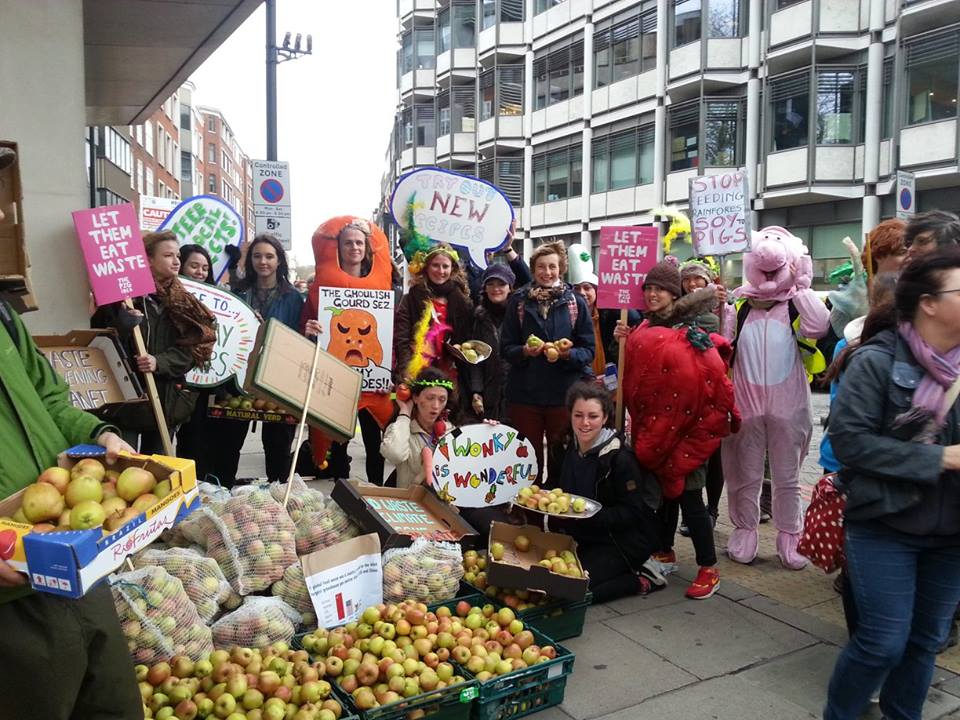
On the evening of last week’s Conference of the Parties: international climate change conference (COP21) (1), people joined together from all over the world to demonstrate what we can do to fight climate change.
I’m not afraid of anything that’s blocking me/ I’m not afraid of human force”(2)
Even in Paris, where public demonstrations were banned in the days preceding the conference under the ambiguous reason of “security concerns”, more than 10,000 activists managed to make a human chain in a peaceful manifestation (3). However, London’s March was even more demonstrative of our potential to create positive change; as we were not demanding anything from anybody, simply showing what we have got.


This was the overwhelming sentiment I got from last month’s People’s March – by the people, for the people. Government “leaders” may have been getting high on the sound of their own voices in Paris, but one thing the March clearly demonstrated was the huge variety of initiatives aiding the process of positive societal change, all of which are already functioning in the UK and beyond.

Free (no price) and Free (liberated)
My role at the March was very particular: as an “exotic waste warrior”, I was showing what I got!
What did I have? Apples! Around 2500 of them, rejected by supermarkets due to “cosmetic standards”, but thanks to the Gleaning Network (4) and This Is Rubbish(5), the apples were intercepted and gifted as sustenance to anyone who came within a hundred feet of us.

2,500 apples seemed quite overwhelming at first, but in fact they all went amazingly quickly. We began handing out the apples around 11.30am and by the time the March actually began moving around 1.30pm we had only a couple of handfuls left. Such speed of redistribution shows that redirecting abundance can be very simple and easy; especially if we bring the surplus food to a place where there are many hungry people already gathering.
If you eat, you’re in
One key reason to be handing out apples on a march focused on climate change (other than their clear high value in both taste and symbology) is to highlight the impac food waste has on the environment. We currently throw away 30 – 50% of our food on a global scale before it gets to a consumer (6). If food waste were a country that would equate to it being the third largest producer of carbon emissions in the world, after only the USA and China (7).
If you are not a citizen of the USA or China you may think there is not much you can do about the first two, though it may be worthwhile considering where you buy your products from. There is a lot you can directly do about food waste and climate change, if you ever indulge in the pasttime of eating.
You do? Then read on, as the solutions are delicious!
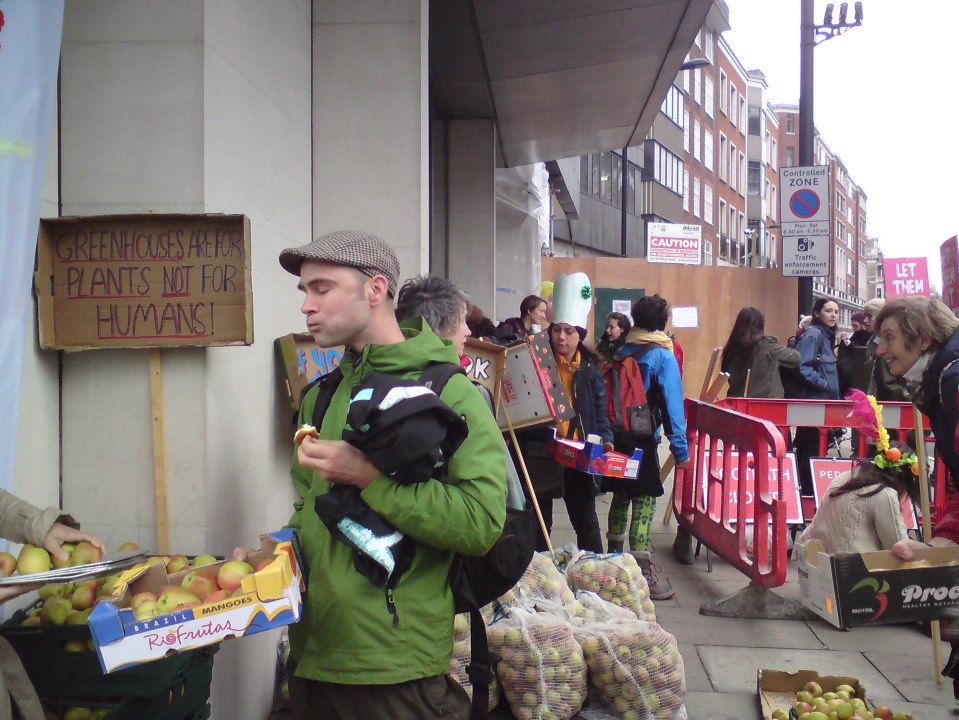
Some tasty ideas
For starters we have harvesting rescuers The Gleaning Network (4) who intercept fruit and vegetables from the fields which would otherwise have gone to waste, and Abundance (8), who map wild fruit trees for DIY harvesting. Then there is the national network Fareshare (9) who redistribute supermarket surplus to charities and community groups, and more local versions of this such as Community Food Enterprises (10) in London and the Food Waste Collective (11) in Brighton.
This is Rubbish uses intercepted supermarket fruit and vegetables in tantalising and creative ways to entice and inspire you to do more about saving food.
These groups are doing fantastic work to bring the surplus abundance which already exists to people who are hungry. Yet all are working on the idea that, once the root of food waste is addresd, ideally they would no longer need to exist.
We can all help with this simply by changing our shopping habits. One very easy step is to only buy food produced in your country of residence; as it has had to travel a lot less farther and thus is less likely to produce carbon emissions or for unnecessary amounts to be thrown away.
Another is to check out This is Rubbish’s new campaign Stop the Rot (12), which is aiming to reduce food waste throughout the UK supply chain.
Enough to whet your appetite? You don’t have to stop here… Food is an issue which affects us all, and eating can always feel good. How do you relate to your food? How can you use this to create a healthier, more energy efficient food system?
The only limit here is your imagination…
References
1. Cop21, 2015. ‘COP21’. http://www.cop21paris.org/
2. Dubioza Kolektiv, 2006. ‘Justce’. Lyrics by Dubioza kolektiv. https://www.gugalyrics.com/lyrics-403779/dubioza-kolektiv-justice.html
3. Ecowatch, 2015. ‘10,000 form human chain in Paris demanding that world leaders keep fossil fuels in the ground’. Ecowatch, 29/11/15. http://ecowatch.com/2015/11/29/human-chain-paris/
4. Foodrise, 2015. The Gleaning Network’. http://www.thisisrubbish.org.uk/
5. This is Rubbish, 2015. ‘About TiR’. http://www.thisisrubbish.org.uk/
6. Institute of Mechanical Engineers, 2013. ‘Waste Not Want Not’. Imeche: London. Available as a PDF here: http://www.imeche.org/docs/default-source/reports/Global_Food_Report.pdf?sfvrsn=0
7. European Commission JOint Research Centre, 2015. CO2 time series 1990-2013 per capita for world countries. http://edgar.jrc.ec.europa.eu/overview.php?v=CO2ts_pc1990-2013
8. Abundance, 2015. ‘About Us’. http://www.abundancenetwork.org.uk/about-us
9. Fareshare, 2015. ‘About Us’. http://www.fareshare.org.uk/about-us/
10. CFE, 2015. ‘About Us’. http://www.c-f-e.org.uk/About%20CFE.htm
11. HASL, 2015. ‘Food Waste’. http://www.hasl.org.uk/food-waste.html
12. This is Rubbish, 2015. ‘Stop the Rot’. http://www.thisisrubbish.org.uk/project/stoptherot/
Food waste is a massive global problem and it has received more and more attention during recent years. The figures are shattering. UNFAO estimates that one-third of all food produced for human consumption is wasted. This amounts to roughly 1.3 billion tons of food. The retail equivalent of this is $1 trillion worth of food each year, which is 1% of the global output. These numbers indicate that there is an urgent need for action on food waste and the problem is huge.
But there is another way to look at it. Start thinking about food waste as an opportunity rather than as a problem. Turn these numbers around and see it as a $1 trillion continuously growing market rather than a $1 trillion problem.
Some entrepreneurs have already understood the huge opportunity lying in food we throw away. During the past years new businesses started to storm the food waste scene. Turning food waste into treasure is not easy but they are successfully making enterprises out of converting it to compost, animal feed, biogas, renewable energy or organic fertilizers. Their activity does not only increase food security, but is also beneficial for the environment and even better for their bottom line. As part of the first ever London Food Tech Week in October, TEDxHackney gathered a range of entrepreneurs who shared their stories and inspired action to change the future of food. As founder of Winnow, I was among the speakers to share the story of my involvement in the world of food tech, food waste and how we came up with the business idea of founding Winnow to help the hospitality sector cut food waste in half by using technology.
We believe that there are incredible challenges and opportunities lying in food waste. For an entrepreneur approaching a $1 trillion market, food waste is like a modern day gold rush.
Food is lost in every part of the food chain all around the world. In developing countries food gets wasted due to inefficient processing, inadequate storage and lack of suitable infrastructure. In the developed world perfectly good food gets dumped because it does not meet standards of perfect shape and consumers are encouraged to buy more food than they need, failing to plan their food purchases.
We encourage entrepreneurs who care about food to find a spot in the supply chain that they are passionate about and build something to help solve the food waste issue. There are tons of opportunities for new businesses to spring up along the food waste system. It takes investment and time but the potential economic, environmental and social benefits are huge. This is not just a trend, it is a growing movement. Join it!
About Winnow
The Winnow System is a smart meter that helps chefs cut their food waste in half, dramatically improving their profitability.
Kitchens can waste as much on food waste as they make in net profits. Tackling food waste with Winnow can help you increase food gross margins by 2-6 percentage points. To date Winnow has saved its customers over £2 m by reducing the amount of their food waste.
#fightfoodwastefriday
The European Commission’s Circular Economy package announced today falls short in the measures it proposes to tackle food waste; despite the European Commission’s earlier indication that the new package was going to be stronger and further reaching than its predecessor.
Food production is the single biggest source of greenhouse gas emissions, species extinction, and deforestation – yet one third of all that production and its impacts goes to waste. In spite of this, national targets to reduce food waste by 30% between 2017 and 2025 proposed in the earlier package have been dropped.

To tackle the staggering level of global food waste, action must be taken. Feedback recommended not only maintaining the EC’s targets, but broadening them to include food waste on farms. The FAO estimates that nearly two thirds of Europe’s food waste occurs between production and retail levels, and only one third at consumer level. Yet the new EC package lets the food industry completely off the hook for their two thirds by refocussing the EC’s calls around the Sustainable Development Goals, which only have specific targets to reduce retail and consumer waste.
Policy recommendations proposed by Feedback during the EC’s public consultation on the circular economy included:
– Empower agencies to crack down on unfair trading practises by retailers, which create upstream food waste. The UK’s Groceries Code Adjudicator has demonstrated the effectiveness of using economy-friendly competition law to simultaneously reduce failures in the market and food waste.
– Incentivise and remove barriers to redistribution of surplus food;
– Redress perverse financial incentives that encourage the use of food waste for biogas production when options higher in the food waste hierarchy, such as feeding people or livestock, would be the better environmental option.
– Remove or relax regulations on cosmetic standards on fruit and vegetables which contributes to food waste both in Europe and beyond.
– Review legislative barriers to safely use food waste as livestock feed to improve Europe’s food security, reduce costs to farmers and create jobs in the “Eco-feed” industry livestock;

Never before has there been such a unified and massive public mandate to act against food waste. Over one million people have signed Feedback’s Avaaz petition calling for national leaders to launch national action plans to prevent waste, including passing laws obliging supermarkets publish their waste data, and to establish authorities to investigate supermarkets’ unfair treatment of suppliers that lead to waste. Over 700,000 people have signed the Change.org petition, sponsored by Feedback in the UK, calling for the European Commission to require big supermarkets to donate food to charities rather than destroy perfectly good food as part of the Circular Economy Strategy.
There is strong political support for action to prevent food waste as well, most notably demonstrated by the Green Card issued earlier this year by Lord Boswell and signed by 16 member states, calling on the Commission to “adopt a strategic approach to the reduction of food waste within the EU” within the Circular Economy package.
The EC has effectively ignored its own recommendations from commissioned research from 2010 which suggested that ‘Food waste data reporting requirements’ was in the top three recommendations for reducing EU food waste. Removing food waste reduction targets is a regressive move. Furthermore, it presents a missed opportunity to maximize the effectiveness of the Commission’s €9 million funding of the Resource Efficient Food and Drink for Entire Supply Chain initiative (REFRESH) earlier this year. REFRESH, of which Feedback is a core partner, is a consortium of organisations working to find solutions to Europe’s food waste issue that would lead to a more circular economy with the aim of contributing to the reduction of food waste by 30% by 2025.
The EC’s lack of ambition is all the more disappointing in view of the tide of public support for measures to tackle food waste and positive signs of government action within the EU at national level. Governments in Belgium, France, Spain and UK have taken forthright steps to tackle this problem through legislation, showing that national efforts are slowly being realised. With several years of concerted, collaborative effort, the UK is on track to beat the Sustainable Development Goal adopted by the UN in September of halving food waste by 2030. Each member state should set itself such a target, and the EC should be leading the charge. Organisations involved in bringing about change, such as WRAP and Feedback, are willing to put all the know-how built up over several years at the disposal of governments to help other countries halve their food waste even faster than the UK. Feedback pledges to open source all its knowledge – to give away its’ intellectual property to as many people as possible as quickly as possible. Feedback believe together swift transformation can be achieved.
The EU still has a chance to show it has significance in the global fight against food waste. The draft package on the circular economy is not up to the job. Feedback look to the European Parliament and the Council of Ministers to strengthen it.
We use cookies where necessary to allow us to understand how people interact with our website and content, so that we can continue to improve our service.
We only ever receive anonymous information, and cannot track you across other websites.


