
Donate
Support us in the fight for a better food system.
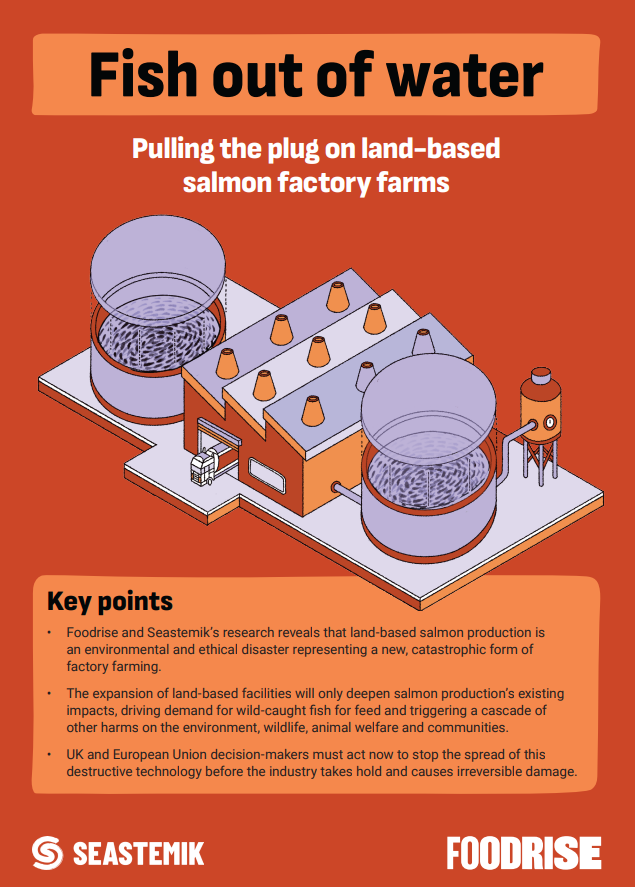
Foodrise and Seastemik have published a stark new policy briefing Fish out of water: Pulling the plug on land-based salmon factory farms – calling for governments to ban land-based salmon production.
This is a call now backed by 22 organisations including Communities Against Factory Farming, Greenpeace France, Greenpeace Africa, the Green Britain Foundation, and World Animal Protection.
Key Findings:
What is land-based salmon production?
Globally, around 70% of all the salmon we consume is farmed. Most of this happens in open net pens – giant floating cages in coastal waters. However, a new trend has emerged as companies are starting to experiment with producing salmon on land.
Using costly and high-tech systems, salmon are now starting to be raised in warehouses on land, crammed inside artificial indoor tanks. This technology is swimming under the radar and presented as the new frontier of the salmon industry, bringing with it a fresh wave of environmental harm and animal suffering.
Land-based facilities are spreading across the globe, from the USA and Canada to Norway, the Netherlands, Iceland, and the UAE. In the UK, interest in land-based salmon is growing rapidly. While no such facilities are operating yet, multiple projects are already in the pipeline.
That’s why Foodrise and Seastemik have published this new policy briefing to give this emerging technology the scrutiny it needs and raise the alarm with decision makers.
What’s the problem?
Land-based salmon farms are nothing more than industrial factory farms. These on-land warehouses are sterile, unnatural and built for mass production. Salmon are packed into barren indoor tanks, denied natural light and space, suffering until slaughter or premature death. It’s factory farming at its worst – and it has no place in our food system.
The expansion of land-based production systems will only deepen the industry’s existing harms:
What can governments do?
Around the world momentum is building to stop these factory fish farms. 22 organisations have already joined the call for a ban on this destructive industry.
However, the responsibility to stop the expansion of the destructive industry must not rest with communities and local authorities alone.
It is therefore critical that government acts now to ban land-based salmon production before it takes hold and becomes the new ‘normal’.
What the experts say
“Land-based salmon production is one of the worst forms of factory farming imaginable, reliant on the unsustainable plunder of wild fish for feed and plagued by shocking mass mortality events where thousands of fish die.
This not the future of food. Governments must act now to stop this dystopian reality,” says Carina Millstone, Executive Director of Foodrise.
Read the briefing:

We use cookies where necessary to allow us to understand how people interact with our website and content, so that we can continue to improve our service.
We only ever receive anonymous information, and cannot track you across other websites.
