
Donate
Support us in the fight for a better food system.
“We applaud Triodos’ principled decision to divest from salmon farming… The writing is on the wall for the global salmon corporations; we now look to other financiers including Rabobank, DNB Bank and Nordea to follow Triodos’ example and pull their support from Big Salmon.” – Natasha Hurley, Deputy Director at Foodrise
Key points:
Triodos IM has divested from Bakkafrost, a major producer of farmed salmon based in the Faroe Islands, and no longer holds any investments in salmon farming, following pressure from campaigners revealing the destructive reality of this industry. In 2025, Foodrise published data showing that, as of November 2024, Triodos IM had US $16 million invested in Bakkafrost, and ran a campaign urging it to divest its holding in the company.
The same research identified Bakkafrost as one of salmon farming’s leading recipients of investment and credit from multinational banks and investors, as well as a public subsidy of £2 million from the Marine Fund Scotland for its Scottish subsidiary in 2021.
Salmon mortality rates linked to disease and chemical usage at Bakkafrost’s Scottish subsidiary have soared in recent years, with two of its sites (Druimyeon Bay and East Tarbet) reporting more than 80% mortality in recent years. This trend has persisted into 2026, with the company’s Vuia Mor fish farm in Loch Roag, Isle of Lewis, recording almost 50% mortality earlier this year. This has resulted in a huge financial hit to the company totalling EUR 5.6 million in the third quarter of 2026 alone.
In 2025, Bakkafrost Scotland reported a 17% annual fish mortality rate across its Scottish farms, a significant jump from the reported 10% mortality rate in 2019 when the company took over the Scottish Salmon Company.
Responsible investors beat a retreat from salmon farming
Until recently, the booming aquaculture sector has been viewed within responsible finance circles as offering attractive opportunities for global lenders and investors keen to diversify their portfolios away from land-based animal protein production. Salmon farming companies have been at the forefront of this, and have benefited from significant inflows of capital and other forms of financial support which have turbocharged the sector’s growth over the past five decades.
However, with evidence stacking up of the huge environmental and social harms caused by salmon farming and other forms of extractive aquaculture, investors are now beginning to beat a retreat.
Natasha Hurley, Deputy Director at Foodrise, said: “We applaud Triodos’ principled decision to divest from salmon farming. This shows true leadership and sends a powerful signal to other lenders and investors to turn off the money tap that is fuelling the expansion of this hugely destructive industry. The writing is on the wall for the global salmon corporations; we now look to other financiers including Rabobank, DNB Bank and Nordea to follow Triodos’ example and pull their support from Big Salmon.”
Catalina Cendoya, Director of Global Salmon Farming Resistance, said: “Investors are increasingly led by ESG data and ethics. They are now seeing what really lies behind the salmon farming industry, which for years was sold as part of a ‘blue revolution’ promising sustainable, healthy protein. But mass mortalities, polluted waters and damage done to communities show a very different picture. Bakkafrost is not an isolated case: the same story is repeating itself across the world. We congratulate Foodrise and the many organisations around the world working to bring this reality to light, and praise Triodos for making the right call. Many experts predict such decisions will become the rule rather than the exception.”
Nick Underdown, Scotland Director at WildFish, said: “On behalf of endangered wild fish populations across the UK, we salute Triodos for divesting from the destructive salmon farming industry. Losing the support of ethical investors is the inevitable consequence for an industry that is inherently unsustainable. No responsible investor or shareholder wants to be associated with biodiversity loss and driving the extinction of the iconic wild Atlantic salmon.
From chefs refusing to serve farmed salmon, to local communities campaigning against new salmon farm applications, Triodos joins a growing movement of people and organisations taking principled action against an industry that is causing net harm to our rivers and oceans. Recovering our wild fish populations and their habitats is something truly worth investing in”
Ola Janus, Banks and Nature Campaign Lead at BankTrack said: “Forward-looking banks are starting to recognise that industrial farming cannot be done ethically or sustainably and allocate capital accordingly. Concrete action like dropping a whole harmful sector from the portfolio shows that the bank takes commitment to nature protection, human rights and climate action seriously. We can’t wait to see more banks align their business with planetary boundaries.”

Foodrise’s new briefing, Sinking Ship, reveals that nearly a fifth (17% in 2023) of EU fishery landings are ground into fishmeal and fish oil. That’s over 600,000 tonnes of wild fish in a single year, or as much as the entire landings of Spain, Finland and Germany combined. Most of this goes to industrial aquaculture, specifically the farming of carnivorous species such as salmon in Scotland and Norway.
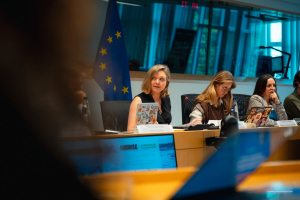
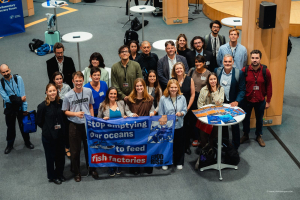
During EU Ocean Week, Foodrise took these findings to the European Parliament. Alongside Compassion in World Farming EU, we organised a panel event that brought the environmental, community and animal welfare costs of carnivorous aquaculture to the heart of EU decision-making in Brussels.
Challenging the EU’s embrace of extractive aquaculture
Our panellists, including representatives from coastal communities in Spain and Greece and leading scientists, discussed the real-life consequences of this extractive industry, from pollution to fish welfare.
Natasha Hurley, Deputy Director at Foodrise, presented our brand-new briefing Sinking Ship: why the EU’s wild fish need protecting from extractive aquaculture, which highlights the EU’s blind spot when it comes to fish farming’s impact on European fisheries.
We found that 92% of the fish oil and 69% of the fishmeal that the EU exports heads to Norway and the UK, where it feeds salmon farms. It takes up to 6kg of wild fish to grow just 1kg of farmed salmon, and most (90%) of wild fish used for feed are good enough for us to eat ourselves.
Meanwhile, the fish targeted by industrial (or ‘feed’) fisheries are running out. Baltic herring populations have fallen by 80% since the 1960s, which is bad news for the cod, seabirds and seals that feed on them.
This is an inefficient and extractive industry that poses an increasing threat to wild fish and the ecosystems and communities that rely on them.
Carnivorous aquaculture is a growing threat
During her presentation, Dr Elena Lara, Senior Research and Policy Advisor at Compassion in World Farming EU, exposed how farming new species like tuna is further fuelling demand for wild fish to feed farmed fish, as explored in detail in CIWF EU’s latest report.
As top predators, tuna eat many times their body weight in smaller fish such as sardines and anchovies. CIWF revealed that it takes up to 16kg of wild fish to grow just 1kg of Atlantic Bluefin tuna. That is equivalent to up to 33,280 sardine-sized fish. Those fish could be feeding people or sustaining marine habitats. Instead, they’re extracted from the ocean and fed to farmed tuna, and increasing tuna farming only piles more pressure on wild fish and the ecosystems that rely on them.
People pay the price
Bringing the issue back to the communities at the frontlines of extractive aquaculture, our host, Emma Fourreau MEP, set out how fish that are essential to local food systems in West Africa are increasingly turned into fishmeal and fish oil to feed aquaculture in Europe, depriving communities of a vital source of protein and income.
Panellist Marco Bittner, Councillor for Calpe, Spain, described the toll seabass farming is taking on his community: heavy pollution along the coast and a growing threat to the livelihoods of low-impact fishers:
‘‘Calpe has centuries of history with the sea…[aquaculture] puts the lifestyle of my town at risk’’
The event also featured a preview of the documentary SEABASS INC by Carlos Underwood, bringing the issue to life with an investigation into the seabass industry, featuring voices of coastal communities and activists from around the world.
This included Poros in Greece, where community action has secured the cancellation of a plan to massively expand fish farming. This has saved the island from the huge damage wreaked by extractive aquaculture elsewhere in Greece, and represents an iconic win in a high-stakes battle against corporate-controlled aquaculture led by communities across the Mediterranean Basin.
Whether it’s salmon in Scotland, tuna in the Mediterranean, seabass in Spain or fishmeal factories in West Africa, carnivorous aquaculture is extracting vast amounts of wild fish that people and ecosystems depend on.
Our panellists were clear: this industry isn’t feeding the world, it’s draining the ocean, and the EU needs to stop supporting it.
A key moment: Vision 2040 for Fisheries and Aquaculture
The EU’s Vision 2040, which was published not long after our event, emphasises low-trophic aquaculture, and it’s good to see low-impact fishing given real weight in future plans. But it doesn’t grapple with the inefficiency of feeding carnivorous species like salmon, seabass and tuna on fish, soy and animal-based feed. In doing so, the Commission is failing to take leadership against an industry that extracts the very nutrient basis of our seas.
That’s why we’re calling on the EU to stop the use of whole wild-caught fish in fish feed and to withdraw support, including public subsidies, from extractive aquaculture.
To learn more, read Foodrise and Compassion in World Farming’s reports:
Over 180 experts, academics, farmers and community food leaders joined us in warning the Prime Minister and First Secretary of State that if food supplies fail, there is nobody responsible for feeding people.
The letter, signed by experts, councillors, professors, food bank directors, growers and a retired Lieutenant General, says the UK is “complacent” and unprepared for the food emergencies we know are coming. Climate change is already hitting harvests here and in the countries we source food from. The inputs that industrial farming depends on like agrichemicals and feed arrive through routes exposed to conflict. Distribution runs on software that can be shut down through cyber attacks, and international food supplies can be weaponised. Defra’s own 2024 assessment, revealed by The Times, found a realistic possibility that by 2030 our food, water and natural ecosystems face catastrophic failure, and the Joint Intelligence Committee warned in its January assessment that without greater resilience the UK is unlikely to maintain food security if ecosystem collapse drives competition for food.
The Government has not heeded these warnings. Its official advice is that households should keep a few days’ food in the cupboard, though in its own survey 29% of people said they couldn’t afford to.
The letter asks for concrete change, and it landed as the Cabinet Office closed its call for views on the Civil Contingencies Act 2004, the law that decides who has responsibilities in an emergency. We want a much stronger role for government, with every local authority to have a duty to prevent and respond to food supply emergencies and the farmers, wholesalers, distributors and food hub directors who would feed us recognised as emergency responders. Sustain’s Civil Food Resilience in practice shows food partnerships across the UK already doing this work, and Food Resilient London, has mapped what the capital’s community food infrastructure could do in a crisis. But nobody has a duty to do any of it, so preparedness is a postcode lottery.
Foodrise is calling for much more than emergency planning, because part of our vulnerability – both for the UK population and overseas – is thanks to the food system we have allowed to become dominant. UK diets far overshoot planetary boundaries, many people already can’t afford healthy and sustainable food, and our food is controlled by a handful of large corporations. They control what is grown, what reaches the shelves and what we can afford, and they have built a system optimised for short-term profit rather than for feeding people reliably. That same system is driving the environmental breakdown which is threatening harvests. In the middle of this, the Government is planning to expand UK industrial poultry production; driving more land to grow feed instead of food, more pressure on water, more emissions, more power in the hands of polluting corporations and a more import-reliant food system. We are failing to prepare for a food emergency while worsening its causes.
Read the full letter and list of signatories here:
5 October 2026
Dear Prime Minister and First Secretary of State,
Request for your leadership to build national food resilience and security
For too long, the UK has been complacent about food as a national security matter, even as the urgency of the matter has become irrefutable. Government agencies, the National Audit Office, parliamentarians, industry insiders and researchers have all warned of impending shocks and a scale of destabilisation that could make business-as-usual nigh impossible (see Annex 1).
The UK (along with the West) is entering a new era in which food supplies will be disrupted, public expectations may not be met and food can be weaponised. The food system is exposed to shocks and threats from geopolitics, climate heating, ransomware, energy outages, software malfunction and disinformation. These shocks will fall upon a system that is highly wasteful, import-dependent, environmentally unsustainable, and driven by the pursuit of private profit rather than resilience, with millions of people unable to afford a decent, healthy diet. The ‘just-in-time’ model means little or no stock is held along the supply chain, and the UK has no national food storage, as stores were wound up in the 1990s. Instead, the Government’s Prepare website and recent ministerial comments have advised households to keep a store of food for emergencies lasting a few days, with scant attention paid to the form that store should take or the practicalities and affordability of such recommendations for many lower-income households. In the Government’s own 2026 survey, 29% of respondents said a lack of money had stopped them preparing further.
In this context, we welcome your Government’s continuation of the resilience work begun under Sir Keir Starmer’s leadership. HM Government has also rightly acknowledged, in the UK Food Security Report and its national security assessment on global ecosystems, the escalating environmental and geopolitical risks to UK food security. And yet the gap between HM Government’s current approach and what must happen next to secure the nation’s food security is stark.
At the same time, there is much that the UK can and should build on within its current food system: the creativity of farmers and growers; the improvement of British food availability and cultures since the mid-20th century; the awareness that food systems rely on natural ecosystems; the recognition that food is one of the UK’s largest employers; and much more.
But the hard truth is that the food system built over recent decades is not fit for today’s or tomorrow’s challenges. The UK’s home production is woefully inadequate in many different food types. More than half of our croppable land grows feed for livestock rather than produce for people. Indeed, as the above-mentioned national security assessment concludes, ‘The UK does not have enough land to feed its population and rear livestock: a wholesale change in consumer diets would be required.’ The public has been led to assume that food will simply be there. It may not be, unless the UK’s food system is transformed for the world of climate, ecosystem, and geopolitical volatility.
We therefore urge you to:
We are keenly aware that any attempts to accelerate public protection are likely to elicit political challenges. Yet feeding all people well in the coming era of shocks will not be easy, nor will the process of change be effortless. Your leadership, Prime Minister and First Secretary of State, is required to build the nation’s food resilience and national security. Food security must be championed, not ducked.
Yours sincerely,
Professor Tim Lang, Professor Emeritus of Food Policy, City St George’s, University of London; Lead Author, National Preparedness Commission ‘Just in Case’ report
Professor Paul Behrens, British Academy Global Professor, University of Oxford
Carina Millstone, Executive Director, Foodrise
Co-signed by:
Lt Gen (Retd) Richard Nugee, Chair, Advisory Board Climate, Nature and Security APPG
Dr Jessica Banks, London School of Hygiene and Tropical Medicine
Dr Matthew Gibson, London School of Hygiene and Tropical Medicine
Dr Lynne Jones OBE, Honorary Associate Professor, London School of Hygiene and Tropical Medicine
Professor Martin McKee CBE, London School of Hygiene and Tropical Medicine
Dr Maddy Power, Associate Professor, London School of Hygiene and Tropical Medicine
Dr Jordan D. Beaumont, Sheffield Hallam University
Professor Emeritus Tim Benton, University of Leeds
Professor Stefan Kepinski, University of Leeds
Dr Megan Blake, University of Sheffield
Professor Emeritus Peter Jackson, University of Sheffield
Professor Hannah Lambie-Mumford, University of Sheffield
Professor Sarah Bridle & Professor Bob Doherty, University of York
Dr CM (Tilly) Collins, Imperial College London
Dr Jessica Thorn, Imperial College London
Professor Emeritus Dave Goulson, University of Sussex
Professor Caroline Lucas, Professor of Practice, University of Sussex
Professor Emeritus Erik Millstone, University of Sussex
Professor Aled Jones, Anglia Ruskin University
Dr Dimitrios Koutoukidis, Associate Professor, University of Oxford
Professor Peter Scarborough, University of Oxford
Dr Siobhan Maderson, Aberystwyth University
Professor Emeritus Terry Marsden, Cardiff University
Professor Kevin Morgan, Cardiff University
Dr Adrian Morley, Manchester Metropolitan University
Professor Oyinlola Oyebode, Public Health, Queen Mary University of London
Dr Clare Pettinger, Associate Professor, University of Plymouth
Professor Chistina Vogel, City St George’s, University of London; National Preparedness Commission
Professor Neil Ward, University of East Anglia
Dr Lopa Saxena, Coventry University
Professor Moya Kneafsey, Coventry University
Kath Dalmeny, Chief Executive, Sustain: The alliance for better food and farming
Anna Taylor DBE, Executive Director, The Food Foundation
Dr Helen Angel, Founder/Director, Golden Zones Foundation CIC
Lucy Antal, Director, Alchemic Kitchen; Founder, Queen of Greens.
Sara Ayech, UK Director, Madre Brava
Vic Borrill, CEO, Brighton & Hove Food Partnership
Julie Brown, Director Growing Communities
Mark de Cates, Director, Stroud Community Agriculture
Steve Clarkson, CEO, Organic Farmers & Growers CIC
Dan Crossley, Executive Director, Food Ethics Council
Deborah Doane & Dr James Meadway, Directors, Verdant
Joyce D’Silva, Ambassador Emeritus & Philip Lymbery, CEO, Compassion in World Farming
Jenny Ekelund, CEO, Good Food Oxfordshire
Michael French, Founder, Ecclesia Farms Bournemouth and Grounded Community Charity
Dorothea Hackman, Founder, Euston Foodbank
Shane Holland, Executive Chairman, Slow Food in the UK
Gemma Hoskins, Global Climate Director, Mighty Earth
Keenan Humble, Director, Feeding Liverpool
Natasha Jones, Director, Canalside Community Food CSA
Daphne Lambert, Founder CEO, Greencuisine Trust
Maddy Longhurst, Co-director, We Are Avon; Landed Community Kitchens UK/EU
Dr Amy McDonnell & James Sutton, Co-executive Directors, Zero Hour
Gemma McFarlane, Director, Sharing Skills CIC
John Mclennan, Trustee, A Greener Melrose
Caroline Monkhouse Flower, CEO, FEAST With Us
Lisa Noteyoung, Deputy CEO, Nine Yards
Heather Poore & Gavin Ellis, Co-CEOs, Hubbub
Claire Pritchard, CEO, Greenwich Cooperative Development Agency; Chair Mayor of London’s Food Board
Matt Reynolds, Director, Living Seeds CIC
Kath Rosen, CEO, The Orchard Project
Suzy Russell, Coordinator, Community Supported lp (CSA) Network UK
Daniel Sargison, Director, Grassroots Garden CIC
Charles Secrett, former Director, Friends of the Earth EWNI
Shiri Shalmy, Co-Director, Cooperation Town
Gilly Smith, Founder, BrightonFoodStory
Ian Smith, Director, Food Plymouth CIC
Helen Starr-Keddle, Deputy Director, Food Matters
Charlotte Steel, Chief Executive, Highland Good Food Partnership
Rebecca Sunter, Interim Executive Director, Eating Better
Anna Taylor, Co-founder, Patcham Repair Cafe
Matthew Thomson, Director, Sustainable Food Cornwall
Pam Warhurst CBE, Chair, Incredible Edible
Duncan Williamson, Director, Joyfully Greens CIC
Sarah Witts, Founder and lead facilitator, Nature Connects CIC
Rajesh Makwana BEM, Executive Director, Sufra NW London
Sue Cooper, Good Food Stockport
Mary Cosnett & Chloe Masefield, Bwyd Powys Food
Dr. Daphne Du Cros, Shropshire Good Food Partnership
Nikki Dravers & Gwen Young, Gateshead Food Partnership
Mary Duckett, Bwyd Abertawe Food, Swansea’s Food Partnership and Network
Adam Guy, Middlesbrough Food Partnership
Kate Hughes, Chair and farmer, Sustainable Food Somerset
Caroline Kenyon, Chair, Greater Lincolnshire Food Partnership
Finlay Laverton, Andover Food Partnership
Augusta Lewis, Sustainable Food Places, Carmarthenshire
Susana Lopez, Enfield Food Partnerships
Shannon Mahanty & Stephen Mawhinney, Islington Food Partnership
Ann Owen, Partneriaeth Bwyd Ceredigion
Matthew Passchier, West Northants Sustainable Food Network
Alice Peperell, Bristol Food Network; Bristol Good Food 2030
Kelly Price, Food Partnership Coordinator, Borough of Hammersmith & Fulham
Lucy Rees, South Gloucestershire Local Food Partnership
Fiona Revell & Karen Stewart, Eastbourne Food Partnership CIC
Lucinda Sehic, Food Cardiff Cardiff’s Local Food Partnership
Professor Dianna Smith, Southampton Food Partnership
Darren Squires, Hull Food Partnership
Sabine Virani, Sustainable Food Norwich
Charles Walker, Nottingham City Sustainable Food Partnership
Carlos Yescas, Food Newcastle
Ali Ghanimi, Brighton and Hove Food Partnership
Vera Zakharov, Sustainable Food Places Campaigns Coordinator, Sustain
Cllr Bethany Anderson, Haringey Council
Cllr Alastair Binnie-Lubbock & Cllr Noah Birksted-Breen & Cllr Emma Neath & Cllr Reiner Tegtmeyer & Cllr Mihai Chereji, Hackney Council
Cllr Dr Ezra Cohen & Cllr Emily O’Brien, Lewes District Council
Cllr Dr Pallavi Devulapalli, King’s Lynn and West Norfolk Borough Council
Cllr Sheridan Kates, Islington Council
Cllr Rosie Pearson & Cllr Sandra Simpson, West Oxfordshire District Council
Cllr Lorna Jane Russell, Camden Council
Cllr Neil Sandison, Rugby Borough Council
Dr Eva Johanna Holmberg, Chichester & Arun Green Party
Tim Howells, Chair, ADPH Yorkshire and Humber Food Systems Network
Matthew Hudson, Luton Borough Council
Zak Shinwarie, Medway Council
Dawn Jenkin, Consultant in Public Health, Fellow of the Faculty of Public Health.
Mike Barry & Ali Morpeth, Co-Founders, Planeatry Alliance
Ffinlo Costain, Co-producer, Conference on Food & National Security
Tessa Clarke, Co-founder & CEO, Olio
Donnally Bettis, Teampuill Stone Growers
Louise Dollimore, Ooooby
Peter Dollimore, The Montessori Place
Patrick Gillett, Director, Hempen Organic
Rob Haward, CEO, Riverford
Andy Middleton, Co-Founder, Weave Global
Nick Miller, CEO, Miller Research (UK) Ltd
Michael Pawlyn, Director, Exploration Architecture
Tom Pycraft, Ark Events
Debra Willoughby, Grange Farm
Martin Bryant & Patrick Mulvany, Rugby Eco Hub
Joe Buxton & Daniel Edwards & Dr Vicky Gerrard & Anna Perego & Jamie Sumner-Ailes, Stroud Community Agriculture
Dr Charlie Clutterbuck, just-grow.uk
Chris Dady, Campaign to Protect Rural England, Norfolk
Barbara Davies Quy, Size of Wales
Laura Elliott & Michael Mayhew, The Food Library, Northampton
Sue Fairweather, Cornwall Climate Action Coalition
Duncan Fisher & Sue Holbrook, Our Food Trust
Alison Fletcher, Programme Manager, Root and Reason CIC
Andy Fryers, Abergavenny Food Festival
Kate Harrison, Healthy Me Healthy Communities CIC
Polly Henderson, Bosavern Community Farm
Dr Julie Hudson, Stratford Climate Action
Tania Inowlocki, Climate Emergency Camden
Michael Kennard, Compost Club; Regenerative Soils
Michelle Lawson, Resilient Orchards Cornwall CIC
Penny Locke, Hungerford Food Community
Dr Stephen Norrie, Net Zero Stratford
Dr Janet Palmer, Warwickshire Climate Alliance
Clare Owens & Becky Vipond, Co-directors, Squash Liverpool CIC
Jo Poulton, Founder, Basic Income for Farmers; National Food Service Advocate
Phil Pritchard, Oxford City Farm
Ketchurah Ravindren, Calthorpe Community Garden
Antony So, Agrifood policy consultant & contributing author, National Preparedness Commission ‘Just in Case’ report
Geoff Tansey, Curator, Food Systems Academy
Dr Lucy Tordo-Gillingham, Feeding Bristol
Anuradha Vittachi, Hedgerley Wood Trust; Mycelium Map
Dr Julia Wilkinson, Chichester Climate Action Network
Georgie Worth, Mike’s Table CIC; Chyan Community Field
Andrew Wright, Incredible Edible Spelthorne
Mark Horler, Chair, UKUAT
Victoria Sherwin, Director, Incredible Edible Lambeth
Annex 1: Recent warnings
Annex 2: Civil food resilience at the local level
Although the fragility of the UK food system is well documented, and although food is one of 13 Critical National Infrastructure sectors (with no individual food asset yet identified as critical), neither the UK Government Resilience Framework (2022) nor the Resilience Action Plan (2025) addresses disruptions to the food supply chain at the local level. If supermarket shelves were to be empty for weeks on end, local responders would be poorly placed to alert the public, coordinate emergency food distribution or tend to the needs of vulnerable groups. The National Audit Office recently found that the capability and capacity of local resilience forums in England to respond to food supply disruptions is insufficient, that most do not plan specifically for them, and that Defra has yet to develop a local food distribution framework for vulnerable people. Ad hoc, haphazard civil society-led responses could emerge, but so could civil disorder.
We see the need for legislation to require local authorities or Mayors to establish a food resilience committee. Operating within or alongside local resilience forums in England and Wales (including London’s borough resilience forums), regional resilience partnerships in Scotland and emergency preparedness groups in Northern Ireland, such civil food resilience committees would enable local emergency responders and their partners to prevent food emergencies – and to respond to any that cannot be prevented.
Each food resilience committee would carry out functions such as:
o communicating with official resilience structures about the local context; receiving and amplifying national action and advice; tailoring national messages to the local context;
o mapping local food supply chains;
o conducting local audits of food capacities and (community) assets;
o maintaining community risk registers on food risks, threats and civil vulnerabilities;
o building networks of expertise and trust to call on as required;
o serving as an early warning system on food matters;
o encouraging place-specific vulnerability prevention and resilience building, including by supporting a shift to sustainable, local food production and consumption, individual and community food growing, composting, water harvesting, and food storage and rotation (since the UK currently does not maintain strategic national food reserves – even though we are dependent on ‘just-in-time’ international supply chains for at least 40% of our food).
Committee membership should bring relevant knowledge and be representative of society in the locality, including civil society, food-related professions (such as public health, trading standards, social services, planners), local food businesses, food industries, educational and research institutions, and leads of local food partnerships, boards and related bodies. Ideally, committee co-chairs should have local standing, such as a local director of an emergency planning committee. To ensure a high level of trust, committee members must be democratically accountable to the elected authority.
– ### –
Carina Millstone, Executive Director, Foodrise said:
“Amidst severe geopolitical tensions and the fast worsening climate and environmental crises, food corporations have led us to an impasse that threatens the UK’s food and farming. The signatories to this letter call for leadership from the Prime Minister to boost the nation’s food resilience and security without delay.”
Professor Tim Lang, Emeritus Professor of Food Policy, City St George’s, University of London, lead author of the National Preparedness Commission Just in Case report said:
“Governments rightly warn people we’re in a hybrid warfare era and to stock up a bit on food. The Government Resilience Framework’s focus on prevention and ‘whole of society’ is great in theory but so far food blind in practice. We need system shift: grow more food; more regionalism, diversity and storage at multiple levels, not just households; and public engagement in civil food defence. Central government must provide more strategic leadership while encouraging actions at different levels. Communities and households cannot resolve faultlines in the UK’s food system.”
Professor Paul Behrens, British Academy Global Professor and food system expert, Oxford Martin School, University of Oxford said:
“The Government’s own national security assessment says the UK ‘does not have enough land to feed its population and rear livestock: a wholesale change in consumer diets would be required’. That is Whitehall’s own analysis but there is still very little action on this. Food resilience, healthy diet, and environmental benefits all point the same direction: grow more of the vegetables, fruit and pulses people actually need, closer to home.”
Tania Inowlocki of Climate Emergency Camden said:
“Our first responders are equipped to prevent and respond to floods and fire, but no one is mandated or resourced to address local food emergencies. Parliament can close this preparedness gap by requiring local authorities to set up food resilience committees under the Civil Contingencies Act 2004. Committee members would have a deep understanding of local food distribution, needs and supplies, and they’d keep the public informed and engaged in building food resilience, including through stockpiling and growing. That would help us make sure that everyone has access to food – even when the supermarket shelves are empty for longer periods”
On Monday 19th October, we’re gathering in Parliament to demand an end to destructive, polluting, factory farming.
The evidence is clear: Factory farming is detrimental to the climate, pollutes our rivers, causes animal suffering and is devastating to communities who live nearby.
Despite this, the government is pushing ahead with factory farming expansion – announcing a new strategy to grow the poultry sector, and rewriting planning rules to build more intensive factory farms, faster.
That’s why we’re urgently calling for a moratorium on new factory farms – and a commitment to end all factory farming in the UK.
MP champions Terry Jermy (Labour), Adrian Ramsay (Green), and Wera Hobhouse (Liberal Democrats) will host us in Parliament as we meet directly with our own MPs to tell them how they can end factory farming for good.
Ahead of the event, you’ll contact your MP to request a meeting in Parliament on October 19th. When you register, we will show you how to do that. We’ll also help you to follow up with your MP if you don’t receive a response.
On the day, we’ll have staff at Parliament to provide support and guidance if needed. You don’t need any previous experience of talking to MPs. We’ll provide resources, training and support ahead of time and on the day, so you feel confident in making your voice heard.
If you can make it to Westminster, you’ll be joining Foodrise, Communities Against Factory Farming, River Action, Project Slingshot and other friends and allies, for an energising day of action.
If coming to London isn’t possible, you can still support this vital call by meeting your MP in your own constituency.
MPs listen to their constituents, and a personal meeting is one of the most effective ways to gain their support. We’ll provide all the guidance and training you need.
We hope to see you there!
England’s kids are back to school. And for the first time in a decade, the government has reformed the School Food Standards which shape the school meals that children get served across the country. The big news is that some of the reforms are massive step forward! That’s worth celebrating, because healthy delicious food is vital not just to help children thrive, but is usually better for the planet too. After a summer holiday full of heatwaves, droughts and wildfires, it’s more obvious than ever we need to act to build a future that’s safe for children to grow up in.
So what’s in the new Standards? Here’s some of the major changes, particularly as they relate to helping shift to more healthy plant-rich foods:
Some of the measures faced backlash when proposed earlier this year, so it’s great to see that the government has resisted calls to weaken the standards. Foodrise have been working hard with our allies to build pressure for these standards to be as ambitious as possible, like though building pressure via the government’s official consultation – so we’re now celebrating these meaningful changes. Some of the measures could have gone further – for instance a more ambitious requirement on the number of portions of vegetables served per meal, and three portions of pulses served per week – but generally these reforms are a big step forward!
Schools now have a major opportunity to introduce children to less familiar foods and make healthy plant-based proteins like lentils, chickpeas, tofu and soya mince normal and exciting. Schools should also be encouraged to go beyond the minimum requirements, and can emulate successful schemes like the London Food Purchasing Commitment which has seen many schools in London boroughs serving more plant-based foods in order to cut greenhouse gas emissions. Schemes like ProVeg’s School Plates initiative provide great recipe templates and support. These schemes show that more plant-rich meals can be a success with students.
We know that the public strongly supports a shift to more plant-based foods in schools. YouGov polling for Madre Brava of over 2,000 members of the UK public from Dec 2025 found that 69% of respondents either strongly or somewhat supported a policy to “make schools serve a higher proportion of plant-based food”, with only 10% strongly or somewhat opposing this policy. This includes majority support from every demographic studied – including voters for every major political party in the 2024 election. Plant-based proteins like pulses are often cheaper than meat, so can help the food served to be high quality, improve the variety of fruit and veg and meet the other Standards. For instance, ProVeg found that a plant-based spaghetti bolognese (made with lentils and soya mince) cost approximately 43% less than a spaghetti bolognese made with beef mince – 41 pence per meal compared to 72 pence per meal. Councils participating in the London Food Purchasing Commitment found that cutting the carbon footprint of public meals in local schools reduced costs by up to 7% – largely by swapping out high carbon ingredients such as beef.
The government has said that it will be developing the guidance to schools on how to implement these changes throughout Autumn 2026. To maximise the opportunities of schools serving more plant-based foods, we recommend this includes things like:
The new rules also offer a huge opportunity to UK farmers; with an estimated 234 million portions of beans or pulses due to be served per year. A recent report co-authored by Sustain, Follow the Carrot, found that a growing number of UK farmers grow beans and pulses as cover or break crops for their nitrogen-fixing properties, but consumer markets are not well established, so the crop is often ploughed straight back into the soil. School meals could offer a market for more environmentally friendly protein crops.
Finally, to ensure these standards are effective, we also now need a national mechanism to monitor and enforce compliance, with Ofsted oversight and transparent reporting. Encouragingly, the government has said it is working on this, after recent research revealed that most schools currently don’t meet existing standards. The devil will be in the detail.
Other government departments should take note. Children will now be better protected from unhealthy foods like processed meat and will have more access to vegetables, pulses and legumes, but the same isn’t true elsewhere in the public sector. Defra must come good on it’s promise to overhaul the government buying standards and guarantee that the public’s money is spent on food that supports good health and reduces our environmental impact.
At Foodrise, we’re committed to holding the government to account to make sure that all public sector food is as healthy and sustainable as possible. But today, we mark a victory.
Wiltshire Council has overturned its decision to approve an intensive land-based salmon factory farm, following a legal challenge brought by our allies at Communities Against Factory Farming.
Land-based salmon: a catastrophic new form of factory farming
Globally, around 70% of all salmon we consume is farmed. Most of this salmon is produced in open net pens, giant floating cages in coastal waters, fjords and lochs where there is no barrier to waste feed, faeces and chemicals contaminating the surrounding waters.
Now, a new trend has emerged, with companies around the world experimenting with producing salmon on land, bringing a new wave of environmental and ethical concerns.
Using costly, high-tech systems, salmon are raised in captivity in indoor tanks. These warehouses are sterile, artificial, unnatural and built for mass production. Salmon are crammed into barren indoor tanks, denied natural light and space, suffering until slaughter or premature death. This is nothing more than factory farming.
These systems can still result in shocking mass mortality events, in which thousands of fish can die, as well as huge water demands. A 10,000-tonne salmon farm, for example, would require wastewater-treatment capacity equivalent to that of a town of up to 100,000 people.
Additionally, land-based farming also does not solve the feed problem. Salmon are carnivores meaning that no matter where they are produced, whether on land or at sea, they rely on wild fish as feed. Research from 2024 shows that producing 1 kilogram of salmon can require up to 6 kilograms of wild fish. Many of these wild fish could otherwise have been used directly for human consumption, highlighting the staggering inefficiency baked into this industry.
Despite claims that land-based salmon farms have little impact on their surrounding environment, reporting has revealed cases involving pollution, tank collapses and fish escapes – all of which can pose risks to surrounding ecosystems and, in some cases, wild fish populations.
The current situation in the UK
In the UK, interest in land-based salmon farming is growing. While no large-scale commercial land-based salmon facilities are currently operating, multiple projects are already in the pipeline, including the one in Wiltshire.
The proposed facility would have been located just metres from the River Avon, an area of conservation for the protection of certain species including chalk stream salmon. Chalk stream salmon are classified as ‘vulnerable’ by the IUCN, just one major shock could push them beyond recovery. We simply cannot afford any additional risks to this species.
More than 1,100 people objected to this planning application. However, in May, despite fierce opposition, Wiltshire Council approved plans for a land-based salmon factory farm in Downton without properly assessing its potential environmental impacts.
Ramping up the pressure, Communities Against Factory Farming challenged the council over its failure to consider animal-welfare harms and its alleged failure to properly assess serious risks to the River Avon. As a result, Wiltshire Council has overturned its decision to grant planning permission, meaning that this proposed land-based factory fish farm has been stopped in its tracks.
How can you help?
The legal proceedings undertaken by Communities Against Factory Farming in this case still need to be covered.
If you can, please help Communities Against Factory Farming cover the legal costs incurred in stopping this intensive fish farm by donating via the link below.
Together, we can halt the development of land-based salmon factory farming in the UK for good!
Read our briefing about land-based salmon farms here.
We use cookies where necessary to allow us to understand how people interact with our website and content, so that we can continue to improve our service.
We only ever receive anonymous information, and cannot track you across other websites.
