
Donate
Support us in the fight for a better food system.
Foodrise’s new briefing, Sinking Ship, reveals that nearly a fifth (17% in 2023) of EU fishery landings are ground into fishmeal and fish oil. That’s over 600,000 tonnes of wild fish in a single year, or as much as the entire landings of Spain, Finland and Germany combined. Most of this goes to industrial aquaculture, specifically the farming of carnivorous species such as salmon in Scotland and Norway.
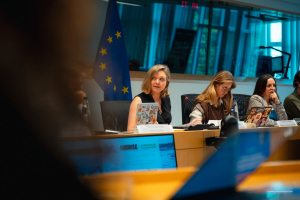
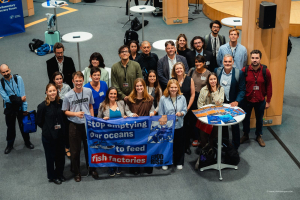
During EU Ocean Week, Foodrise took these findings to the European Parliament. Alongside Compassion in World Farming EU, we organised a panel event that brought the environmental, community and animal welfare costs of carnivorous aquaculture to the heart of EU decision-making in Brussels.
Challenging the EU’s embrace of extractive aquaculture
Our panellists, including representatives from coastal communities in Spain and Greece and leading scientists, discussed the real-life consequences of this extractive industry, from pollution to fish welfare.
Natasha Hurley, Deputy Director at Foodrise, presented our brand-new briefing Sinking Ship: why the EU’s wild fish need protecting from extractive aquaculture, which highlights the EU’s blind spot when it comes to fish farming’s impact on European fisheries.
We found that 92% of the fish oil and 69% of the fishmeal that the EU exports heads to Norway and the UK, where it feeds salmon farms. It takes up to 6kg of wild fish to grow just 1kg of farmed salmon, and most (90%) of wild fish used for feed are good enough for us to eat ourselves.
Meanwhile, the fish targeted by industrial (or ‘feed’) fisheries are running out. Baltic herring populations have fallen by 80% since the 1960s, which is bad news for the cod, seabirds and seals that feed on them.
This is an inefficient and extractive industry that poses an increasing threat to wild fish and the ecosystems and communities that rely on them.
Carnivorous aquaculture is a growing threat
During her presentation, Dr Elena Lara, Senior Research and Policy Advisor at Compassion in World Farming EU, exposed how farming new species like tuna is further fuelling demand for wild fish to feed farmed fish, as explored in detail in CIWF EU’s latest report.
As top predators, tuna eat many times their body weight in smaller fish such as sardines and anchovies. CIWF revealed that it takes up to 16kg of wild fish to grow just 1kg of Atlantic Bluefin tuna. That is equivalent to up to 33,280 sardine-sized fish. Those fish could be feeding people or sustaining marine habitats. Instead, they’re extracted from the ocean and fed to farmed tuna, and increasing tuna farming only piles more pressure on wild fish and the ecosystems that rely on them.
People pay the price
Bringing the issue back to the communities at the frontlines of extractive aquaculture, our host, Emma Fourreau MEP, set out how fish that are essential to local food systems in West Africa are increasingly turned into fishmeal and fish oil to feed aquaculture in Europe, depriving communities of a vital source of protein and income.
Panellist Marco Bittner, Councillor for Calpe, Spain, described the toll seabass farming is taking on his community: heavy pollution along the coast and a growing threat to the livelihoods of low-impact fishers:
‘‘Calpe has centuries of history with the sea…[aquaculture] puts the lifestyle of my town at risk’’
The event also featured a preview of the documentary SEABASS INC by Carlos Underwood, bringing the issue to life with an investigation into the seabass industry, featuring voices of coastal communities and activists from around the world.
This included Poros in Greece, where community action has secured the cancellation of a plan to massively expand fish farming. This has saved the island from the huge damage wreaked by extractive aquaculture elsewhere in Greece, and represents an iconic win in a high-stakes battle against corporate-controlled aquaculture led by communities across the Mediterranean Basin.
Whether it’s salmon in Scotland, tuna in the Mediterranean, seabass in Spain or fishmeal factories in West Africa, carnivorous aquaculture is extracting vast amounts of wild fish that people and ecosystems depend on.
Our panellists were clear: this industry isn’t feeding the world, it’s draining the ocean, and the EU needs to stop supporting it.
A key moment: Vision 2040 for Fisheries and Aquaculture
The EU’s Vision 2040, which was published not long after our event, emphasises low-trophic aquaculture, and it’s good to see low-impact fishing given real weight in future plans. But it doesn’t grapple with the inefficiency of feeding carnivorous species like salmon, seabass and tuna on fish, soy and animal-based feed. In doing so, the Commission is failing to take leadership against an industry that extracts the very nutrient basis of our seas.
That’s why we’re calling on the EU to stop the use of whole wild-caught fish in fish feed and to withdraw support, including public subsidies, from extractive aquaculture.
To learn more, read Foodrise and Compassion in World Farming’s reports:

We use cookies where necessary to allow us to understand how people interact with our website and content, so that we can continue to improve our service.
We only ever receive anonymous information, and cannot track you across other websites.
