Donate
Support us in the fight for a better food system.
Yesterday’s announcement of a new national target to reduce the UK’s emissions, including from international aviation and shipping, by 78% by 2030, is a welcome indication of the government’s commitment to taking a bold position on climate change.
But with the effects of climate change already being felt around the world, particularly on those who have done least to cause them, ambitious targets to reduce emissions are only the first step. What matters is what the government plans to do to meet them.
Foodrise is disappointed to see that the enormous value of pursuing healthy diets lower in meat and dairy, and of halving food waste across the supply chain, is excluded from the government’s plans.
Both these measures have enormous potential, for our health, for the robustness and diversity of our agricultural system and importantly for our ability to rapidly decarbonise. A recent report by the UN highlighted that the food system accounts for over one third of all global greenhouse gas emissions. To put it plainly, even if every other sector of the economy decarbonised, without addressing the climate damage caused by the food system, we cannot meet climate goals to remain below 1.5°C of warming.
The failure to take the enormous opportunity presented by public measures to support greener food choices and prevent waste is particularly disappointing considering that the government’s own expert Committee on Climate Change recommended sustainable dietary shifts as a ‘low cost, no regrets’ option. With COP26 rapidly approaching, the UK is losing an opportunity to demonstrate the seriousness with which it takes the climate crisis, and to employ the most effective tools at its disposal to combat it. We hope, particularly with the publication of the National Food Strategy later this year, that the government will reconsider.

Local-level schemes to help reduce food waste in Bucks have started to sprout up over the last year. I am very open to the idea of free food but sceptical as to whether they really WORK on a local level. As part of Foodrise’s Food Citizens Project, I spent this year’s Food Waste Action Week testing if Buckinghamshire is really on the food waste app map.
The main schemes operating in Buckinghamshire are OLIO and Too Good To Go, and their goal is to make surplus food available to others to prevent it being tossed into a bin. If you have a smart phone, registering is as easy as pie!
 This app has an interactive map showing how many retail outlets are ‘live’ and offering ‘Magic Bags’ near your location. What’s a ‘Magic Bag’, I hear you say? Supermarkets, convenience stores, coffee shops and bakeries offer daily bags for a small cost (£2- £6). Organised by location, bags are listed at certain times of the day, to be collected in allocated time slots. Across Bucks, there are a good number of listings – the more strategic user could probably note times and days of the week when more is listed and where to maximise the opportunity. Even this aspect offers a good insight into what could have been wasted without this scheme in place.
Olio was supported by Buckinghamshire County Council four years ago in a countywide launch. However, this scheme is only as strong and effective as the residents and households that use it. According to the app, there are 1,733 OLIOers near me, so I was excited to see what was on offer! The daily listings showed that people are engaging with repurposing food waste; this app easily supports people a) wanting/ needing food, or b) wanting to help items not to go to waste, as all listed food is free. On OLIO, it’s not just fresh or close to date items that are listed – there are also drinks and ambient goods, as well as a range of other non-food items, from upcycled crafts and preloved goods, to toiletries and children’s toys, which is another great way to prevent waste.
So, do these apps work in Buckinghamshire?
The answer is YES!
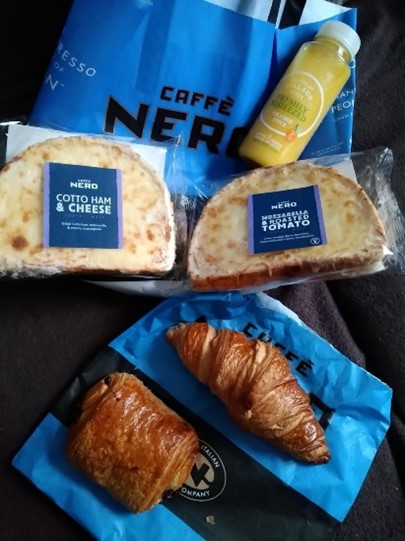
I was able to test Magic Bags from 4 outlets near Aylesbury. Although certain suppliers do have healthier options (e.g. fresh goods) rather than just bakery items, as a vegetarian, I did wonder if I would find myself with meat products, thus left disappointed and with items I wouldn’t personally use. And indeed, I did receive some meat-based products.
This gave me the perfect chance to try OLIO and see how the ‘giving’ process works and whether anyone would be interested locally. Within an hour of listing items, I had arranged for ‘contactless’ collections to take place.
In conclusion, Too Good To Go, will obviously be more beneficial in town centres or places near listed outlets. OLIO is also a great scheme to be used in urban and rural areas, as long as people actively use it! We still need to challenge supermarkets to waste less in their supply chains and help us to only buy what we need, but these apps can help make sure good food isn’t going to waste. So what are you waiting for? Get to know your cupboards and, if in doubt, why not donate it to someone who could use it!

Growing skills, connection, and resilience through food and farming
See the issueLater this year, the next major climate negotiations, COP26, will be hosted in Glasgow and right now, diplomats and politicians are deciding on what will be discussed.
Changing the way we eat and how much food we waste are two of the single biggest actions governments can take to respond to the climate crisis. In fact, even if every other sector of the economy decarbonised, without addressing the climate damage caused by the food system, we can’t meet important climate goals. Meanwhile, changing the way we grow food and shifting to more regenerative production systems can help safeguard ecosystems and reduce carbon emissions, while producing healthy food.
Despite this, how we produce and consume food isn’t even on the agenda for COP26!
Alok Sharma MP is president of COP26, leading the UK government’s diplomatic efforts to make the negotiations a success. He could raise food issues up the climate agenda and make sure it’s addressed at the meeting.
This week, over 30 organisations and individuals, including Foodrise, Compassion in World Farming, RSPB and the Soil Association have written to Alok Sharma, asking him to put food systems on the table in his diplomatic efforts. Read the joint letter here.
The letter calls for Alok Sharma to drive a change in policy and investment by bringing a focus on food systems. It also calls on him to make sure time and space is given to high-level discussions about food systems and climate policy.
Meanwhile, over 57,000 people have joined in, telling the COP26 team that food must be part of the climate effort to prevent dangerous global warming and ensure everyone has fair access to healthy food. You can add your voice by tweeting at Alok Sharma, or sharing the joint letter above.
The UK Government is already showing leadership on a joined up approach to food policy with its national food strategy for England, and by its commitment in the current NDC to healthy diets supported by a sustainable food system. Meanwhile, the Scottish Government is an early signatory to the Glasgow Declaration on food and climate, a commitment by subnational governments to adopt and implement integrated food policies to tackle climate change. Now, hosting COP26, the UK has an opportunity to show global leadership on the transition to sustainable food systems.
Many of us have found solace in gardening and food growing during lockdown. We want to celebrate this on International Women’s Day with a ‘Cultivating Conversations’ event.
The theme this year is “Choose to Challenge” and we want to challenge beliefs around food growing and land access. Join us for an inspirational panel and discussion facilitated by Helena Appleton from our Alchemic Kitchen.
This event is supported by the Food Citizens Project run by Foodrise in Buckinghamshire.
You can view a recording of this event here: https://www.youtube.com/watch?v=o_dOysAwvys
Our wonderful panel is:
 Judy is a painter, poet and environmentalist, best known as the Honorary President of Black Environment Network (BEN). For 27 years she was the UK Director of BEN, with an international reputation as the pioneer and creator of the field of multi-cultural participation in the built and natural environment. Judy is a major voice on policy and practice towards social inclusion. She is recognised as a visionary advocate for diversity and equality. She was awarded an OBE for pioneering multicultural environmental participation in 2000, and a CBE for services to heritage in2007. Recently, she was included in the BBC Power Women List, and the Forbes List of 100 Leading Environmentalists in the UK.
 Joy is an inclusion expert, educator and green care researcher. In 2018, while supporting young people at risk of exclusion from education, she made a visit to a care farm and was ‘hooked’ on the approach. Since then Joy has been working with green care, community growing and care farming organisations across the UK, Australia and North America. In 2020 Joy was awarded a Churchill Fellowship to research care farming in Europe.
 Ruby Radwan has always been interested in the relationship between health and the environment. Ruby previously studied Psychology, trained as a holistic therapist and worked as a reflexologist at the Acland hospital, whilst also applying her academic and spiritual principles in seeking to raise her children in a healthy and natural environment. Eighteen years ago, Ruby and her husband Lutfi took their young family on an adventure. They gave up their jobs and established Willowbrook Farm where they sought to rear animals ethically, nurture the environment on the farm and live sustainably. They now live in a house made of mud which they built and deliver ethical and sustainable produce to customers in Oxfordshire and beyond.

Freya stumbled upon organic vegetable growing by chance from a low point in her life and has never looked back. She is driven to help others find connection to their food and subsequently the planet through farming. Since finding passion in food Freya has studied horticulture, soil health, composting and naturopathic nutrition. Freya believes that personal health, plant health, soil health and planet health are intrinsically connected and is evolving her first business Old Tree Market Garden to explore and inspire others to see the links between these often isolated subjects, as well as to grow delicious food!
“
Growing skills, connection, and resilience through food and farming
See the issue

How do we dismantle food corporation’s hold on the food system? How do we ensure that our actions meet the scale of the injustices perpetuated by industrial meat and dairy production?
These are questions that we grapple with daily at Foodrise. As the outside world grows distant and disconnects us from those face-to-face moments for activism, it is increasingly important for those of us who are concerned about the climate, deforestation, and systemic racism in the food system to come together to hold food corporations to account.
As campaigners, we find ourselves alternating between being angered and frustrated by the next corporate scandal, the next worker death in the food system, or the next community exploited for their land. If the past year has taught us anything, it’s that this anger is justified. Take giant meat and dairy corporations for example, companies like Tyson Foods, Smithfield, JBS and Arla (we call them Big Livestock): to date there have been at least 56,000 positive Covid-19 cases tied to meatpacking plants and at least 277 worker deaths in the United States. Here in the UK, the BMPA has denied claims from unionised workers in the industry that low-paid, migrant meatpackers are being treated as “disposable assets” despite the virus’ deadly spread. Just recently we witnessed the 1000th day of ongoing struggle in Turkey to bring justice to The Cargill 14 – 14 workers who were unfairly dismissed for trying to unionise at a Cargill plant in Turkey.
This isn’t a case of a handful of companies handling the pandemic badly. It’s evidence of what we’ve known all along: that extracting profit from people and the planet is at the core of industrial meat and dairy’s business model. Without low-paid migrant workers baring the brunt of this crisis in slaughterhouses, without indigenous communities being stripped of their land and livelihoods, rich consumers in the UK, US and Europe simply wouldn’t have the possibility to consume so much meat.
To dismantle this toxic industry we must turn to the systems that brought it into being in the first place which is why at Foodrise we’re launching workshops for activists, students, and everyone concerned about giant meat and dairy corporations but find themselves feeling powerless in the fight against them. Through critically examining the food on our plates and questioning the systems of power that give rise to the biggest failures of our food system, together we are reimagining what food activism in the UK, for food justice globally, looks like.
Our divestment campaign calls, not for a reform of these companies, but a complete end to them. Corporations processing meat and dairy produced at an industrial scale will always be driven by extractive forces. When an industry is rotten to its core, there is nothing else to do but uproot it. By imagining a world without exploitation and extractivism in the food system, we’re equipping campaigners with the skills and tools they need to call for their banks, institutions, and pension funds to divest from Big Livestock – will you be one of them?
To find out more about our campaign or to organise free workshops, get in contact with Big Livestock Campaigner Mia here.

Read Foodrise’s new Market Brief Meating the climate challenge: Why supermarkets must urgently cut their meat and dairy sales
Last week Tesco launched its first ‘Green Bond’ – an event which went unsurprisingly largely unreported amid spiralling Coronavirus crisis in the UK and the inauguration of President Biden. The bond essentially allows Tesco to raise capital – a cool 750 million euros – against its Sustainability Performance Targets. These targets aim to reduce Tesco’s global Greenhouse Gas emissions from its direct activities – like energy used for heating and cooling stores and warehouses, delivery fleets and refrigerant gas leaks – by 60% by 2025, against a 2015 baseline.
While Tesco is an undoubted leader among UK retailers on sustainability transparency it is worth interrogating this news a little more closely. And indeed, there is a catch: while Tesco does have a target to reduce the emissions from the production of the goods it sells (by 17% by 2030), this target is not included in the list of KPIs against which it is raising the money.
This is a more serious omission than it may seem: emissions created in retailers supply chains, in the production of the goods they sell us, are up to seven times higher than those from their direct operations (like heating and cooling systems in shops and warehouses, or emissions from transporting goods). By ignoring the climate burden of the goods they sell, retailers like Tesco are effectively framing themselves as supermarkets with the emissions reduction strategies of a lorry company. While very few retailers publish a full breakdown of emissions produced in their supply chain, figures from a small Dutch retailer, Ahold Delhaize, suggest that its supply chain emissions dwarf its direct emissions by 19 times, and that meat fish and dairy makes up 38% of its supply chain emissions.
Few retailers match this level of reporting and target setting – but they will have to catch up, and fast, as investors and the public ask supermarkets to live up to sustainability claims. Nor will ‘this is hard to measure’ count as an excuse for much longer. And so to the meat of the matter – why retailers must square up to the role of animal agriculture in driving climate impacts. Today, Foodrise publishes a new brief arguing:
It’s more than apparent that industrial meat production is fanning the flames of the climate crisis – from chicken and pork fed on soya grown on deforested land in Brazil, to the excessive quantities of red meat we consume in the compared to the world average. A very recent systematic review of 18 academic studies showed consistent evidence of positive health impacts and low environmental footprints of diets congruent with government dietary guidelines, which suggest a lower consumption of meat and dairy. These health and environmental benefits don’t require universal veganism, but they do require a massive reduction of consumption of the most damaging forms of meat, as well as large-scale changes across the agricultural system to integrate agro-ecological and ‘livestock on leftovers’ approaches to producing the meat and dairy we do eat. Those changes will need policy leadership, but in the short-term, they’ll also need action from the most powerful businesses in our supply chain – retailers.
While retailers tend to be squeamish about acknowledging their enormous influence on their shoppers’ food choices, the evidence is clear: food decisions are deeply influenced by our ‘food environment’ and supermarkets play a major role in shaping those environments. The surge in meat consumption in 2020 (sausage sales alone were up 17%) demonstrates the difficulty of resisting a food which has long been marketed to us as redolent of comfort and ‘treating yourself’. Yet retailer interventions can and do yield behaviour change: the Collaboration for Healthier Lives has evidenced that ‘nudges’ in-store (e.g. layout of goods, promotions and marketing) can change purchasing decisions.
Finally, and most importantly, while there is growing interest in sustainable and healthy diets, a shift of the scale needed will be difficult, if not impossible, to achieve without the collaboration and active participation of retailers – one of the few businesses with a reach across geographical locations and communities. If anything, the persistence of high meat sales, alongside an uptick of interest in flexitarianism and plant-based eating has indicated that providing choice alone will not answer without addressing the invisible drivers of high meat consumption, like the way food is marketed and branding (for a indicative look at the way supermarkets continue to resist the incentive to sell more meat as well as more plant-based products, see the persistence of marketing like ‘fake farm’ labels which continue to give an misleadingly bucolic impression of the way factory farmed meat is produced).
Increasingly, big food companies are responding to their social responsibility to lead the way on addressing the vast climate burden of our food system, with good reason. As CSR champions steel themselves to get their teeth into their company’s supply chain emissions problem, meat and dairy will have to be centre plate. Foodrise will be monitoring commitments and action in the run up to our second retailer scorecard on meat and dairy reduction – watch this space.

Every January, many Foodrise staff travel to the Oxford Real Farming Conference for a chance to connect with others working towards building a better food system. This year, things were a little different: like most things, the conference went virtual. Despite not being able to connect in person, the conference provided inspiration and hope. Below are some reflections from Foodrise staff.
“ORFC 2021 has re-inspired me and reconnected me. In the breakout rooms from workshops, I met people from all over the world and I even have a pen pal from another continent. However, the highlight for me was when Pete Ritchie, of Nourish Scotland, invited us to imagine a day in 2030, at which point our dreams of our perfect lifestyle and food system have been achieved. Over the weekend, and with the help of Rob Hopkins’ time machine, I fleshed out this vision – adding details to the cooperatively owned farm, until I could smell the flowers, hear the birds singing and the children laughing. I could even feel the weight of the veg bags as we hand them out to our diverse CSA co-owners. With help from Frances Moore Lappe, who has taught me that democracy is something we do, not something we are given, and from a panel about making CSAs more accessible to run and to eat from, I can start to translate my vision into changes and policy asks that we can work on achieving over the next few years.” Krysia Woroniecka, Project Manager Soil Depletion and Land Use
“Solidarity, innovation and perseverance were the underlying themes of this year’s ORFC Global. Whilst the ORFC has always had a global presence, this year’s online conference was a revelation. Participants from across the globe took part in the 7-day meeting of minds. Particular highlights included the ‘food justice, not food aid’ talk, which highlighted the work carried out in South Africa and Kenya to establish grassroots movements, and the Community Supported Fisheries seminar, a concept which is thriving in countries such as the USA, Turkey and France but is yet to take off in the UK. Inspiring talks from closer to home included the captivating Merlin Sheldrake, talking about the lessons we can all learn from mushrooms and mycelial networks; a discussion hosted by Baroness Rosie Boycott on post-Brexit trading relations; and an ORFC favourite, the need for small abattoirs in the UK, hosted by Patrick Holden from the Sustainable Food Trust. Missing from the conference was a wider debate on the future of sustainable meat. A discussion around animal feed failed to take into account the land requirements for increased soy production in Europe and there were very few mentions of protein alternatives. Indeed, the main innovation of the conference was the global platform; many of the panellists and viewers appeared to be united in their outlook and practices. Hopefully the momentum and vibrancy of this year’s conference will be carried over to ORFC 2022.” Helena Appleton, Project Officer Regional Food Economy
“I felt honoured (and a little intimidated) to have been invited to attend such an unusually international event from the comfort of my bedroom during a pandemic. As someone who is just beginning to dip my toes into the world of agroecology I really tried to make the most of the global expertise on offer. I came away overloaded with new knowledge, as well as inspiration and ideas for my own projects.
I was particularly motivated by the session run by the International Federation of Organic Agriculture Movements showcasing good policy practices across 3 continents. It was incredible to learn about the differences in what is tried and test in different places, but also the commonalities. It left me with the decision that aside from prioritising rescued veg, I will try to only buy organic produce.
I wanted to learn about the global food system; how and why much of farming has become so horribly unsustainable and some ideas on ways people are trying to change it. To gain some background information I attended a great talk about the neo-colonial hold on farming systems worldwide which detailed some of the ways that the international farming trade is rooted in colonial ideology. The talk confronted some of the false ‘solutions’ that have been implemented over the years and their impacts, as well as the bureaucratic and at times negligent teamwork by AGRA (Alliance for a Green Revolution in Agriculture) and the UN itself (among others) to hide evidence of the damage of the false promises they have made. However, despite some negative aspects, overall, I was uplifted by a workshop run by Sustain about ways that the UK’s supply chains and infrastructure for supporting agroecology is improving. I was particularly interested in how we can encourage the use of Dynamic Procurement Systems to help smallholder farmers access mainstream public sector contracts (e.g universities, hotels etc). my takeaway sentiment was: What an opportunity!” Abi Itkin, EcoTalent Intern working on Foodrise’s Flavour Project Pilot, Sussex Surplus
All the sessions are available on YouTube and can be viewed here: https://www.youtube.com/c/OxfordRealFarming/videos


I love to cook and get excited about what I can make from my weekly veg box but I would be lying if I didn’t admit that sometimes I feel like screaming ‘Cabbage – again???’
Eating seasonally means we often have to deal with gluts (an abundant amount of a certain fruit or vegetable). Thankfully our Food Citizenship project in Buckinghamshire along with Empower to Cook has created a cookbook to showcase all the wonderful things you can do with seasonal gluts. We also have created short videos to show you how to cook frittatas, soup, risotto and crumble.
Growing skills, connection, and resilience through food and farming
See the issue
Last month, with much fanfare, the government announced its intention to legislate for ‘world leading new measures to protect rainforests’. The law, enshrined through an amendment to the Environment Bill, will require large businesses to ensure that they are not using products that drive deforestation considered illegal in the country where they were harvested.
Just two weeks after the announcement, an investigation by The Bureau of Investigative Journalism showed how flawed the governments approach is. The Bureau and its partners tracked soya grown on land owned and deforested by farm conglomerate SLC Agricola, sold to the ‘worst company in the world’ Cargill, who then shipped it to Liverpool, turned it into animal feed and fed it to chickens to supply to Tesco, Asda, Lidl, Nando’s and McDonalds. Because Brazilian legislation permits clearance of forest and other natural areas outside of the Amazon, all of this was perfectly legal, and the new forest law will do nothing to stop it.
As Foodrise and many others argued in our response to the government, this is a terrible oversight, especially because the government’s consultation earlier this year recognised that half of global deforestation is legal where it takes place. The law is further flawed; while the new rules will require companies like Tesco to perform robust checks for illegal deforestation, shockingly, those who bankroll deforestation will get off scot-free. They will not be required to perform any checks.
So, how big a problem is this – just how much money from UK banks and investors goes to Brazilian soya mega-farms?
Brazil’s soya trade is hourglass shaped, with a huge number of producers, a small handful of soya traders/exporters and many end users. Over 80% of UK soybean imports come from South America, covering the hugely important Amazon, Chaco and Cerrado biomes, and nearly all of this is used as animal feed[a].
Usually, investigations into soya focus on the big-player traders, processors, and exporters (Amagi, ADM, Bunge, COFCO, Cargill and Louis Dreyfus). But a small number of mega-farm companies wield considerable influence and attract heavyweight billionaire backers. The billionaire owner of Brazil’s largest soybean producer, Grupo Amaggi, was once Brazil’s agriculture minister and is a former governor of the Brazilian state of Matto Grosso. His cousin runs another major player, Grupo Bom Futuro. Major player Adecoagro is George Soros’ farmland speculation vehicle. Farm company Fazendas Bartiras is owned by the secretive $500 billion-dollar Canadian investment firm Brookfield Asset Management. The list goes on.
Foodrise commissioned research firm Profundo to map the financial backers of Brazil’s largest soya producers. Through Bloomberg and Refinitiv databases, and by trawling company reports and websites, we used this data to shed light on the UK money behind the secretive players expanding Brazil’s soya monocultures. For a full methodology see our landmark report exposing the scale of international finance behind Big Meat and Big Dairy: ‘Butchering the planet’.
As of April 2020, 11 UK investors invested US$155 million in Brazil’s 3 largest publicly listed soya producers, Adecoagro, BrasilAgro and SLC Agricola. The largest shareholders of two of these businesses are British investors.
Odey Asset Management tops the list with its’ stake in SLC Agricola – the largest of any investor. Crispin Odey, the fund’s former manager dismissed SLC Agricola’s fines from the Brazilian regulator as “a parking fine” earlier this year. Autonomy Capital’s is the largest shareholder in BrasilAgro and invests in Adecoagro earning it second place – its founder has been vocal about the importance of climate change, and its importance in every investment analysis. Given the impact of Brazilian soya on the climate, both due to its deforestation footprint, and it’s propping up of greenhouse gas intensive models of industrial animal agriculture, as well as the industries vulnerability to the climate breakdown it helps drive, these investments seem like an odd choice. We also found two loans totalling $260 million from HSBC to Adecoagro both of which matured in 2018.
Table 1: Investors in Adecoagro, BrasilAgro and SLC Agricola as of April 2020
| Investor | Bondholding | Shareholding | Total ($mln) |
| Odey Asset Management | 115.82 | 115.82 | |
| Autonomy Capital | 24.33 | 24.33 | |
| Kirkham Capital | 5.24 | 5.24 | |
| Aviva | 2.44 | 2.44 | |
| Colchester Global Investors | 2.05 | 2.05 | |
| Standard Life Aberdeen | 1.97 | 1.97 | |
| HSBC | 1.37 | 1.37 | |
| Montagu Private Equity | 0.67 | 0.20 | 0.87 |
| Legal & General | 0.54 | 0.54 | |
| GSA Capital | 0.06 | 0.06 | |
| Schroders | 0.02 | 0.02 | |
| Grand Total | 2.72 | 151.99 | 154.71 |
Adecoagro, SLC Agricola and BrasilAgro are high deforestation risk businesses, with an average score of 31% on Forest 500’s assessment of their deforestation policies.
Brasilagro and SLC Agricola have business models geared towards the transformation of native Cerrado vegetation into “productive” farmland, combining extractive land speculation with extractive agriculture to form a toxic business. Since 2015 over 50,000 acres of deforestation has been recorded on SLC Agrícola farms, that is an area nearly 150 times bigger than Hyde Park. And this year acquisitions by BrasilAgro have raised concerns of thousands of hectares of forest land on their new properties, given the organisations track record of clearances. Adecoagro is no different, called out by our allies at the Global Forest Coalition for their capturing of “financial incentives for deforestation” in Argentina, including from the International Finance Corporation, who have a deeply troubled approach to agriculture.
The Bureau’s investigation showed the direct link between deforestation on an SLC Agricola owned farm and the UK animal feed supply chain putting chicken on the shelves of major retailers and restaurant chains. Prior to this, Chain Reaction Research estimates that SLC Agricola had deforested nearly 25,000 acres during the first 5 months of 2020 alone. And while SLC says it will stop deforestation Cerrado by the end of 2020, and move to increasing productivity on already deforested land this new target will not happen immediately.
To ensure that due diligence legislation truly prevents British supply chains and British stakeholders’ risk of complicity in deforestation, we call on the government to ensure that such legislation:
| Company | Headquartered | Soy area (ha 2019, A) |
| Grupo Amaggi | Brazil | 275,000 |
| Grupo Bom Futuro | Brazil | 270,000 |
| SLC Agricola | Brazil | 243,139 |
| Bom Jesus | Brazil | 133,500 |
| Terra Santa | Brazil | 91,063 |
| Adecoagro | Luxembourg | 247,000* |
| Grupo Los Grobo | Argentina | |
| Fazendas Bartira | Canada | 150,000 |
| Brasilagro | Brazil |
*Includes Argentina and Uruguay
Today, five years on from the landmark Paris Agreement, the UK government hosted a major climate summit – a get together for governments designed to try to ramp up ambition ahead of next year’s COP26, the annual international climate negotiations which were delayed this year due to Covid-19.
The government also – with relatively little fanfare – published its first official submission setting out how it plans to ensure the UK contributes to achieving the goals of the Paris Agreement, its ‘Nationally Determined Contribution’ (NDC), the first post-Brexit (previously the UK shared a wider plan with other EU member states). Coming in the wake of a series of climate announcements this autumn, and on the back of the UN Secretary General’s call for countries around the world to declare a climate emergency, as the UK has already done, its fair to say the pressure is on for the UK to set an ambitious tone.
Foodrise have been waiting with particular to interest to see what, if anything, this plan would have to say about food. The research is very clear: an Oxford University study published in November, only the latest in a long series of papers with similar conclusions, demonstrated that without action on food system emissions, and even if all other sectors were immediately net zero from 2020, we would likely surpass the greenhouse gas emissions limit needed to keep the world under a 1.5°C increase in temperatures. Taking into account that other sectors are not net zero from 2020, and instead assuming a (still ambitious) linear decarbonisation of non-food sectors from 2020 to 2050, we would surpass the 1.5°C emissions limit by 2031. In other words, we really need to act on food, and fast.
And it seems there’s good news – the UK’s NDC says:
‘The UK is committed to delivering a national shift to healthy diets supported by a sustainable food system which contributes towards a reduction in GHG emissions. The Resources and
Waste Strategy sets out England’s plans to move away from a linear economy, towards a more circular and sustainable economy in which natural resources are used efficiently and waste is minimised.”
This is important because, up until now, very few national climate plans have had any focus on food, despite the fact that, as the UK’s official climate advisors, the Committee on Climate Change, said last week, action like a move towards sustainable diets, and reducing food waste, are ‘low-cost, no regret measures’. They recommended a 20-40% reduction in meat and dairy consumption by 2030, and a halving of food waste from the field to the fork, by the same date. Unlike, say, complex and as yet unproven technology to capture carbon emissions from energy production and store them so they don’t escape into the atmosphere, reducing waste and eating less meat and dairy needs no new technology, and can be implemented straight away. These measures also have major co-benefits – reducing food waste frees up land, because less space is taken up growing food that is never eaten, and land is urgently needed to grow trees and make more space for nature. Eating less meat and dairy is already recommended by the NHS’ dietary guidelines, and has positive implications for public health – something, post-Covid, we’re all more aware of than ever.
The devil, of course, is in the detail, and there’s little enough of that on how these goals could be achieved – the NDC references the UK’s new National Food Strategy, coming out in January, and it is vital that this strategy grasps the thorny question of not only how to move beyond the UK’s stalling progress on food waste, but also how to fairly and equitably reduce our meat and dairy production and consumption.
There is plenty to do to pave the way for future dietary policy. At an international level, championing food system measures may help other countries take steps towards realising their climate potential – as hosts of next year’s negotiations, the UK can push for national food systems targets at the COP26. Importantly they can also work on raising awareness domestically through testing measures to shift the public towards healthier diets, increasing education on plant-rich cooking in communities and schools alongside funding plant-rich menus in schools and public institutions through public procurement rules. There is no substitute for leadership, and leadership is very much what is needed right now.
We also need to see some strong signals to the private sector that it too must act. Supermarkets, always key players in the nation’s food culture, also need to take action on diets, and are well placed to make plant rich options appear appealing, normal and easy by promoting low or no meat substitutes, printing a comparison of personal versus average food shop emissions on the backs of the receipts and addressing negative stereotypes such as real men eat meat. However, without government incentives to sell less meat, supermarkets will struggle to go against their imperative to sell more. It will be down to our leaders to take the next opportunity to give the public the sustainability leadership they expect to see.
On food waste, we need attention not just on our plates and fridges at home, but also up the supply chain, on the approximately 3.6 million tonnes of food wasted before it even leaves the farm-gates. An issue, with the spectre of post-Brexit disruption to food supply chains, likely to become even more glaring in the months to come. Of course, wasting food also means wasting the land, soil, fossil fuels and water used to grow it. Halving UK food waste from farm to fork, and then planting trees on some of the spared land, would mitigate up to approximately 11% of UK’s total emissions. At the citizen end of the supply chain, little attention has been paid to how the way that food corporations shape our food environment affects how must we waste, or to the fact that widespread household food waste is in essence an issue of over-purchase. More on how to solve this problem can be found in our recent food waste policy brief.
The climate crisis we face can only be face together. It’s governments’ responsibility around the world not to turn their faces away from this challenge, not to hope that someone else will deal with it. To avoid catastrophic global heating, we need to imagine the most ambitious path we can to a better future and throw everything we have at making this a reality, using the best available evidence as our guide. That evidence says we must act on food. The government has taken a first step – now it’s time to hold them to it. Write to your MP now and call on them to ensure that food is centre table in the UK’s climate plans going forwards.
Back in March the government introduced a 12-month break on business rates to help struggling retailers, fearing that the effects of the Covid crisis could hamper their ability to feed us. In total, nearly £2 billion in public funds have been handed to the ‘big six’ – Tesco, Sainsbury’s, Asda, Morrison, Lidl and Aldi – while at the same time they’ve made major pay-outs to their shareholders.
Supermarkets are one of the few businesses who have done well during the lockdowns. In fact, their sales have boomed while local cafés, pubs and restaurants have gone bust. The result has led to supermarkets paying dividends to shareholders even while receiving state aid. Earlier this year Sainsbury’s disclosed business rates relief of £230 million – suspiciously, this is the same figure that they’ve paid out to their shareholders. If public funds are going directly into the pockets of supermarket shareholders instead of the thousands of hungry people and small businesses that need it the most, we must question whether there is any integrity to this financial aid at all. We’re demanding that supermarket CEOs do the right thing and hand back the cash.
Sign the petition and demand that supermarkets hand back the cash!
Supermarkets will inevitably claim that the money they’ve received is compensation for all their hard work “feeding the nation”, but when we clapped for careers and other essential workers, we weren’t thinking of supermarket CEOs or shareholders. We were thinking of the thousands of people working tirelessly to look after and feed our communities, including those working on shop floors around the country who took the greatest risks to keep the rest of us safe and well-supplied.
Food growers, packers, and those who work in the hospitality industry (including those who support them, such as beauticians and cab drivers) have been systematically undervalued for the work that they do. Many of these workers, many of whom are migrants, have endured poor working conditions, little to no sick pay, insufficient salaries, leaving some of them turning to food banks themselves. These people are the backbone of our food system, our communities, and our support networks.
Now, more than ever, small, independent and struggling businesses need the support to get them through the crisis. 72% of pubs and restaurants predict that they won’t survive the impacts of Covid – but isn’t this inevitable when the money that’s supposed to help them is going to wealthy shareholders instead of the small businesses who are being left behind?
In a time of crisis, £2 billion could be put to far better use than to simply line the pockets of the wealthy. This could be spent protecting jobs at our local cafés and pubs, supporting small-scale producers who are keeping our communities fed. It would even pay for free school meals for kids ten times over.
Sign the petition and demand that supermarkets hand back the cash!
Growing skills, connection, and resilience through food and farming
See the issue
Supermarket Sainsbury’s describes itself as ‘leading the way in sustainable fish’ (1), yet ranked 6th in a ranking of retailers on sustainable farmed seafood. Sainsbury’s farmed salmon – one of its major seafood sellers (3) – in particular fails to match up to its own sustainability claims according to a new market brief from Changing Markets and Foodrise. Their research shows that the feed Sainsbury’s farmed salmon is fed has damaging environmental and social impacts. They also highlight wider concerns over business practices of Mowi, the Norwegian-owned global salmon farming giant, which is Sainsbury’s main supplier (4).
Sainsbury’s farmed salmon packaging states: ‘The salmon are fed a bespoke diet designed to protect our natural resources from overfishing and guarantee great taste and nutritional benefit for you’ (5). But Foodrise calculates that in 2019, Mowi used 880,000 tonnes of wild fish in its global operations, sourced from countries such as Mauritania and Peru, to produce just 436,000 tonnes of farmed salmon (6) – more wild fish than the total fisheries capture of Canada, at 720,000 tonnes in 2018 (7).
More sustainable feed options, such as using non-fish ingredients, or by-products from fish that was caught for human consumption, do exist, but neither Mowi nor Sainsbury’s has adopted a policy to phase out wild fish in its salmon feed. Earlier this year, Sainsbury’s ranked below Tesco, Co-op, Waitrose, M&S and Lidl in a scorecard assessing supermarket chains’ sustainability policy on farmed seafood (8), obtaining a lowly score of 20%.
The campaigners also raised concerns about mortalities on Mowi farms in Scotland, where Sainsbury’s sources its salmon. Between January and September 2020, Mowi reported over 1.1 million salmon mortalities to the Scottish government fish inspectorate (9). This is the second highest figure of all large salmon farming companies operating in Scotland, though reporting standards varied between companies. In addition, Mowi’s Scottish farms have seen high numbers of farmed salmon escapes, 124,000 in two separate incidents this year (10), raising concerns for further impacts on Scotland’s dwindling wild salmon population, which is suffering the effects of by inter-breeding with escaped farmed salmon (11).
Natasha Hurley, Campaign Manager at Changing Markets said:
“We’re shocked at Sainsbury’s misleading claim that its farmed salmon diets prevent overfishing. This is demonstrably untrue: the reality is, hundreds of thousands of tonnes of wild fish – which could feed millions of people – are ground into fish meal and fish oil just to feed farmed salmon on Mowi farms. Fishing communities in Asia and Africa are deprived of valuable protein just so that wealthier consumers in the UK can buy cheap salmon. Salmon farming is big business, but while the Sainsbury’s-Mowi partnership may be lucrative for both sides, it is a terrible deal for the health of global fisheries.”
Jessica Sinclair Taylor, Head of Policy at Foodrise said:
“Sainsbury’s trumpets the fact that it only sources Scottish farmed salmon, claiming to support rural communities, but neglects to mention that its sole supplier, Mowi, is a multi-national business listed on the Norwegian stock exchange: hardly the rural fish farmers Sainsbury’s website makes out.
“Mortalities this high are a colossal waste – not just of the salmon themselves, but also of the wild fish caught to feed them. To live up to its own marketing, Sainsbury’s must commit to phasing out the use of wild-caught fish to feed its farmed fish by 2025 at the latest, and use its purchasing power to ensure that its suppliers, like Mowi, immediately take steps to comply with this commitment.”
Read Changing Markets and Foodrise’s new brief ‘The Hidden Cost of Farmed Salmon: Exploring why Sainsbury’s farmed salmon supplier Mowi doesn’t live up to its sustainable image and what Sainsbury’s needs to do about it’.
Foodrise welcome the ADBA’s response to our Executive Director’s recent article in Responsible Investor – however, since the ADBA misrepresent our view and the issues, we hope that this response provides some clarity. For more info, read our report on AD.
A summary of Foodrise’s advice to investors
Don’t invest in:
Do invest in:
First, the points on which we agree: AD does have some role in a sustainable future, as a last-resort waste management option – as we argue in our report, there is a ‘sustainable niche’ for AD. AD is certainly better than landfill and incineration of food waste, and is preferable to open storage of manure and slurries – practices which should be heavily taxed and banned as soon as possible. To be clear, this will require some growth in the AD industry, and investment to this end – so it is sometimes sustainable to invest in AD, within limits and in some specific situations. We also agree that sewage treatment by AD is part of this sustainable niche. ADBA’s false claim that Foodrise assume AD can only be used to treat food waste is misplaced – our report and the Life Cycle Assessment (LCA) study on which it is based, examine bioenergy crops, manure and slurries too.
However, crucially we model two scenarios: the “industry driven AD” scenario in line with ADBA’s ambitions for AD industry growth, and the “climate optimised AD” scenario where environmentally preferable alternative uses for AD feedstocks are maximized (like food waste prevention) with remaining feedstocks used for AD. In the climate-optimised scenario, we model no bioenergy crops and about a third less food waste going to AD, and additionally we model a context where meat production (and thus availability of manure and slurries) is roughly halved – but all available slurries go to AD in both scenarios. The LCA found that the climate optimised scenario resulted in over double the emissions savings, as well as generating more energy (generated by solar PV on land previously used for bioenergy crops) and significantly higher food production on spared cropland.
ADBA’s presentation of AD as a “win-win-win-win” solution is a simplistic fantasy, although not a surprising stance to take for a body set up to promote the AD industry. Our ground-breaking LCA study, completed in collaboration with academic experts at Bangor University, shows a far more complex and nuanced picture, with some serious limitations to AD. Below, we highlight four key problems:
The first problem is that, as the ADBA acknowledge, AD is far less effective than waste prevention. In fact, preventing food waste results in 9 times more emissions savings than sending it to AD, and if trees are planted on the spared grassland, about 40 times more. The ADBA also often ignore animal feed – our LCA found that sending food waste to animal feed saves 3 times more emissions than sending it to AD. This makes food waste prevention, and using food waste as animal feed, far more effective green investments – and means that only unavoidable food waste inedible to both humans and animals should be sent to AD. Within the current legal framework, there is plenty of scope to increase the processing of food waste like bread for animal feeds – and EU-funded research found that it is possible to feed food waste containing meat to pigs and chickens safely, if EU law is reformed to allow this in a safely regulated fashion. When it comes to manures and slurries, these wastes can be prevented too – through shifts from meat to plant-based diets. For instance, switching from pig meat to a plant-based protein alternative such as tofu results in a 74% reduction in emissions and 80% in land use – land which can then be used for tree planting to offset emissions even further. The emissions savings from sending slurries to AD are far smaller in comparison – so investing in plant-based alternatives to meat would be a far greener investment, from pulses and beans to plant-based burgers and milks. Investors looking to green their portfolios should aim to support dietary shifts as a priority, with AD only used to mitigate the emissions of a smaller, more sustainable livestock sector.
The second problem is that high subsidies to AD create perverse incentives, sometimes actively impeding the better waste prevention alternatives mentioned above. It is completely disingenuous of the ADBA to claim that they are not advocating for high subsidies locked in for decades – their own report clearly advises that AD subsidies are returned to the very high levels of 2011-15, that large-scale AD is subsidised at the same high levels as small-scale plants, and that these be guaranteed for decades into the future. In Northern Ireland, AD subsidies at a similar high level to those advocated by the ADBA were explicitly designed as a means to support an explosion in the size of the country’s intensive livestock industry. Through reducing the industry’s waste disposal costs (even paying for their waste), enabling sites to gain planning permission and bypass environmental regulations, highly subsidised AD plants actually helped expand the polluting industry it was meant to be reducing the environmental effects of. In the case of food waste too, testimonies to a House of Lords enquiry complained that high AD subsidies created perverse incentives to send edible food to AD rather than ensure it is eaten, and Foodrise has found many other instances of such complaints. In one case, Foodrise’s investigations found an AD plant in a port that in a single day was processing an estimated 60,000 cucumbers, 10,000 figs, 4,000 cabbages and many other foods – which all appeared edible. In this context of distorting high subsidies, investments in some AD plants may thus actively prevent far more sustainable alternatives. The better way to make AD plants financially sustainable without creating these perverse incentives is to tax or ban worse alternatives to AD, such as incineration, landfill, and open manure storage, thus pushing up the supply of wastes to AD and gate fees they can charge for collection.
The third problem is that AD’s emissions mitigation potential significantly declines over time. This is a big problem, since AD plants often take decades of highly subsidised operation to break even on their high up-front costs. The reason for the decline is that as society decarbonises, the emissions that AD currently mitigates are often avoided by other means – for instance, as the electricity grid shifts to renewables, heat and transport are electrified, landfill and open manure storage are banned, AD begins to compare less and less favourably with alternatives. Our study found that some AD feedstocks like grass even begin to have a negative rather than positive environmental impact in a net zero context. This means that the green credentials of investments in AD will decline significantly over time. In comparison, food waste prevention, tree planting, dietary change and solar PV consistently far outperform AD in future decarbonisation contexts (see our report for more detail on this).

The final problem with AD is that, although the AD industry claim that they only want “unavoidable” wastes to go to AD, they have a strong incentive to downplay how much waste is “avoidable” to maximize their growth. The ADBA nowhere in its report mentions dietary shifts away from meat as an option and only currently support the UK’s unambitious voluntary targets on food waste, which pledge only a 24% reduction in post-farmgate food waste between 2015 and 2030. A 50% reduction in UK meat consumption, a genuine 50% reduction in UK food waste from farm to fork through ambitious regulation, and tree planting on the millions of hectares of land that would be spared by these measures, could together mean that UK agriculture could be net carbon negative by 2040 without recourse to BECCS. The AD industry is eager portray agriculture as “difficult to decarbonise” because it actively sidelines these more ambitious alternatives.
*Using 2007 as a baseline year, excluding inedible food waste, using per capita figures which also use a 2007 baseline year.
As we follow the back and forth of the US election result, we also remember that this week marks one year until COP26 – the next round of the UN’s annual negotiations on how to meet the targets of the Paris Agreement to reign in run away climate change.
A year from now, world leaders and climate experts will meet in Glasgow, hosted by the UK government. It’s a big moment for the UK on the international stage – our chance to meet the ambition of the Paris Agreement, and set the agenda.
With the US tipping in and out of the picture (Trump took the US out of the Paris Agreement, and Biden has pledged to rejoin), and countries like China, Japan and South Korea stepping up their climate pledges, one important element is missing in action: food. Both an integral part of our everyday lives and a huge piece of our individual and collective impact on our environment, food needs to be considered at every level of climate policy, from local commitments to national plans.
In fact, new research published this week shows that even if we stopped emissions from fossil fuels tomorrow, emissions from the global food system alone would make it impossible to meet the Paris Agreement’s goal to prevent dangerous warming.
That’s why Foodrise is calling for the Prime Minister to make sure food – and specifically food waste and sustainable diets – is a core part of the UK’s climate plan, due to be announced next month. You can join us by writing to Boris Johnson too.
Many of us are aware of the environmental damage caused by fossil fuels and flying but the food on our plate can often be overlooked. Food represents all the precious resources required to produce it, including land and water. The environmental footprint of our food increases for products like factory farmed meat as it requires large amounts of feed. Furthermore, food waste represents a waste of the precious resources used to produce food and also when sent to landfill leads to emissions.
Cutting food waste in half and switching to healthy, low-meat, plant-based diets in industrialised, high-income countries has huge benefits for our health and the health of our planet. Yet, so far, food waste and sustainable diets are not mentioned in a single country’s climate plan.
Write to Boris Johnson now asking him to put food waste in the UK’s climate plan.
The Covid-19 crisis has highlighted the need for a resilient food system, but it has also allowed us to re-evaluate what is possible. It has exposed our risky dependency on global food supply chains and impacted our food security. In the UK for example since the lockdown began, four times as many adults are experiencing food insecurity as were before it started. It has also brought to light that the same issues that drive climate change, such as food waste and excessive meat consumption, also increase the risk of pandemics, according to a new report by the IPBES. Preventing pandemics rather than reacting to them, like climate change, will save lives and help protect our natural world.
At a time of climate emergency, it’s vital that we all pull together to reduce food waste. We rely on donations from our supporters to carry out this vital work. Will you help us end food waste?
We use cookies where necessary to allow us to understand how people interact with our website and content, so that we can continue to improve our service.
We only ever receive anonymous information, and cannot track you across other websites.