
Donate
Support us in the fight for a better food system.

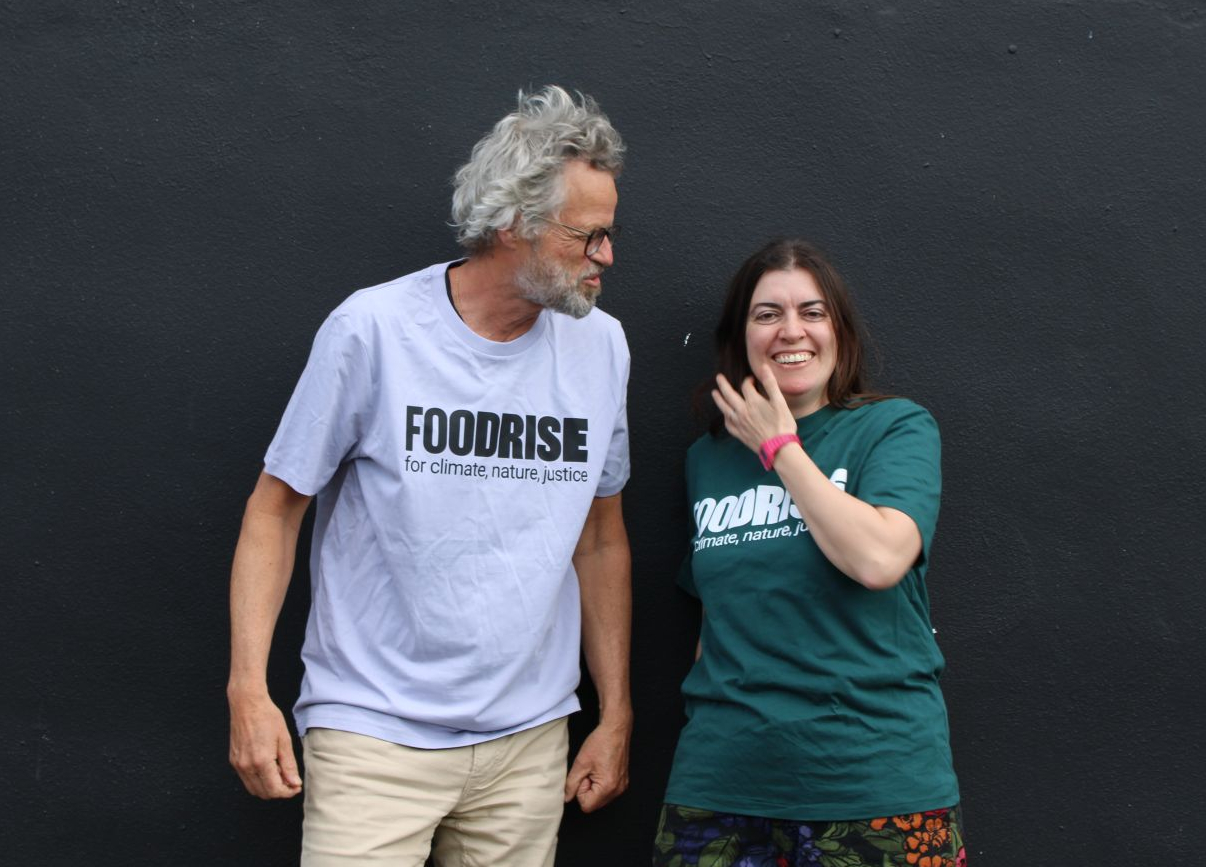
We are excited to share that Tom Kools has been appointed as the new Executive Director of Foodrise EU. Tom has been a valued member of our board since September and now steps into a more active, operational role to help drive our mission forward.
Gemma Verhoeven (chair of the board of Foodrise EU): “With extensive experience across the food system and strong ties throughout the sector, Tom brings fresh ideas, energy, and a wide-reaching network to support our work. We are looking forward to this next chapter with Tom and to continuing our collective efforts toward a more sustainable and equitable food system”.
Tom Kools: “Now more than ever, we have the chance to shift money and power away from a food system that harms people, animals and the planet, and instead invest in one that supports health, sustainability and fairness. I’m proud to join Foodrise in this new role to help build the movement to make that happen”.
As of July 1, Tom will be joining and can be contacted at tom@foodrise.eu
NICE, FRANCE. 12 June 2025 – The devastation caused by fish farms in Scotland and Norway has been increasingly under fire, yet huge swathes of the Mediterranean have been quietly taken over by industrial-scale seabass and seabream farms – boosted by European Union and government funding. This is driving untold environmental destruction and depriving global communities of food and livelihoods.
This Mediterranean ‘takeover’ by seabass and seabream farms is revealed today [12 June, 2025] at the United Nations Ocean Conference (UNOC) in a new report Ocean Takeover from environmental charity Foodrise (formerly Feedback Global), Greek alliance Aktaia and Spain’s Associació Cultural Ecológista de Calp (ACEC).
The new research reveals the sheer scale of the ‘feed footprint’ of seabass and seabream farming with huge numbers of wild fish turned into fish oil to feed farmed seabass and seabream. The researchers found 300,000 tonnes of fish could be left in the ocean, or that over a quarter more people (28%) could be fed a weekly portion of 200g fish if it wasn’t used to feed farmed seabass and seabream.
This means that seabass and seabream farming has a negative impact on global food security, contrary to what the industry consistently claims.
The extraction of wild fish from countries in West Africa, including Senegal, Mauritania and Gambia to produce fish meal and fish oil (FMFO) for industrial aquaculture is contributing to the worsening food security crisis: in 2023, food insecurity in the region hit a 10-year high [1].
The latest data (2021) from EUMOFA underlines the scale of the problem, with 98% of the European seabass eaten coming from farms, while just 2% is from fisheries [2].
While Türkiye is the world’s biggest producer of farmed seabass and seabream (44%), Greece is the biggest in the European Union – with its industry growing 141% since the turn of the century [3]. This growth in Greece is fuelled partly by the extraction of vast amounts of wild fish from West and Southern Africa – enough to feed nearly one million people a year, according to the new research.
Despite this, the report reveals substantial support from national governments and the European Union, which collectively have channelled millions of euros into promoting the growth of intensive fish farming – to the detriment of critical Mediterranean ecosystems and coastal communities, as well as people across the globe.
For example, Under the European Maritime, Fisheries and Aquaculture Fund (EMFAF) 2021–2027, Greece will receive €91 million to support “sustainable aquaculture and processing” [4].
Meanwhile, changes to legislation in Greece have dramatically increased the permissible areas for intensive aquaculture – expanding them 24-fold. This effectively grants vast stretches of the country’s coastline to private companies from across the world for their exclusive use to make big profits – at the expense of the environment.
Natasha Hurley, Campaigns Director at Foodrise, said: “It’s high time we all knew where the seabass and seabream on our plates comes from – and the huge environmental cost of each bite. Our new research clearly shows the shocking takeover of the Mediterranean by profit-hungry corporations is driving environmental destruction and global food insecurity. What’s even more galling is that this is happening courtesy of funding from national governments and the European Union.
“Industrial aquaculture is increasingly touted as a solution to ecosystem collapse and food insecurity as our oceans’ wild fish populations come increasingly under threat, but this is a deeply misleading narrative, fuelled by vested corporate interests. Today’s findings powerfully demonstrate that intensive fish farming is a false solution, and shows why we need to see an urgent end to the rapid expansion of seabass and seabream farms in the Mediterranean.”
Mor Mbengue, President of the Cayar artisanal fisheries committee (Cayar, Senegal), said: “Before, the sea made us live. We caught enough to feed our families, and the women of the village processed the fish to sell to the inhabitants of the cities far from the Senegalese coast, thus providing 70% of their animal protein needs. Since the arrival of fishmeal factories, which target coastal pelagic species and fish for juveniles, everything has collapsed.
“The fish have disappeared, the air has become unbreathable, the water is polluted. Women have lost their jobs, young people no longer have a future here. Many take to the sea, no longer to fish, but to flee. The most revolting thing is that all this fish plundered here does not even feed human beings: it goes to Europe and Asia to fatten farmed fish or pigs. We sacrifice our lives to feed animals on the other side of the world. It’s an injustice that we can no longer bear.”
Fay Orfanidou, from Aktaia – The Greek Alliance for the Protection of the Marine Environment from Aquaculture, said: “We are aghast at the pillaging of wild fish populations off the coasts of Africa, Latin America and Asia to produce feed for the fish farms which are blighting our lives here in Greece and throughout the Mediterranean.
“This is not food security. It’s theft: taking fish from the hungry to feed a polluting export industry. We are the voice of the coastal communities, and we will not be silenced. Our seas are not for sale. Our fight is for the future of Greece – and we will not give up.”
Read the report: Ocean Takeover – How seabass and seabream farming in the Mediterranean is driving environmental destruction and food injustice.
References
[1] Alexandra Heal et al., “The Hidden Cost of Your Supermarket Salmon,” The Financial Times, January 31, 2024, https://ig.ft.com/supermarket-salmon.
[2] New study: Fresh European Seabass in the EU, European Market Observatory for
Fisheries and Aquaculture Products, New study: Fresh European Seabass in the EU
[3] Hellenic Aquaculture Producers Organization, “2024 Annual Report: Aquaculture in Greece,” 2024, https://fishfromgreece.com/wp-content/uploads/2024/10/HAPO_AR24_WEB_v5.f.
[4] European Commission, “Greece Will Receive €364 Million from the European Maritime, Fisheries and Aquaculture Fund 2021-2027,” December 1, 2022, https://oceans-and-fisheries.ec.europa.eu/news/greece-will-receive-eu364-million-european-maritime-fisheries-and-aquaculture-fund-2021-2027-2022-12-01_en.

Today the Department for Environment, Food and Rural Affairs (Defra) has announced the projects it’s funding to stop thousands of tonnes of nutritious food being wasted.
This includes funding for Foodrise’s Gleaning Network to deliver a partnership project with six existing gleaning groups across England who last year collectively shifted more than 70 tonnes of surplus produce from farms into the community for people to eat.
Foodrise will lead the gleaning project alongside Khepera in Buckinghamshire, Sussex Surplus in Brighton, Avon Gleaning Network based across Bristol and Bath, Deal With It who are part of Transition Deal in Kent, Still Good Food in Bury St Edmunds and Alchemic Kitchen in Merseyside.
Phil Holtam, Regional Programmes Manager at Foodrise, said: “We’re thrilled that our gleaning partnership has received this new funding. Gleaning is a brilliant example of environmental and social action – food waste is reduced, the complexity of food and farming is better understood, communities engage in social action, and marginalised communities are able to access healthy, nutritious food. We’re looking forward to getting going in partnership with six other brilliant organisations to tackle food waste and feed our communities.”

Our exciting move from Feedback to Foodrise has been a long time coming. It means we finally have a name that reflects who we are and what we stand for. We are a small but mighty team of audacious activists – taking often unlikely action in pursuit of exposing systemic issues within our food system right the way from farm to fork.
‘Food’ is our focus, and ‘rise’ reflects how we create change. Through bold action, community collaboration and systemic shifts. Foodrise reflects the wide scope of our world-changing work and move – almost a decade ago – from a single-issue charity focusing on the scourge of food waste to one tackling issues right across the food system.
We work at the grass roots and grass tips. Taking on the corporate control of our food system which normalises over-production and exposing its colonial legacy and need for reparations. While showing a better way is possible through our community projects in Merseyside, Sussex, Buckinghamshire, and in The Hague in the Netherlands.
We now – as Foodrise – have a name that is fit for purpose for our broad, audacious and ambitious work in the UK, EU and globally.
We held our first ever ‘Feeding the 5000’ event in London’s Trafalgar Square back in 2009. Thousands were introduced to the shocking levels of waste in our food system – while enjoying a delicious meal. A global movement was born leading to similar events all around Europe and resulting in long-lasting policy change on food waste.
Then we officially registered as a charity and became Feedback in 2013, founded by Tristram Stuart and Nikki Charalampopoulou to shine a light on food waste. Our founders’ impact was significant as they exposed the social scandal and environmental tragedy of food waste, and positioned it as an environment issue.
Following Carina Millstone’s appointment as Executive Director in 2017, and with Frank Mechielsen at the helm in the Netherlands since 2021, we have grown into so much more than a voice against food waste.
We are confronting the structural drivers of injustice in our food system — from exposing the financiers of the global livestock industry to advancing community-led alternatives across Liverpool and Knowsley. All with an unwavering commitment to equity, justice and anti-oppression.
From legal challenges and hard-hitting research to supporting movements on the ground, our work now spans the UK, Europe, and globally. Including the founding of Feedback EU in 2022 to broaden our impact in the European Union, and strengthen involvement with EU food policy development, civil society coalitions and create alternative local food environments in the Netherlands.
But we still needed a name that reflects the breadth of our expanded, turbo-charged mission. At this critical moment — as climate breakdown accelerates, nature collapses, and millions face hunger and poor health — Foodrise captures our readiness to rise to the challenge and our vision for a future that works for people and the planet.
We are at a moment of crisis and opportunity. We are seeing the impact of climate change being felt – the geopolitical implications on food security, records numbers of children living in poverty. The worst harvest in 40 years. The wettest 18 months on record followed by the hottest ever spring. The decline of nature.
Our shift to Foodrise is a pivotal moment — one that positions us to amplify our voice, grow our impact, and build momentum in the fight for a just food system. We want more and more people to know who we are and what we do.
We’re rising up with fresh energy and a deeper commitment to transform the food system. For climate, nature and justice. Thank you for rising with us.
Carina Millstone, Executive Director at Foodrise
Frank Mechielsen, Director at Foodrise in the EU
Carina Millstone is a lifelong environmental activist and campaigner. She is currently serving as executive director of campaigning group Foodrise.

We’re well aware that farmed animals are all too often raised in confinement. But is it possible to imagine that the entire food system – crops, livestock, farmers and all – is itself confined and caged? Locked-in and constrained. Not able to deliver what it was meant to and restricted in what it can achieve.
This might seem an unusual way to think about food. But it’s how Feedback has been analysing the multiple connected problems in our food system – and it’s proving to be transformative in how we analyse problems and advocate for solutions.
We’ve been exploring how the system is unfairly weighted towards the industrialised model of food production. Our conclusion is that we are ‘locked-in’ to a system that is harmful for people and planet.
In our latest webinar on the Meat-Soil-Energy Nexus – outlining the connections between industrialised livestock production, the man-made fertiliser industry, and biomethane – we showcase this emergent thinking.
Industrialised livestock production
Feedback demonstrates that big corporations and governments in the global north are shaping food and energy systems around industrialised livestock production. For example, an estimated 80% of the EU Common Agricultural Policy money supports emission intensive animal agricultural products.[1]
Fertiliser
This industrialised system also relies on damaging inputs via fossil fertiliser and the overuse of synthetic fertiliser is used to grow feed for animals not people. 80% of the nitrogen harvest in European crops provides feeds to support livestock.[2]
Biomethane
And these two industries are actively promoting the rush for biomethane as a response to the energy crisis. Biomethane from manure is one of the drivers growing industrial livestock production. Herd sizes at dairy facilities with digesters that produce biomethane grew 24 times the growth rate for overall dairy herd sizes.[3]
These industries are intertwined. They feed off each other, they are connected, it is a nexus. For example, industrial meat and dairy produces manure, manure is promoted as an energy source (biomethane), which can also be used to produce fertiliser, which is applied to soils, which in turn are used to feed livestock. According to industry voices this is a win-win – but it is in fact a vicious circle that locks us into a food system of continued and multiple harms.
And this system runs counter to peer-reviewed climate science that clearly outlines the adverse impacts of intensive livestock production on planetary boundaries, the negative impact of overuse of fertiliser on our soils, rivers and public health, and the indisputable evidence that we should be moving towards renewable sources of energy such as wind and solar, not incentivising the production of biomethane way beyond its ‘sustainable niche’.
It also reflects a disastrous example of policy incoherence, with current UK and EU policies on food production and consumption, climate targets, public health and animal welfare working against one another.
But by shining a spotlight on how these industries are connected, we can unlock the positive levers for change.
How can this be done? Through redirecting financial flows of private and public finance away from industrialised livestock towards lower meat and dairy production and consumption, reshaping public policy towards a just rural transition that allows land use and diet change, and dismantling corporate power through targeted regulation and divestment in the sector. Our webinar set out some positive examples of these changes.
If we break this cycle, we can feed the estimated world population of 10 billion in 2050. But we do need to change what we grow and what we eat.
By understanding how the system operates as a whole, we can ‘unlock’ the cage and deliver a food system that is fit for people and planet.
References:
[1] Kortleve, A., Mogollon., J., Harwatt, H., Behrens, P. (2024) ‘Over 80% of the European Union’s Common Agricultural Policy supports emissions intensive animal products’ Nature Food 5 (4), 288-292
[2] Sutton, M., Howard, M., Erisman J, et al. (2011), The European Nitrogen Assessment: Sources, Effects and Policy Perspectives. Cambridge University Press
[3] Waterman, C. & Armus, M. (2024). Biogas or Bull****? The Deceptive Promise of Manure Biogas as a Methane Solution. Friends of the Earth

The planning application for an industrial megafarm in Norfolk has been unanimously rejected in a landmark decision that could shape the future of industrial farming in Britain and bolster councils and rural communities in their fight against harmful environmental practices in their areas.
Failure to include information on full direct and indirect greenhouse gas emissions in the application was considered grounds for rejection by King’s Lynn and West Norfolk Council’s planning experts, in what will be a significant boost for climate campaigners but a damning indictment for UK megafarms. The outcome follows widespread public outcry, over 15,000 objections to the development going ahead and growing concern about the damaging impacts of industrialised farming on the environment, animal welfare, and rural communities.
In rejecting the application, the committee followed the recommendations of the council’s planning experts, who last week advised that the facility should not go ahead, and that the council could face legal challenges if approved. As part of their 200-page report, the council’s planning officers advised that a landmark climate change ruling was applicable to the Methwold megafarm application, meaning the full direct and indirect greenhouse gas emissions must be assessed transparently and taken into account when making this planning decision. They advised that failure to include this information in the application was grounds for rejection.
In doing so, the planning officers agreed with legal testimony provided by environmental charity Feedback and Sustain, the alliance for better food and farming, as part of the consultation process. The organisations argued that the polluting emissions from the facility would be significant, unnecessary, unacceptable and incompatible with the UK’s legally-binding climate targets, and that without comprehensive emissions information the application is unlawful.
The planning officers also recommended rejecting the application on the grounds that it failed to provide clarity on how waste (especially pig manure) would be disposed of to prevent pollution to the air and water. The committee was also further advised that the facility risked impacting sites protected for nature conservation.
Lily O’Mara, Climate Campaigner at Sustain, said: “Local authorities are waking up to the reality of industrial farming: a damaging and extractive system of food production that poses a serious threat to human health and our country’s future, both economically and environmentally. King’s Lynn and West Norfolk Council has rightly put nature and communities first by saying no to a development that would have sent us in completely the wrong direction.”
Phil Holtam, Programmes Manager at Feedback, said: “The firm rejection of the proposed megafarm is undoubtedly the right decision. The council has recognised the climate-wrecking impact of this kind of mass production of meat, which should not be the direction of travel for rearing livestock in the UK. Cranswick’s plans would have caused environmental impacts we simply cannot afford if we are to meet Net Zero targets. Factory farming is not the answer – there is a better way to provide food security and decent agricultural livelihoods in the UK.”
Jan Palmer, local resident, said: “These multi-billion food giants simply cannot be allowed to continue bulldosing their way into rural areas, bringing nothing but pollution and the destruction of nature with them.”
The developer, Cranswick PLC, is one of the UK’s largest intensive chicken and pig producers and behind a number of the UK’s livestock ‘megafarms’, whose number has increased by one-fifth since 2016, according to Compassion in World Farming. The growth in intensive livestock farming has been accompanied by a decline in the health of the UK’s rivers, and intensive agriculture is now the main source of river pollution in the UK. Cranswick has been the subject of complaints and enforcement in action, including extreme ammonia pollution. In February, an investigation revealed that several farms owned by Cranswick trading entities had breached environmental regulations at least 90 times in the last seven years in East Anglia.
Objectors to the application noted that the increase in this kind of automated intensive livestock system, which is replacing smaller and more traditional family farms, is estimated to have already cost 14,000 jobs in the UK. Focus on Labour Exploitation (FLEX) has reported widespread use of insecure, seasonal migrant labour in the poultry sector, as well as trafficking, and risks of infringement of employment rights. In 2024, over 100,000 people called on the government to support a campaign led by UK family farmers to halt the intensification of farming, which they said was risking the livelihoods of farmers for the benefit of agribusinesses.
When you think of the food system, I imagine the image that comes to mind for most people is a vision of fields of crops and sheep, a few tractors or maybe even your local supermarket. But an aspect that tends to be left out of the conversation is seafood and more specifically fish farming fish (a.k.a aquaculture).
Many people are amazed to learn that aquaculture is the fastest-growing food production system in the world with the farmed salmon industry being the most profitable. Since the 1990s the production of farmed salmon has grown by over 1,000%.
But this rapacious growth comes at a cost.
The salmon farming industry is plundering our ocean and extracting food from communities living in some of the poorest parts of the world. Precious wild fish populations are being squandered to feed farmed salmon, while wild salmon populations facing collapse are plagued by sea lice infestations passed on from salmon farms. Our ecosystems are drowning in plastics, chemicals, and fish faeces. As the industry has grown, it is communities, wild fish populations and nature around the world that are paying the price.
This catastrophic growth does not happen in isolation and would not have been possible without significant financial backing.
After months of detailed and rigorous research, with financial analysis conducted by Profundo, we set out to expose industrial salmon farming’s biggest financial backers through our new report, Fishy Finances, published in partnership with the Global Salmon Farming Resistance.
What did we uncover?
From January 2015 – November 2024, industrial salmon farming received $18.8 billion in credit and, as of November 2024, financial institutions had nearly $12 billion invested in some of the world’s biggest salmon farming companies, with the Government Pension Fund Norway topping the chart as the largest single investor ($1.7 billion).
The top 5 creditors we identified were Scandinavian banks Nordea, DNB, Danske Bank and Dutch banks Rabobank and ABN Amro.
The top 5 investors we identified were Government Pension Fund Norway, BlackRock, Storebrand, Vanguard and Nordea.
Our research also reveals that even so-called ‘sustainable’ banks are fuelling salmon farming. As of November 2024, Triodos had $16 million invested into Bakkafrost, one the world’s largest salmon farming companies. Triodos recently asked, “Your money isn’t just sitting in your bank account – it’s being used to fund something. But is it funding what you believe in?”. Very few of its customers would support industrial salmon farming given the toll it is extracting from the environment and communities around the world.
The biggest benefactor of all these fishy finances is the global salmon farming giant Mowi – which made €5.6 billion (US$5.9 billion) in revenue in 2024. From January 2015 – November 2024, it received over one-third of all credit combined ($7 billion) and had received over half of all investment as of November 2024 ($6 billion).
All of this is giving Mowi the heft to continue on its course of global domination. From 2015-2024 Mowi’s farmed salmon production grew by nearly one-fifth, from 420,000 tonnes to 502,000 tonnes, and it more than doubled its feed production from 282,000 tonnes to 582,000 tonnes.
The UK and Scottish government have funnelled MILLIONS of pounds of taxpayer money into some of the world’s biggest salmon farming giants. At a time of increasingly squeezed government finances, this is a shocking use of public money.
The UK government provided £7 million to Mowi Scotland (yes, Mowi again…) through the UK Seafood Fund between 2022-2023 – five times the amount Mowi paid in UK taxes in 2022 (£1.3 million).
The fund also handed out £5 million to Scottish Sea Farms (co-owned by Lerøy Seafood Group and SalMar) between 2022 – 2023 – nearly double what the company paid in taxes to the UK treasury in 2023 (£2.8 million).
Since 2021, the Marine Fund Scotland has awarded nearly £5 million (£4.8 million) to salmon farming companies including Bakkafrost subsidiary the Scottish Salmon Company, Mowi and Cooke Aquaculture.
This seems like a great deal for a profit-hungry foreign corporations benefitting from the Scottish coast and less so for the UK taxpayer.
What’s the consequence of all this financial backing?
The significant financial backing of this destructive industry has fuelled the unsustainable growth of an industry that urgently needs to be rolled back.
Total global production of farmed salmon increased by nearly one-third, from 2.3 million tonnes in 2015 to nearly 3 million tonnes in 2024, considerably outpacing the growth of global meat production. The explosive rise of salmon farming companies in the space of mere decades would not have been possible without the billions in financial support provided by banks, asset managers and governments.
Far from being passive bystanders, financial institutions are actively driving an industry that values profits over everything else.
What can we do?
Our call to action is simple. It’s time to #DefundBigSalmon.
Share our Instagram post far and wide and read our full report here.
New research released today [25 March, 2025] shows the burden of damaged, out of date or nutritionally inadequate food is being unacceptably passed on by supermarkets and retailers to food aid organisations to deal with – and, often, dispose of.
The new data – based on the experiences of food aid workers in the UK – found 91% have had to discard donated food, with the most common reason the food was damaged or inedible. While 85% reported feeling frustrated, angry or sad when they received donated food items that they can’t use or redistribute.
The research from food experts at environmental charity Foodrise comes with clear recommendations for tackling the significant problems with the UK’s food distribution model, including a whistleblowing mechanism for workers to report when bad quality food is repeatedly passed onto them and mandatory reporting of food waste for large and medium businesses.
Link to the report: Used by: How businesses dump their waste on food charities or www.foodrise.org.uk/used-by
This comes at a time when food aid usage is at a record high with more than 3million people in the UK accessing food aid organisations last year – a huge increase from the 26,000 people who did so in 2008/09. While food bank workers and volunteers go above and beyond every day to try to get decent food to people in need.
But today’s new report – Used By: How businesses dump their waste of food charities – exposes that food redistribution isn’t the answer to either food waste or food poverty. The food experts say businesses must take responsibility for the time and cost of disposing of their own food waste – rather than passing it on to volunteers and community organisations.
The experience of dealing with businesses’ food waste led 98% of food aid workers to say government needs to do more to prevent food waste arising in the first place. While 84% said it was essential larger businesses should be legally required to report their food waste and 71% said government should introduce legally binding targets to reduce food being wasted.
The food aid workers also reported bizarre items being donated that are hard to incorporate into meals or didn’t provide nutritional value. This includes six turkeys frozen together, brandy-flavoured cream in the summer, 10kg of crème fraiche, tiny miso sachets and new experimental flavours of mayonnaise. While one worker said they spent £375 on carpet cleaning after a donation of rotten bananas.
Smaller organisations felt the burden of managing businesses’ food waste most acutely. For example, the majority of food aid organisations which had to throw away 10 per cent or more of donated food items were smaller ones lacking in the resources to quickly process and store donations.
The charity behind the research says the redistribution model fails to take account of the burdens placed on food aid organisations. It’s calling for mandatory reporting of food waste for large and medium businesses throughout the supply chain, national targets to halve food waste by 2030 and a levy retailers must pay in relation to the food wasted in their supply chain. It also endorses the establishment of a real living wage, universal free schools meals and the removal of the five-week wait for Universal Credit.
The new report – Used By: How businesses dump their waste on food charities – is being launched today in the House of Commons.
Jessica Sinclair Taylor, Deputy Director at Foodrise, said: “The redistribution of food is quite clearly not the answer to tackling either food waste or food poverty in the UK. Our research shows that – despite the heroic efforts of food aid employees – food donated by businesses is often damaged, expired, nutritionally inadequate and ends up never being eaten. We need to stop kidding ourselves that food poverty can be solved by food waste and vice-versa, and start addressing the root causes of both to the benefit of people and planet.”
Sheila Dillon, food journalist and presenter, said: “This report sheds light on the lived experience of food aid workers, revealing the frustration, anger and exhaustion of those working at the sharp end of our food system. Their voices make one thing clear: we need systemic change. Businesses must be held accountable for their waste, policymakers must ensure fair wages and social protections, and we must move beyond the short-term fix of redistribution to build a food system that works for everyone.”
Quotes from food aid organisation workers:
“I think it is wrong that supermarkets can record zero waste when actually we, as a food bank, are having to dispose of their waste.”
“Veg comes to us mouldy and we have to sort/clean before we start.”
“We are lucky in that we have facilities to deal with bigger packs for portioning and cooking.”
“I’m cross that the supermarket has not already checked this [food] – leaving it to us to dispose of it.”
REVEALED: UK and Scottish governments giving millions to wealthy salmon farming corporations at the expense of wild fish populations and communities
Destructive salmon farming companies are benefiting from government money despite access to billions in financing from global banks and asset managers over the past decade – new report reveals.
New data released today [12 March, 2025] reveals billions from big banks and asset managers is driving enormous growth of industrial salmon farming – making huge profits for shareholders at the expense of wild fish populations and communities around the globe.
Shockingly, the massive cash injection into the devastating industry also includes millions of pounds of public money from the UK Seafood Fund, which is managed by the Department for Environment, Food and Rural Affairs (Defra), and from Scottish government’s Marine Fund Scotland. This is revealed in today’s new analysis from environmental charity Foodrise and Global Salmon Farming Resistance (GSFR).
The numbers include the UK government providing Mowi – the world’s biggest salmon farming company – with £7 million and Scottish Sea Farms (co-owned by Lerøy Seafood Group and SalMar) with £5 million through the UK Seafood Fund between 2022 and 2023 [1]. The £7 million is five times more than the amount of tax Mowi paid to the Treasury in 2022 (£1.269million)[2], while last year the company’s annual revenue was EUR5.6billion [3].
Government money Mowi received included £2 million to buy equipment to rapidly process fish, which is projected to increase throughput from 65,000 to 95,000 tonnes of fish annually [4]. Mowi also received £5 million to establish a new broodstock farm for breeding fish, which will result in 25-30 million fertilised fish eggs per year [5].
Since 2021, the Scottish government’s Marine Fund Scotland has awarded nearly £5 million (£4.8 million) to salmon farming companies including Bakkafrost subsidiary the Scottish Salmon Company, Mowi and Cooke Aquaculture [6].
Scottish government money was used by companies to increase production, including £2 million to Scottish Salmon Company for a land based recirculating aquaculture system and £105,000 to Aquascot to increase processing capacity [7].
The new figures also expose that over the last decade (January 2015- November 2024) more than $18.8 billion in credit and nearly $12 billion in investment financing has been provided by global financiers to some of the world’s largest salmon farming companies. Over the same 10-year period, salmon produced from industrial farms has soared by almost a third (from 2.3 million tonnes in 2015 to nearly 3 million tonnes in 2024) [8] – considerably outpacing the growth of global meat production.
These vast sums of money from public and private finance – revealed today in Foodrise and GSFR’s report Fishy Finances – have played a central role in the consolidation and growth of industrial salmon farming corporations. This has rapidly transformed the way fish is produced and what is eaten in the high-income markets targeted by salmon farming companies. According to the Marine Conservation Society, farmed salmon is now the single most popular fish consumed in the UK [9]. Meanwhile, regions which provide fishmeal and fish oil to the salmon farming industry suffer from chronic food insecurity. The report cites the example of West Africa, where Norwegian salmon farming’s demand for fish oil is depriving up to 4million people of fish.
Community resistance to industrial salmon farming
More and more communities are rising up to oppose the worldwide expansion of salmon farming, many of them under the umbrella of the Global Salmon Farming Resistance (GSFR), an international alliance comprising more than 100 NGOs, activists, scientists, and individuals from 19 different countries. From Scotland, Norway, Iceland, France, Canada and the USA in the Northern Hemisphere, to Argentina, Chile and Australia in the Southern Hemisphere, salmon farming is encountering fierce resistance wherever it goes.
Salmon farming causes huge damage to the environment and natural ecosystems. It has been identified as a key threat to wild salmon populations, already imperilled by the climate crisis and poor water quality. In 2023 the International Union for Conservation of Nature (IUCN) classified global wild Atlantic salmon populations as ‘near threatened’ and reclassified UK populations as ‘endangered’.
Mowi’s shocking track record
Mowi has a shocking track record. The new report details how in recent years it has breached environmental laws in Scotland, used banned chemicals on salmon sold to UK supermarkets as organic, been implicated in a ‘price-fixing’ scandal and seen mass mortalities at its farms. For example, last year more than a million fish died at two adjacent Mowi Scotland sites – the biggest mass die-off of farmed salmon in Scotland in a decade.
The data, commissioned from independent research organisation Profundo, shows that between January 2015 and November 2024, Mowi was the largest recipient of all credit from global financiers, receiving US$7 billion, more than one-third of the total identified credit awarded to salmon farming companies. According to Foodrise’s calculations, this has helped boost Mowi’s production volumes by around one-fifth, from 420,000 tonnes in 2015 to 502,000 tonnes in 2024 and more than double its feed production from 282,000 tonnes to 582,000 tonnes over the same period.
Natasha Hurley, Director of Campaigns at Foodrise, said: “It’s truly shocking that public money is being given to wealthy salmon farming corporations whose shareholders are netting big profits at the expense of wild fish populations and communities around the world. For years global financiers have helped fuel the stratospheric growth of this destructive, extractive industry while using their power and influence to push misinformation about salmon farming. This cannot go on – it’s high time to listen to local communities and stop finance to industrial salmon farming.”
Agustina Copello, from Global Salmon Farming Resistance, said: “All over the world communities are rising up to defend their waters, cultures, and livelihoods from the destruction caused by open-net salmon farming. Through the GSFR, we are uniting this resistance into a powerful global movement—not just to fight back, but to create a future where food systems truly respect nature and people.”
Rachel Mulrenan, Scotland Director at WildFish, said: “Open-net salmon farming is one of the key threats facing our iconic wild Atlantic salmon populations. From the dispersal of sea lice parasites, which can prove fatal to migrating smolts, to the impacts of escaped farmed fish on genetic fitness – the growth of open-net salmon farming in Scotland has coincided with a catastrophic decline in the wild salmon population. There is no doubt that salmon farming has been a significant contributory factor to this decline.”
Ailsa McLellan, oyster farmer and campaigner, said: “It is so difficult for communities to fight salmon farms, it’s always David versus Goliath, and the farms have literally billions of pounds at their disposal. But more and more people are waking up to the truth that the ever-increasing negatives hugely outweigh the benefits of industrial-scale salmon farming. We are a growing movement, we have a voice that is getting louder and we will continue to fight against the scourge of industrial salmon farming.”
ENDS
For more information please contact Fraser Wilson, Media Manager at Feedback, on fraser@foodrise.org.uk or 07931783084.
References
[1] gov.uk, “UK Seafood Fund: Infrastructure Scheme – Projects,” https://www.gov.uk/government/publications/uk-seafood-fund-infrastructure-scheme-projects.
[3] Mowi, “Mowi Quarterly Report Q4 2024,” 2024, https://mowi.com/wp-content/uploads/2025/02/Mowi_Q4_2024_Report.pdf
[6,7] Marine Fund Scotland: grants awarded – gov.scot
[8] Based off yearly global production of farmed Atlantic salmon worldwide, Feedback calculated production increased by 29% from 2015-2024. (Using: https://www.statista.com/statistics/1179062/global-atlantic-salmon-production/
[9] https://www.mcsuk.org/ocean-emergency/sustainable-seafood/seafood-buying-guides/spotlight-on-salmon/
About Feedback
Feedback is an environmental campaign group working for food that is good for the planet and its people. To do this it challenges power, catalyses action and empowers people to achieve positive change. For more information visit www.foodrise.org.uk.
We use cookies where necessary to allow us to understand how people interact with our website and content, so that we can continue to improve our service.
We only ever receive anonymous information, and cannot track you across other websites.
