
Donate
Support us in the fight for a better food system.
Sugar consumption in the UK is double the government’s ‘maximum intake’ and isn’t on track to meet that goal, feeding public health challenges such as obesity, childhood tooth decay and type 2 diabetes. We all know too much sugar is bad for our health – so why do we eat so much of it? A new report from Foodrise and Action on Sugar identifies the role that supermarkets play in perpetuating this dangerous level of sugar consumption, and what they should be doing instead.
Far from leveraging their power to aid public health, we found that supermarkets are pursuing ‘business as usual’ strategies that drive overall sales of sugary products even higher. Foodrise and Action on Sugar’s research found that 9 out of 10 UK supermarkets do not have policies to measure overall sugar sales, or to ensure that they are consistently reducing sugar sales.
Further, they were neglecting responsibility for sugar sales beyond their own branded products. Supermarkets choose to continue stocking, and promoting, very high sugar products – including those explicitly targeted at young children. Supermarkets could instead seize the opportunity to remove the worst offenders from their shelves, with unparalleled impact.
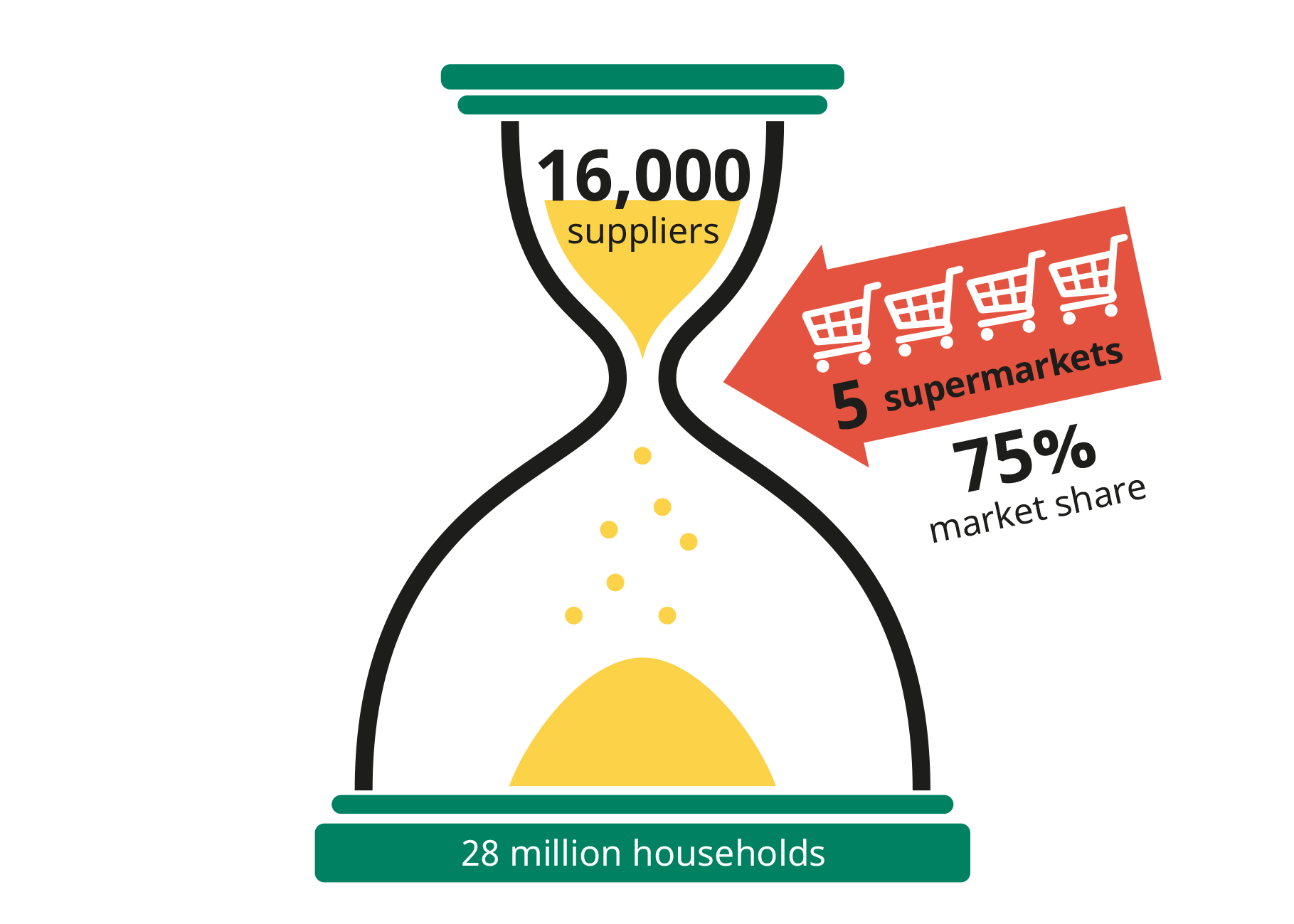
Supermarkets are playing up their efforts to reduce the sugar content of some of their products – many have reformulated products so they are lower in sugar, or introduced new ‘low sugar’ versions of family favourites. Yet, overall, government research shows that after 5 years of efforts to reduce sugar in a range of foods, sales of sugar have climbed by 7%.
Our original survey of supermarket policies also shows that no retailers are willing to publicly support mandatory reduction targets for sugar, despite marketing their efforts to be healthier. This gap demonstrates that action will not be forthcoming without pressure.


I was disappointed to see Waitrose using the phrase ‘Perfect for the food bank’ for in-store marketing of some veg stock powder. I took to Twitter to share my disapproval, where it was retweeted over 1,600 times – clearly, my Tweet hit a nerve. Tone matters: Yes, whilst some products are useful for food banks, and shoppers find such in-store reminders helpful, the reality is that no food is ‘perfect’ for the food bank because food banks should not exist. Signs like these are becoming normalised in our society, encouraging shoppers to feel good about helping ‘the poor’ (very Victorian) whilst overlooking why this structural inequality exists in the first place.
Let’s take a deeper look at the relationship between supermarkets and food banks.

As helpful as it is when someone buys something to donate to a food bank, each purchase ultimately boosts the supermarket’s profit margin. Sainsbury’s was recently in the news for continuing to record massive profits, and these high profits celebrated by Sainsbury’s only serve to highlight the painful inequality of our society: Research from the High Pay Centre revealed that, in 2022, the CEO of Sainsbury’s earned a whopping 183 times more than the average employee. Over at John Lewis, who own Waitrose, the top earner makes 75 times that of an average employee. Interestingly, the pay ratio used to be 25:1 at John Lewis but this was changed in 2012, perhaps given the the Cost of Living Crisis it is time for it to be changed again.
Supermarkets continue to rake in profits whilst millions of people are struggling to feed themselves. Food bank usage is at a record high: the Trussell Trust saw an 81% increase in food bank usage across its network last year. Figures reveal that one in five referrals to food banks are from households where someone works, including nurses. This even includes supermarket employees, with reports that Asda staff are relying on foodbanks.
Ultimately, good food should not be wasted, and if supermarkets have food surplus, it should be redistributed. But much like that thoughtless sticker in Waitrose, food banks can only ever be a sticking plaster. Furthermore, we have heard anecdotal evidence that up to 20% of products donated directly from the supermarkets as surplus is in fact unusable, yet all supermarkets like to point to their altruism of donating millions of meals per year.
After the debacle of the mini budget under Liz Truss et al, we were promised a period of stability and growth that would rebuild the economy. Instead, we have an ever increasing rate of food cost inflation, alongside the quadrupling of energy costs. We are reminded that “everyone” has received an energy support payment, but what is not discussed or even mentioned is Chancellor Jeremy Hunt’s decision to defer an uplift to welfare support until April 2023. That means people in receipt of universal credit, pensions and more are still trying to live on an income that hasn’t kept pace with inflation. For these people, food costs are spiralling, hence the increased need for food aid. A rights-based approach to food, on a cash first basis, would create the necessary breathing space and safety net for people, especially if this was enshrined in law.
Food banks only work in a short-term capacity and were indeed created as an emergency response for absolute destitution. They have now become ubiquitous, but the model is not sustainable. We are so deep in dystopia that a sign reading ‘perfect for the foodbank’ is being defended by Waitrose. There is nothing perfect about food poverty, there is nothing perfect about supermarket workers relying on food banks, there is nothing perfect about people being made to be grateful for the meagre crumbs given to them – we need a right to food, now.
Find out more
https://www.ianbyrne.org/righttofood
https://www.foodaidnetwork.org.uk/cash-first


Often presented as a sustainable alternative, Foodrise has shown over the past years that farmed fish production is based on a highly unsustainable mode of production, including, but not limited to, its reliance on wild fish as feed. To satisfy the rapidly growing sector’s ongoing demand for wild ‘feed’ fish, these are increasingly sourced from food-insecure West Africa, where stocks are already under pressure following decades of overfishing of the region’s waters by foreign vessels. Recently, Foodrise travelled to Dakar to discuss this issue with grassroots organisations representing coastal communities affected, and to kick off our newest fish campaign, Notre Poisson (Our Fish) – a collaborative three-year campaign focusing on the fishmeal and oil industry in the region and its links to Europe.
Widely presented as a healthy, climate-friendly protein alternative to meat, a way to protect fish stocks and ‘solve world hunger’, most consumers are unaware that lots of the farmed fish we eat are fed wild fish in the form of fishmeal and oil.
Each year almost a fifth of the world’s marine catch is reduced to fishmeal and oil, the majority of which is used to produce feed for the aquaculture industry – today, the world’s fastest-growing food production sector.
To satisfy the sector’s demand for wild fish, the fishmeal and oil industry has expanded into West Africa. Focusing on Mauritania, Senegal and the Gambia, the number of factories in the region has boomed from 5 to 49 in the past decade.
Today, over half a million tonnes of small pelagic fish, enough to feed over 33 million people, are instead caught, reduced, and exported—from a region dependent on fish as a vital source of affordable protein and micronutrients—to feed farmed fish and livestock elsewhere. These same small pelagic fish are the main source of income for thousands of fishermen and female traders and processors across the region.
While most of the fishmeal goes to China, Europe—home to several of the world’s largest aquafeed companies: Cargill Aqua Nutrition/EWOS, Skretting, Mowi and BioMar (all of which are involved in the trade of fishmeal and oil trade from West Africa)—is the largest importer of fish oil from the region.
Home also to some of the largest farmed fish producers in the world, well-known European retailers are sourcing from companies with supply chain links to these four aquafeed companies. More directly, European firms have invested in factories in West Africa.
Since 2018, Foodrise has established a robust body of evidence on the damaging socio-ecological impacts of feed production for the fish farming sector and campaigned to reform aquaculture, so it delivers the greatest nutritional value for the least environmental impact, does not contribute to destructive fishing, deplete fish stocks, or worsen global food injustice.
To date, this work has largely focused on Europe. Our newest fish campaign, Notre Poisson (Our Fish), now combines this work with a collaborative three-year project comprising partners in Britain, the EU, and West Africa.
Our collective goal is to secure legislative and policy change via a three-year programme of coordinated research, investigation, and advocacy designed to influence politicians and policymakers and equip civil society and consumers with the knowledge and tools to demand policies and actions that protect ecosystems and support food sovereignty of West African communities and nations.
They steal our fish and jobs
At the end of November, we organised a three-day project kick-off meeting with our partners in Dakar, Senegal. Also in attendance, were representatives of several grassroots organisations from Senegal, Mauritania, and the Gambia, who provided first-hand testimony of the devastating impacts of the fishmeal and oil industry on local communities across the region.
According to a report published by the FAO earlier this year, the rapid expansion of the industry in the region has had negative impacts on fish stocks and fishing livelihoods. The social benefits of the industry to the region have been limited and have been “accompanied by threats to livelihoods, employment, food security and nutrition, and the health and well-being of local communities.”
Reflecting this, “they steal our fish and jobs” was a common theme over the course of our discussions together. The devastating impacts of the diversion of catches from human consumption to the production of fishmeal and oil for export on the availability and affordability of fish were particularly salient. The implications for women fish processors and traders are especially acute.
Stressing the severity of the problem, Diaba Diop, president of Réseau des Femmes de la Pêche Artisanale du Sénégal (REFEPAS), an organisation that represents women fish processors and traders, warned “our survival depends on our ocean”.
Undelivered promises from factories, in terms of jobs, and direct environmental and health impacts, in terms of environmental pollution, smells, and consequent impacts on tourism were also highlighted by participants from across the region. Drawing on his own experiences in the Gambia, Biochemist Ahmed Manjang (CETAG) highlighted just how serious these were.
Adding to these, participants shared stories of the historical, as well as the ongoing, decimation of fish stocks off the West African coast, more generally, by foreign fishing interests and the knock-on implications of this in terms of illegal migration from the region.
In Kayar, Maty Ndaw, a woman fish processor and member of the Taxawu Kayar Collective—who this autumn, began historic legal proceedings against the fishmeal factory located on the edge of their town—shared, “we see our children migrating and dying in the ocean”. Located in the Thiès region, 36 miles northeast of Dakar, artisanal fishing is the main economic activity in Kayar, employing and feeding the population of roughly 18,000 people. The Collective represents a cross-section of the community, most of whom are engaged in fishing or fish one way or another.
We had travelled to the fishing village to hear about the Collective’s more than a decade long struggle against the factory there. Originally owned by Spanish company Barna, the factory was sold this summer to Senegalese owned Touba Protéine Marine.
While there, a street in from the white sand beach full of colourful pirogues, we witnessed near-empty processing facilities. Once worked by over three hundred women fish processors, today, these traditional facilities are used by less than fifty. Another street in, modernised processing facilities are unused. Without fish, the facilities lie idle.
Direct competition with the fishmeal factory for fish, alongside declining catches, means processors have been priced out of the market, with knock-on implications in terms of availability of fish for the local population. According to the FAO, the impact of the fishmeal and oil industry on food security and nutrition in Senegal, where almost half of the country’s protein comes from fish, is considerable.
Across the road from the fishmeal factory, at the lake on the edge of Kayar, clear evidence was visible of the waste dumped by the fishmeal factory. This lake connects to the town’s water supply. Its pollution forms the basis of the Collective’s legal action against the factory.
An ongoing trajectory of stolen resources
Controlled by foreign investors and reliant on catches from already precarious stocks, that the fishmeal and oil industry in the region is threatening fish stocks, food security and livelihoods in West Africa is by now well documented. The lived realities of those from around the coasts are testament to these impacts.
The Kayar case was dismissed by the judge in November on account of there being reasonable doubt that the factory was the cause of the water pollution. The appetite of local, national, and cross-national communities and organisations, however, to unite and work together to tackle this industry is strong.
The problem is also clearly recognised by communities as part of an ongoing trajectory of stolen resources from the African continent.
Implemented together with West African partners RAMPAO, Greenpeace Africa, ADEPA, CAOPA, SRFC, PRCM, alongside Lancaster Universities, in close collaboration with grassroots organisations representing coastal communities across the region, we want to force change in this industry, and those related to it, by turning this issue into one of key concern for a broad group of civil society actors to campaign jointly in West Africa and in Europe.
Ultimately, we want to see better regulation of the industry in the region, and an end to the use of fish fit for human consumption by the industry. As part of this, we will work to increase pressure on companies involved in or related to this sector to hold aquafeed companies who source from West Africa, and aquaculture companies who source from these, accountable for their sustainability promises.
During our discussions in Dakar, Mansour Brahim Boidaha, president of ONG Zakia, an organisation working on this issue in Mauritania, where the boom in this industry has been especially concentrated, pointed out that people from Europe should know that the fish from West Africa is processed to fishmeal and oil, with little benefit to the region’s population.
Summing up the nature of the problem, representing Senegalese small-scale fishermen, Abdou Karim Sall, president of Plateforme des Acteurs de la Peche Artisanales du Sénégal (PAPAs), highlighted the problem wasn’t one just relating to fishmeal, but of their being, their identity. This is about our fish, he said. This is about African fish.

Register here: https://hsi.zoom.us/webinar/register/WN_IxHfbs78SROXdEa27WoZfw
Livestock is responsible for about 14.5% of global emissions and, if current trends continue, the global livestock industry will be using up almost half the world’s 1.5°C emissions budget by 2030. Join us to discuss how we divest, defund and regulate this industry.

Register here: https://hsi.zoom.us/webinar/register/WN_7UInREB3TaiTh5axYpxmOg
The EU wastes more food than it imports, damaging EU food security amid the cost-of-living crisis, according to a recent Foodrise EU report. Food waste also costs EU businesses and households an estimated €143 billion a year, and causes at least 6% of the EU’s total greenhouse gas emissions. Halving EU food waste by 2030 would save an estimated 4.7 million hectares of agricultural land. In this context, a growing chorus of organisations are calling for food waste policies regulations to tackle the issue at the speed needed. 43 European organisations are calling for the EU to set legally binding targets to halve EU food waste from farm to fork by 2030. Inspiring new policies to fight food waste are being proposed around Europe, which aim to move beyond the slow pace of change achieved by voluntary commitments.
Join us for talks and discussion from inspiring speakers, giving a comprehensive overview of why the EU (and countries around the world) need to set legally binding targets to halve food waste, and the policies we can use to accelerate action. Featuring inspiring speakers from Germany, Denmark, Spain and the UK – and with many transferable lessons to countries around the world.

Join us for some Pumpkin gleaning in Sussex on November 2!
Crisp apples. Cosy sweaters. Colourful leaves. Why yes, Autumn is by far my favourite season. And with this changing season comes my favourite holiday: Halloween.
Halloween, and even the whole of October, is characterised by spook and scare. One thing is for certain, the most frightening part of Halloween isn’t the ghosts, the ghouls, the black cats or broomsticks. Instead, what sends a chill down my spine are the pumpkins. Or rather, the unnecessary food waste incurred by their existence.

Carvings pumpkins is great fun, there’s no doubt. However, in an age where food production and consumption are the greatest impacts humans have on the planet, it’s becoming ever more prudent to reconsider the role that our holiday celebrations play as well. Halloween, and our meticulously carved pumpkins, can be no exception. Boo*.
In 2021, Foodrise rescued 5.3 tonnes of pumpkins from farms. This represents a massive waste of precious resources used to grow pumpkins ultimately thrown away. We can personally attest that they are tasty and would be better used for a variety of autumnal recipes!
The Alchemic Kitchen, Foodrise’s social enterprise based in the North West of England, have been leading Foodrise’s creative efforts to use pumpkins that would otherwise be left to rot in the fields or on front porches. Savoury pumpkin scones, a Thai yellow curry, and a delicious dahl are just a few of the possibilities.

Growing skills, connection, and resilience through food and farming
See the issue


We have launched a formal legal challenge against the UK government for its failure to adopt measures to reduce meat and dairy production and consumption, contrary to the recommendations of its own expert climate advisers.
Both the independent review of the National Food Strategy written by Henry Dimbleby and commissioned by the government in 2019 and the Climate Change Committee (CCC), an independent, statutory body established under the Climate Change Act, have identified substantial reductions in meat and dairy as essential to tackle climate change. However, the Government Food Strategy, published in June, ignored the clear advice on meat and dairy reduction coming from both the CCC and the Independent Review. This makes the strategy unlawful and is at odds with the government’s Net Zero Strategy which stated the Food Strategy would outline how emissions savings in food and agriculture would be achieved in support of climate targets.
The only references to reducing livestock emissions are unproven technical approaches, which explicitly oppose the displacement of livestock. With regard to the alternative protein sector, the strategy makes it clear that this is seen as additional to livestock farming, not displacing it. Henry Dimbleby recently stated that meat reduction is critical for emissions reduction but is seen as ‘politically toxic’. Since the publication of the Government Food Strategy, the UK has experienced the hottest day on record. Meaningful action on climate change must be taken and this must include meat reduction.
Carina Millstone, Executive Director of Feedback said: The government has announced some ambitious emission reduction targets but failed to formulate the policies required to meet them. This creates the truly dangerous illusion that it is tackling climate change while continuing business-as-usual. Meanwhile in the real world, expert evidence unequivocally shows that curtailing meat and dairy is critical for all transition pathways to net zero. Rather than outlining plans to support the public and farmers in making the shift to low-carbon foods as promised, the Food Strategy blithely ignored the meat and dairy question altogether. We want the government to go back to the drawing board and come up with a strategy that delivers for the climate rather than one that simply spurts yet more hot air.’
‘The Scottish Government supports the industry’s growth strategy to double the production of salmon by 2030’ – a statement now broadcast by every Scottish salmon producer in some variation or other.
But what might the consequences of this huge growth be?
Evidence of the negative impacts of salmon farming is piling up. It seems reasonable, given the magnitude of the salmon farming sector’s ambitions, to question whether there are unaccounted for social, environmental and economic costs to this increase in production and if the industry really is providing the benefits it claims it is.
A billion-pound industry
Growing at a rapid pace since the ‘70s, the Scottish salmon farming industry has gone from producing just 14 tonnes of fish for commercial sale in 1971 to more than 203,000 tonnes in 2019. That same year, the industry turned over more than £1 billion and claimed its position as the UK’s largest food export by value. No two ways about it, over the past five decades, the Scottish salmon farming industry has become a highly profitable and lucrative business. Today, you can find hundreds of salmon farms all along the west and north coasts of Scotland and the fish they produce in every UK supermarket. But as Feedback’s research and investigations have shown, the industry is built on a highly extractive business model which incurs significant external costs for Scottish society and the environment. These findings are backed up by economic analysis which shows that the total environmental and social cost over a seven-year period is in the region of £2 billion. And yet a big chunk of the financial returns generated by the industry are flowing out of the country: in an article published last year, we revealed that the industry is Scottish in name only, with all five of the major salmon farming businesses owned by foreign companies, including several Norwegian companies and a US investment firm.
Key to this industry’s expansion is the Scottish Government. Despite a 2018 parliamentary inquiry showing just how environmentally damaging the salmon industry is, the Government supports the expansion of the industry on account of the contribution it makes to the economy. However, a recent review of the economic contribution of Scottish salmon farms by the Sustainable Inshore Fisheries Trust (SIFT) shows that the Gross Value Added (GVA) used by Marine Scotland to measure the industry’s contribution to the economy has potentially been exaggerated by 124% and the number of people it employs by a massive 251%. SIFT states that the evidence and reasoning for expansion are “partial, incomplete, unreliable and even irrelevant” and should not be used to increase production without further evidence. This didn’t stop cabinet secretary Mairi Gougeon MSP from using these potentially inflated figures to promote the Scottish salmon farming industry at COP26, when she stated, “the Scottish aquaculture sector supports almost 12,000 often highly skilled and well paid jobs”. Even if we consider this figure to be true, it represents a mere 5% of the number of people employed by the tourism industry across Scotland.
The incomplete picture relied upon by the Government fails to include the loss of jobs and income in other marine-based businesses. This is a particularly shocking omission if we consider the significant levels of pollution the industry generates and the rapid decline of Scotland’s wild salmon stocks, threatening the jobs and income of commercial shellfisheries, recreational fishing, recreational diving, and tourism all over Scotland. If the idea behind the Government’s endorsement is to create jobs, then perhaps it would be better off rebuilding wild stocks or supporting the farming of less harmful species. For instance, the shellfish farming industry is dwarfed by salmon and yet it generates proportionally far more jobs. For every £1 million of industry value, 23 shellfish jobs are generated for every 2 salmon jobs. With native mussel farming requiring no feed, helping to clean up waters and providing habitat for other species, it could be a far more beneficial and sustainable industry to support.
The true cost of salmon feed
Another challenge facing the salmon farming industry, in Scotland and elsewhere, is the true cost of salmon feed. The problem with farming a carnivorous species like salmon is the inclusion of fish in their diet. Current practices rely upon wild fish being caught, sometimes thousands of miles away, ground up into fish meal and fish oil (FMFO) and then included in compound feed which is fed to caged salmon along the Scottish coast. Salmon makes up just 4.5% of global aquaculture yet consumes 60% of global supplies of fish oil and 23% of fish meal destined for aquaculture. In 2014, the Scottish industry used at least 460,000 tonnes of wild fish to produce the fish oil necessary to feed just 179,000 tonnes of salmon – roughly equivalent to how much fish is purchased every year by the UK adult population. To meet its growth projections by 2030, the industry would have to increase its use of wild fish by 310,000 tonnes, to a total of 770,000 tonnes!
Up to 90% of the fish in FMFO are nutritious food-grade species, many of which contain a higher nutrient density than the farmed salmon they produce. After they’re fed to salmon, 50-99% of the essential nutrients they contain are lost. Despite the industry’s current reliance on wild fish, there are alternatives. It is possible for the industry to switch to 100% by-product derived FMFO and eliminate wild fish entirely from its supply chain. Furthermore, it has been shown, that by redirecting wild fish and diversifying our plates, we could reduce pressure on wild stocks and increase our nutrition from the ocean. While the Scottish Government endorses the expansion of the salmon industry, some of the fisheries that prop up its operations are showing signs of decline. An especially troubling thought when you consider many of the feed fish are taken from places where coastal communities wholly rely on fish as a vital source of key nutrients. The Government could do more to reduce this reliance and improve transparency by requiring the industry to produce impact reports on feed and regulate the use of wild-caught fish in FMFO.
Given its track record to date, it seems fair to say that the Scottish salmon industry’s focus on extraction, growth, and profit-at-all-costs will always come at the expense of rural communities, coastal ecosystems and a supply chain of exploited farmers and fishers. Ultimately, Scottish salmon is a high-value product sold in affluent markets. And the current usage of wild fish in salmon feed means that critical nutrients are not being distributed to people who need them the most. If we want fair nutrition around the globe, the industry should not be allowed to grow. If we want to reduce pollution and create long-term solutions for thriving fishing communities, the industry should not be allowed to grow. And, if we want to reduce pressure on wild fish stocks, the industry should not be allowed to grow. In short, rather than uncritically endorsing the salmon farming industry’s growth strategy, the Scottish Government needs to adopt firmer regulations to prevent further economic and environmental damage in Scotland and beyond.
De uitstoot van broeikasgassen van het grootste vleesbedrijf ter wereld, JBS, is in de afgelopen vijf jaar met maar liefst 51% toegenomen, waarmee het bedrijf nog verder verwijderd raakt van het doel in 2040 netto klimaatneutraal te zijn. Het bedrijf is nu namelijk verantwoordelijk voor een uitstoot meer dan twee keer onze jaarlijkse Nederlandse klimaatvoetafdruk, zo blijkt uit nieuw onderzoek.
Een coalitie van actiegroepen – waaronder Feedback EU, IATP, Desmog en Mighty Earth – is woedend over de buitensporige uitstoot van JBS. In vijf jaar tijd heeft het bedrijf het aantal dieren om te slachten verhoogd naar 28 miljoen runderen (54% omhoog), naar 48 miljoen varkens (67% omhoog) en naar 5 miljard kippen (40% omhoog). Het is dan ook geen verrassing dat nieuw onderzoek van IATP, Feedback EU en Desmog op basis van een door de VN goedgekeurde methode laat zien dat de emissies tussen 2016 en 2021 met 51% is toegenomen, van 280 megaton tot 421,6 megaton CO2 equivalent. Dat is meer dan twee keer zoveel als de jaarlijkse uitstoot van Nederland en de helft van wat Shell elk jaar uitstoot.
Voorafgaand aan de jaarlijkse algemene vergadering van het bedrijf die morgen plaatsvindt in São Paulo dringt de coalitie investeerders er op aan om afstand te doen van hun investeringen in JBS. Naast grote beleggers uit de VS en Brazilië wordt ook Nederland gerepresenteerd in het lijstje van top 10 aan investeerders, met ABP op nummer 8.
Frank Mechielsen, directeur Feedback EU: “ABP kan verwachten dat de lovende woorden over het stopzetten van hun beleggingen in fossiele brandstoffen naar de achtergrond zullen verdwijnen. ABP zou het voorbeeld van PFZW moeten volgen die eind 2021 uit JBS is gestapt vanwege incidenten over landgebruik en biodiversiteit. Ook de Robeco en Aegon zouden morgen de kans moeten grijpen om de ‘greenwashing’ van JBS aan te kaarten. Of ze dat gaan doen is een tweede vraag.”
Dirk-Jan Verdonk . directeur World Animal Protection Nederland voegt daaraan toe: ‘Het is wrang dat uitgerekend ABP, het pensioenfonds van de overheid, tientallen miljoenen euro’s in JBS investeert. Aan de ene kant heeft de Nederlandse overheid de mond vol over kringlooplandbouw, dierwaardige veehouderij en het verminderen van vleesconsumptie, aan de andere kant wordt het pensioengeld van ambtenaren gebruikt om een voedselsysteem in stand te houden met desastreuze gevolgen voor mens, dier en planeet.’
In het laatste rapport van de IPCC dat deze maand verscheen wordt specifiek aanbevolen om de uitstoot van methaan door de veehouderij tegen 2030 met een derde te verminderen om de temperatuurstijging tot 1,5º C te beperken. Veeteelt is verantwoordelijk voor 32% van alle methaan emissies. De opwarming door methaan is 84 keer zo hoog dan door CO2. Met de geplande uitbreiding die het bedrijf hoopt te doen en de zoektocht naar meer financiering op de beurs in de VS zal de uitstoot in plaats van verminderen alleen nog maar meer stijgen.
“Het is onthutsend dat JBS in één jaar meer klimaatemissies heeft dan heel Italië,” zei Shefali Sharma, directeur van het IATP, het Instituut voor Landbouw en Handelsbeleid Europa, dat in 2018 schatte dat de uitstoot van JBS ruwweg de helft was van die van oliemultinationals zoals BP of Shell. De nieuw berekende uitstoot laat zien hoe dringend het is om publieke verantwoording af te moeten leggen en onafhankelijke toetsing van klimaatclaims van grote vleesbedrijven te hebben. JBS is het perfecte voorbeeld van de schade die wordt aangericht door loze ambities om klimaatneutraal te worden.”
Met activiteiten in 20 landen en een recordomzet van 72 miljard dollar, beloofde JBS vorig jaar om tegen 2040 een netto-nul-uitstoot te bereiken. De plannen bevatten echter weinig details en zijn door campagnevoerders bekritiseerd, omdat ze de zogenaamde ‘Scope 3’-emissies buiten beschouwing laten. Scope 3-emissies omvatten de hele productieketen en zijn verantwoordelijk voor 97% van de uitstoot van JBS. Het niet meenemen van scope 3-emissies geeft dus een gigantische onderschatting van de bijdrage die JBS doet aan klimaatverandering door ontbossing, verandering in landgebruik, productie van voer en het gebruik van brandstof en landbouwchemicaliën.
Tegelijk met het onderzoek van het IATP over de uitstoot van JBS publiceerde Mighty Earth het rapport “The Boys From Brazil”, waarin werd benadrukt dat de rundveeproductie de grootste aanjager is van ontbossing en de daaraan gerelateerde emissies in het Amazonegebied. Ook bleek dat JBS verantwoordelijk was voor naar schatting 1,5 miljoen hectare ontbossing in Brazilië sinds 2008. Naast het meermaals niet nakomen van beloften om ontbossing in het Amazonegebied en andere ecosystemen zoals de Cerrado en de Pantanal te stoppen, is JBS ook in verband gebracht met omkoping, prijsafspraken, landroof, uitbuiting van arbeiders, moderne slavernij en milieuvervuiling.
Het is voor Frank Mechielsen van Feedback EU dan ook duidelijk: “Het is hoog tijd dat het pensioenfonds ABP, en banken en investeerders zoals Robeco en Aegon, hun verantwoordelijkheid nemen en stoppen met het financieren van de klimaatcrisis en de vernietiging van de natuur. Trek die stekker eruit en stop de financiële steun aan JBS en dochterondernemingen!”
Nederlands fondsbeheerder Actiam besloot dit in 2020 al te doen toen uit een evaluatie bleek dat JBS geen vooruitgang boekte in de gestelde doelstellingen over onder andere ontbossing. PFZW volgde eind 2021. De coalitie hoopt dat andere aandeelhouders volgen, en dat zij van de gelegenheid gebruik maken om morgen voor het algemene welzijn van ons allen op te komen en hun ultimatums te geven tijdens de vergadering. Dat mogen we toch zeker wel verwachten van pensioenfondsen en banken die onze toekomst willen waarborgen?
Einde
Perscontacten:
Nederland: Frank Mechielsen, Directeur Feedback EU: 06-55481678 frank@foodrise.org.uk
Engelstalig: Shefali Sharma, Director IATP: +49 177 1469613 ssharma@iatp.org
Alex Wijeratna: Mighty Earth +44 7725406730 awijeratna@mightyearth.org
Notes for editors:
We use cookies where necessary to allow us to understand how people interact with our website and content, so that we can continue to improve our service.
We only ever receive anonymous information, and cannot track you across other websites.
