
Donate
Support us in the fight for a better food system.
Exhausted Earth: How fertiliser corporations destroyed the nitrogen cycle and how to fix it, a new report by Foodrise, exposes the villains of the nitrogen crisis who are making billions while devastating public health, biodiversity and climate.
What’s the problem?
Nitrogen is essential for all life on Earth – but industrial farming practices since the Green Revolution have unleashed a flood of synthetic fertilisers that has overwhelmed Earth’s natural nitrogen balance. We are now beyond the “safe operating space for humanity”, with devastating consequences for people’s health, biodiversity and the climate. Nitrogen pollution has well and truly Exhausted Earth but the companies causing it are targeting growth, putting us on a collision course with ecological breakdown.
This isn’t new. Scientists and policy makers have warned about nitrogen pollution for more than 50 years. The EAT–Lancet Commission’s 2025 report delivers the starkest warning yet: the nitrogen crisis is a food systems crisis and surplus nitrogen must be halved, meaning that agricultural nitrogen inputs need to be cut by more than one-third (42%) by 2050.
Yet instead of shrinking, nitrogen fertiliser output continues to rise. Production has surged by one-fifth (20%) since 2009, when the first planetary boundary assessment was published and scientists first warned that Earth’s nitrogen boundary had been breached.
This report exposes an industry that has long operated in the shadows but whose activities have set off a visible cascade of environmental, public health and social harms. Flying in the face of the science, it has increased output and deployed a full suite of underhand tactics to maintain business-as-usual and protect its profits.
Nitrogen fertiliser corporations do not feed the world, they fail it. For too long, they have put their profits before our Earth and our food.
It’s time for our political leaders to rein in, require redress from, and begin shrinking this industry before the window of opportunity closes.
Solutions
Tackling the nitrogen crisis means listening to peasant farmers, who already have the solutions – not to agribusiness lobbies who don’t – and redirecting public subsidies. It also means giving teeth to existing domestic and international initiatives to tackle the nitrogen crisis, enforcing them, and moving beyond ‘nutrient loss’ reduction targets.
Governments must set measurable, year-on-year reduction targets for nitrogen production, in line with the EAT–Lancet recommendations.
Our demands
What the experts say
“Nitrogen fertiliser corporations must become as infamous and publicly shamed as the fossil fuel giants for reaping billions in profits at the expense of public health, biodiversity and the climate,” says Carina Millstone, Executive Director at Foodrise. “These companies are pumping millions into greenwashing nitrogen fertilisers and claiming to help feed the world – when in reality they fail it.
Food system transformation will require significant political leadership to tackle the greatest barrier to change: corporate control. It’s time for our political leaders to rein in, require redress from and begin shrinking the nitrogen fertiliser industry before the window of opportunity closes. The nitrogen cycle must be de-corporatised if humanity is to return within its safe operating space, with a life-supporting nitrogen cycle, rather than a destructive nitrogen surplus.”
“Synthetic nitrogen fertilisers are devastating Africa’s soils and waters, accelerating climate breakdown, and trapping farmers in a cycle of dependence and debt,” says Million Belay, General Coordinator at Alliance for Food Sovereignty in Africa (AFSA). “Meanwhile, powerful corporations are flooding the continent with fertilisers to maximise profit, no matter the human or ecological cost. It is time to break this toxic model. Governments and public banks must stop bankrolling harmful fertiliser expansion and invest instead in farmer-led agroecology that restores our lands, strengthens our sovereignty, and safeguards our future.”
Read the full report:


As COP30 wraps up today in Belém, a new climate storyline is taking shape – one that sits squarely at the crossroads of climate action and global trade.
More than ever, governments are using trade tools to deliver their climate targets, from border carbon taxes to deforestation-free import rules.
But why talk about trade when we talk about climate mitigation?
Because climate policy doesn’t happen in a vacuum. It happens in a global economy where countries buy, sell, and ship goods every second. Trade is the channel through which one country’s decisions have a knock-on effect across borders, shaping what gets produced, where, and with what environmental and social consequences.
Brazil is famous for its vast natural resources and for exporting commodities such as soybeans, coffee, and beef to the UK. But in recent years, it has taken the top spot in exporting another everyday commodity to the UK: sugar.
When the UK rewrote its tariff regime post-Brexit, it created a special quota allowing tariff-free imports of raw cane sugar.
The result? A flood of cheap Brazilian sugar heading across the Atlantic and entering the UK market. Today, Brazil – the world’s largest producer and exporter of sugar worldwide – dominates UK sugar imports.
Yet the narrow lens of free market economics helps to conceal a whole swathe of environmental and human rights abuses driven by sugar production in Brazil.
Sugarcane now covers nearly 10 million hectares in Brazil and plays a major role in driving indirect deforestation. As cane expands over old pasture, cattle are pushed deeper into the Amazon and the Cerrado – two vitally important ecosystems already under immense pressure.
The risks have only grown since Brazil scrapped federal zoning rules that once stopped sugarcane creeping into the Amazon and Pantanal – the world’s largest tropical wetland. Together, these dynamics make sugar a meaningful contributor to ongoing land-use change, even if its direct footprint on rainforest remains smaller than commodities such as soy and beef.
Sugar is also profoundly water-hungry, requiring 1,200–1,500 litres of water per kilo. Processing plants still draw heavily on rivers and groundwater, whilst fertiliser runoff and waste products like vinasse pollutes waterways, fuelling algae blooms and degrading ecosystems.
Behind the sugar industry is a dark labour record. Brazilian authorities have rescued thousands of workers from forced-labour conditions in sugarcane fields. Investigations continue to uncover cases of debt bondage, child labour, and dangerous working conditions – sometimes even in operations claiming sustainability credentials. Land conflicts with Indigenous and traditional communities remain a constant pressure point.
Taken together, these issues show that Brazil’s sugar supply chain carries significant environmental and social risks.
When you import sugar from Brazil – putting it on a long sea route across the Atlantic, then onwards to the UK – you’re adding kilometres of shipping, fuel use, and carbon dioxide. Transport-emissions estimates for global food-trade show transport alone can account for roughly 19% of total food-system emissions.
Combine that with the fact that sugar is already identified as a health-risk product linked to obesity, diabetes and other chronic disease, and it begins to look doubly problematic: high carbon footprint and negative health impact.
In short: importing sugar from thousands of miles away makes little environmental sense and even less sense when the product itself is harmful for health. When the value of life and nature is taken into account, the numbers simply do not add up.
It’s time for leaders to confront the real cost of sugar. Climate-aligned trade policy must stop rewarding environmentally destructive and socially unjust supply chains – and start putting people and the planet first.

As COP30 arrives in Brazil, deforestation and its drivers must take centre stage. But will the farmed salmon industry get the scrutiny is deserves?
If you’ve followed Foodrise’s work on aquaculture, you’ll know that the salmon industry extracts vast quantities of wild fish – much of it from the Global South – to feed the farmed salmon that end up on European dinnerplates.[1] But what’s less well known is the salmon industry’s similarly voracious appetite for soy.
Farmed salmon is devouring both the ocean and the rainforest, harming people and planet in its wake.
In Belém, the world’s spotlight will rightly be on Amazon deforestation, which is in part driven by soy production. Global soy production has sky-rocketed over the past 50 years and is now more than 13 times higher than it was in the early 1960s.
Brazil is at the heart of this boom. In 2023, it became the largest producer of soybeans, with exports which hit a record just last month (October 2025). Three decades ago, only four of Brazil’s nine Amazonian states planted soya beans; today, all nine do, making it Brazil’s fastest-growing commodity.
This huge growth is primarily down to the increasing demands of industrial livestock and aquaculture. Nearly 80% of global soy is turned into animal feed, with nearly 6% going to aquaculture alone. This is more than double the amount that goes towards making tofu (2.6%).
Without tackling global appetites for meat, animal products and farmed fish, demand for soy – and the environmental devastation it’s causing – will only continue to grow.
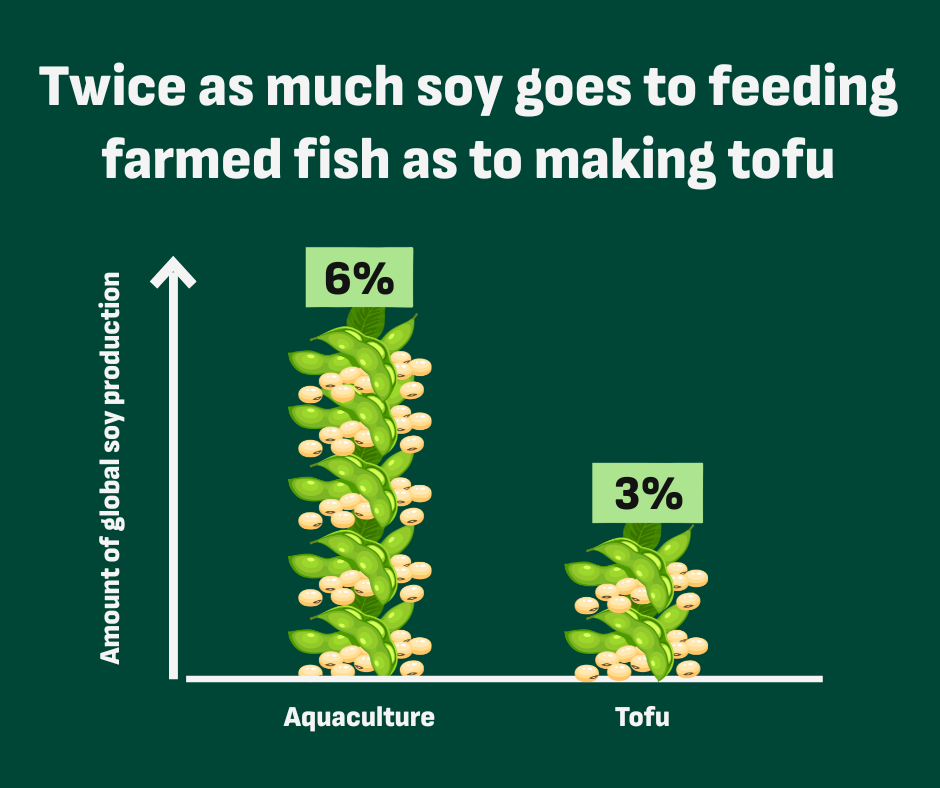
Advertising from the global salmon industry would have you believe that farmed salmon is the ‘climate-friendly’ option, but its outsized demand for soy, alongside its rapacious appetite for wild-caught fish, shows otherwise. The reality? Farmed salmon is a key player in driving the extraction of soy and it should not be overlooked.
In 2020, Norway imported around 370,000 tonnes of Brazilian soy protein concentrate to feed farmed salmon. The land required to grow the soy in Brazil to feed Norwegian salmon in 2020 was 2,154 km2 – an area larger than the size of Greater London.
Foodrise’s research shows that major salmon producers – Mowi, SalMar, Lerøy, Bakkafrost and Grieg – all source soy from Brazil.
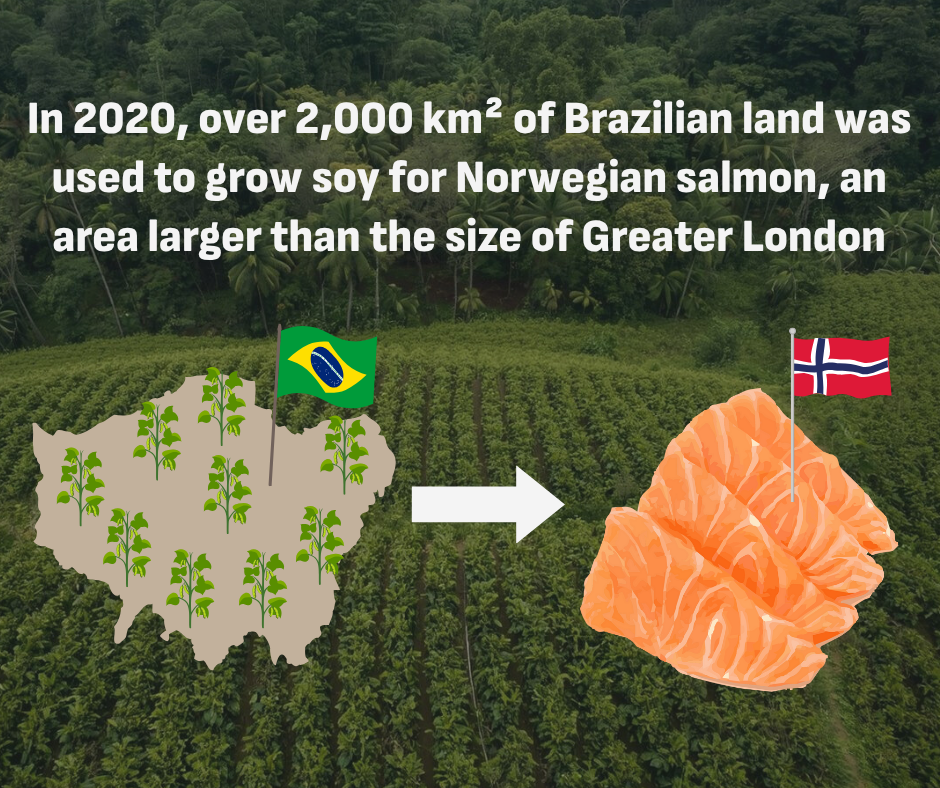
Farmed salmon’s demand for soybeans drives a cascade of environmental destruction:
And the damage doesn’t stop there. Soy production is also linked to serious social injustices, including slave labour, shocking working conditions and the displacement of small farmers and Indigenous peoples.
According to the Rainforest Foundation Norway report ‘Salmon on Soybeans’, the soy industry’s expansion is intensifying land conflicts between Indigenous groups and farmers. For example, in the Guarani-Kaiowá territory, soy plantations now occupy disputed lands claimed by Indigenous communities, leading to ongoing violence. Just last year, when Indigenous people attempted to reclaim their land, they were attacked by farmers, leaving 11 people injured.
Without cutting our global demand for meat, dairy, and farmed fish, soy-driven destruction will only grow.
At COP30, world leads must act to break this cycle of exploitation and stop the farmed salmon industry from devouring Brazil’s forests and eating up the Amazon in the name of profit.
Amelia Cookson is Aquaculture Campaigner at Foodrise
Learn more about the impacts of salmon farming here: Blue Empire, Fishy Finances
[1] Research published in 2024, suggests that it takes up to 6 kilograms of wild-caught fish to produce just 1 kilogram of farmed salmon (https://www.science.org/doi/epdf/10.1126/sciadv.adn9698).

This Autumn, the government’s budget might come with a sugar rush – but not the good kind.
On November 26th, brace yourself for the familiar flash of cameras as Rachel Reeves, the UK’s Chancellor, brandishes the iconic red briefcase outside No. 10. The Autumn Budget will take centre stage, with headlines buzzing about tax tweaks, spending plans, and the delicate act of balancing the books.
But beneath the soundbites, one quiet policy may be poised to slip by unnoticed: a sweet deal for Big Sugar.
Enter the Autonomous Tariff Quota – or ATQ – a wonky-sounding trade measure with big consequences. In short, it lets 260,000 tonnes of raw cane sugar into the UK tax-free. Yes, current policy is actively helping flood the country with cheap sugar.
That’s why Foodrise and Action on Sugar responded to the UK Government’s Treasury Autumn Budget representation survey, making the case for why the ATQ on raw cane sugar being imported into the UK should not be renewed.
Because this sugar flood is a big problem, and not just a dietary one. The UK already has nearly three times more sugar than its population should be consuming, according to NHS guidelines. We need 0.75 million tonnes to stay within safe limits. What we actually have? A staggering 1.91 million tonnes. And about a quarter of that is imported raw cane sugar.1
And where does all this sugar end up? Often in the diets of the most vulnerable. Children in deprived areas are consuming more sugar than those in wealthy communities. Black people and people of colour are far more likely to face sugar-linked health issues such as Type 2 Diabetes. And childhood tooth decay is hitting Asian, Black, and mixed-race children the hardest.
That’s not the whole story, either. Over half of those sugar imports come from Brazil, where industrial-scale cane production wreaks havoc, from air pollution and deforestation to water depletion and labour abuses.
So who does this policy actually benefit? Just one company: Tate & Lyle. The ATQ was introduced after the sugar giant lobbied hard – and it’s reportedly saving them up to a cool £72.8 million a year.
If this government is serious about cutting sugar consumption in half and improving public health, it can’t just talk tough – it needs to act. That starts with putting a stop to cheap sugar imports. The ATQ must go.
Sweet tooth or not, this is a bitter pill we can’t afford to swallow.
Over the next few weeks, we will be inundated with news from COP30 in Belém. As you follow the developments, bear this question in mind: How much are you hearing about the influence of the fertiliser industry?
The lobbying prowess of oil and gas is not big news – and the first blog in our COP30 series outlined how the agribusiness lobby has been showing up in high numbers at recent UNFCCC climate talks.
But another powerful force is increasingly muscling in on these negotiations: the nitrogen fertiliser industry.
New analysis by Foodrise shows that the number of nitrogen fertiliser lobbyists has tripled since COP26. But the extent of their influence is slipping below the radar.
While we have long known that food systems account for roughly a third of global greenhouse gas (GHG) emissions, nitrogen fertiliser is an unrecognised but critical contributor to this figure.
What most people don’t know is that nitrogen fertiliser alone has a bigger climate impact than the entire aviation sector:
‘A peer-reviewed study published in August 2022 found that the global climate impact of nitrogen fertiliser alone exceeds that of commercial aviation, contributing roughly 2 percent of all global GHG emissions.’
And the recently launched EAT-Lancet Commission’s report delivers the starkest warning yet: the nitrogen crisis is a food systems crisis.
However, this is not what we are hearing from the fertiliser industry, who have deflected responsibility for the nitrogen crisis onto farmers, and doubled down on an insidious narrative that they ‘feed the world’.
The nitrogen fertiliser industry has sent lobbyists to every climate summit since COP26. And this year is no exception, with 17 in attendance – that’s more than triple the number of lobbyists compared with COP26.
COP28, held in Dubai, maintains the record for the industry’s biggest turnout, with 48 representatives from eight major nitrogen fertiliser producers: EuroChem, Fertiglobe, Nutrien, OCI Global, PhosAgro, Pupuk Indonesia, UralChem and Yara International.
This outnumbered the individual official delegations of Nauru (21), Cook Islands (19), Niue (24), Micronesia (26) – all South Pacific small island development states experiencing some of the deadliest impacts of climate breakdown.
While fewer lobbyists are attending COP30, this year’s contingent is dominated by just three companies: Pupuk Indonesia, UralChem and Yara International.
So why is this a problem?
Nitrogen fertiliser production continues to accelerate (production has increased by 20% since 2009) despite the multiple harmful consequences (soil depletion, biodiversity loss, eutrophication, air pollution), and despite the call for a required reduction by 3% every year till 2050.
Nitrogen fertilisers are pushed by industry and policymakers as necessary for increasing yields and food production. But in reality, they trap farmers into paying for expensive inputs – not to mention that more than half of today’s fertilisers are made from fossil fuels. They are a lifeline for the fossil fuel industry, fuelling extraction and the climate crisis.
And the biggest obstacle to change is the powerful fertiliser industry itself, who are determined to protect their profits and water down, influence and obstruct policy change. Their presence represents a blatant conflict of interest. While their actions cause environmental destruction, they are in the negotiating rooms embedding their narrative that fertilisers are ‘necessary and safe’.
The science is clear – we can’t tackle climate breakdown without solving the nitrogen crisis. The growing number of fertiliser industry lobbyists at the climate negotiations must raise questions about power, access and influence.
Perhaps the continued presence of the fertiliser lobby is a response to the increasing body of evidence highlighting its catastrophic impacts. Our analysis even exposed that Bernhard Mauritz Stormyr, the Vice President of Sustainability Governance at fertiliser giant Yara International, has attended every climate summit since COP26.
To address this, the United Nations Framework Convention on Climate Change (UNFCCC) must urgently implement a governance framework that mitigates conflicts of interest and ensures equal and meaningful representation for all food system actors – particularly marginalised communities (including women, small holders and indigenous communities).
Whether you sit within the negotiating rooms at COP30, or are following along from afar, consider who might be controlling the narrative – and look out for the fertiliser industry hiding in plain sight.
2025 sees us arrive at the 30th UN Climate Change Conference – or COP30.
Just weeks before the conference, the UN Environment Programme warned that the world is severely off track to limit global heating to 1.5C. Clearly, this is the perfect time for negotiators to double down on serious commitments that can urgently bring the target back into focus and finally put corporate control over our food systems in the spotlight.
But if the recent string of COP summits is anything to go by, this outcome is looking unlikely. For one thing, food systems have historically been low on COP agendas and largely absent from their final agreements.
This is a glaring omission, considering that food systems are responsible for one third of human-caused greenhouse gas emissions, and:
So why is food still missing from the COP table?
A small handful of corporations stand to make huge profits from delaying climate action. In the food industry, this includes some the world’s largest meat, dairy, fertiliser and pesticide companies, who are increasingly showing up at COPs to influence negotiations – and even participate directly.
Since COP26, DeSmog has tracked the attendance of ‘Big Agriculture’ delegates, finding that their presence more than doubled at COP27, and went on to triple at COP28, with over 340 representatives attending negotiations in Dubai.
Even more concerningly, industry representatives are being upgraded from ‘observer’ status to being included within country delegations – granting them more access and power to influence negotiations. DeSmog’s analysis has found that 40% of food industry lobbyists travelled to COP29 with country badges – an increase from 30% at COP28, and just 5% at COP27.
Meat giant JBS has attended via the delegation of Brazil for the past three years – the country which has consistently brought in the highest numbers of Big Ag lobbyists. With Brazil now being the host of COP30, we expect this shameful trend will continue.
This corporate capture threatens to stall progress on transforming food systems at COP, and gives these companies a license to further greenwash their destructive, exploitative practices. Research by Changing Markets has revealed extensive efforts by the meat industry to control narratives on agriculture in the lead up to COP30.
Meanwhile, those working towards just, resilient food systems – including small-scale farmers, Indigenous peoples and food justice activists – are frequently excluded from COPs. Attending COP is a significant expense, and it can be difficult to obtain a badge without existing political or industry connections. Research also shows that border and visa restrictions are increasingly barring the participation of people from the Global South.
There are initiatives working to change this, including the Global Alliance for the Future of Food, which supported a delegation of 42 community leaders – including small-scale farmers, fishers, and Indigenous peoples – to attend COP28. But without intervention to tackle the dominance of the Big Ag lobby, it threatens to drown out these much-needed perspectives.
Foodrise is not attending COP30 in person but will be keenly following its progress – in particular, uncovering evidence of corporate takeovers and calling out instances of Big Agriculture hijacking the negotiations.
Only by resisting corporate capture, and continuing to build food sovereignty movements beyond COP, will we enact real change.
Sunita Ramani is Campaign Manager at Foodrise.
Foodrise’s COP30 blog series exposes how corporate interests – from agribusiness to industrial meat and fish farming – dominate food discussions at COP, shaping climate policy to protect profits instead of people and the planet.
Through research and reporting, data analysis, and storytelling, each post reveals a different layer of the corporate capture of our food systems, connecting local struggles to global power dynamics.
Menu of Food Voices reflects our key learnings during the eighteen-month Food Voices Coalition project, funded by Healthy Food Healthy Planet.
Seven organisations in six European countries worked in various ways to influence the food retail sector, from workshops to research and campaigns, through food policy councils, networking, and mobilisation. The common thread in all our work is that we worked from the bottom up, giving a voice to citizens; to marginalised communities, students, and farmers.
A brief recap of our impact so far:
What’s special about this journey is that, while pursuing and achieving impact, we did so reflectively, making the quality of the process part of the impact. By raising awareness on processes, not only among communities and stakeholders, but also within ourselves and within our own organisations, we created a lasting impact that extends beyond the project itself, because it’s about strengthening the power of change.
Although the project has come to an end, we will stay connected and continue our work!
Interested in a specific project or location? Please reach out to the organisation in charge.
For general questions please contact: info@foodrise.eu
Two of Foodrise’s longstanding initiatives – Sussex Surplus and Seeding Reparations – have now become independent Community Interest Companies (CICs). This marks an exciting milestone in the evolution of Foodrise and represents a new chapter in our collective work to promote food justice, reduce waste, and support community-led change.
Seeding Reparations is a racial justice organisation that has fostered a collective of allied organisations to form a powerful network of activists working towards food justice and equitable access to resources. The organisation will now be co-directed by Andre Kpodonu, Foodrise’s outgoing Director of Programmes, alongside Tom Wakeford and Tatiana Garavito, providing strong leadership to expand its reach and impact.
During his five years at Foodrise, Andre made an outstanding contribution, and his steadfast guidance and relational approach will be greatly missed in the charity’s communities team. Seeding Reparations continues to grow its network of food justice activists, amplifying the voices and leadership of those working towards systemic change.
“It’s been a joy and a privilege to work with so many incredible people to get Seeding Reparations to this point. More than ever, we need initiatives which work directly with communities to further racial justice and holistic repair within food systems. We look forward to working with Sussex Surplus, Foodrise and our shared networks over the coming years to continue championing our common values.”
Andre Kpodonu (Director), Seeding Reparations
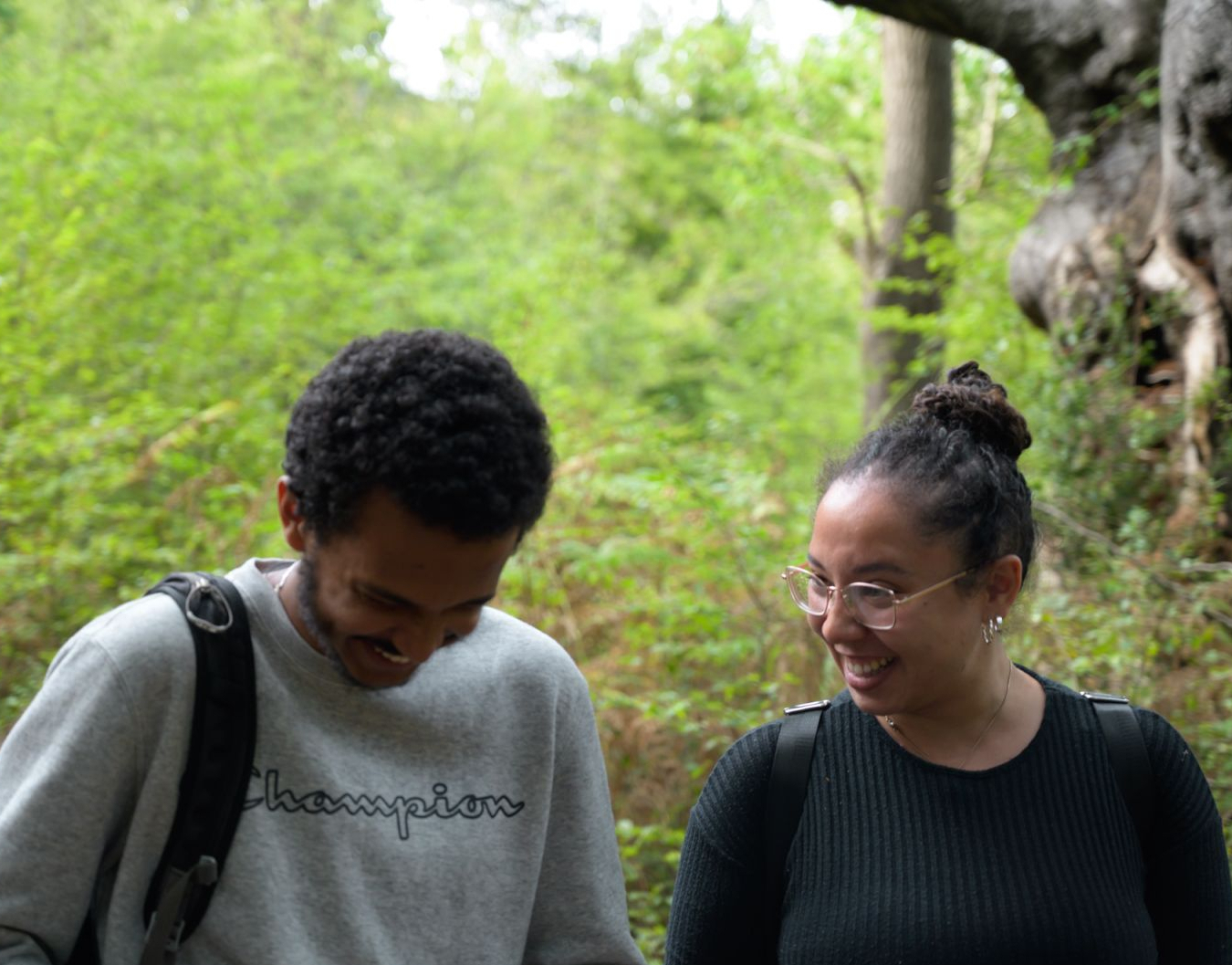

Since its inception in 2020, Sussex Surplus has grown from a small pilot project into a dynamic social enterprise, offering training and opportunities for neurodiverse young people, gleaning surplus food, and providing fresh, healthy, and delicious meals from their community kitchen in East Brighton. The organisation will now be co-led by Phil Holtam and Ingrid Wakeling, combining their expertise, passion and shared vision to guide Sussex Surplus into this next stage.
Co-founding Sussex Surplus has been a real journey, exploring the complexities of how to reduce waste in our food systems while adding value at every step for our community. Foodrise’s guidance in navigating a complex landscape of governance and finance has helped us get our feet rooted firmly in the ground of excellence in the charity sector and we now look forward to spreading our wings in the grassroots sectors of food and community.
Ingrid Wakeling, Sussex Surplus
Independence enables both organisations to strengthen their missions while continuing to collaborate with Foodrise and the wider food movement. Cross-pollination is already underway: at a recent Seeding Reparations gathering at Sadeh Farm near Orpington, Sussex Surplus provided catering, demonstrating the continuing synergy between the two organisations. Sussex Surplus will also continue as a partner on Foodrise’s Defra-funded Ready Steady Glean project, ensuring that gleaned food from farms reaches communities across Sussex.
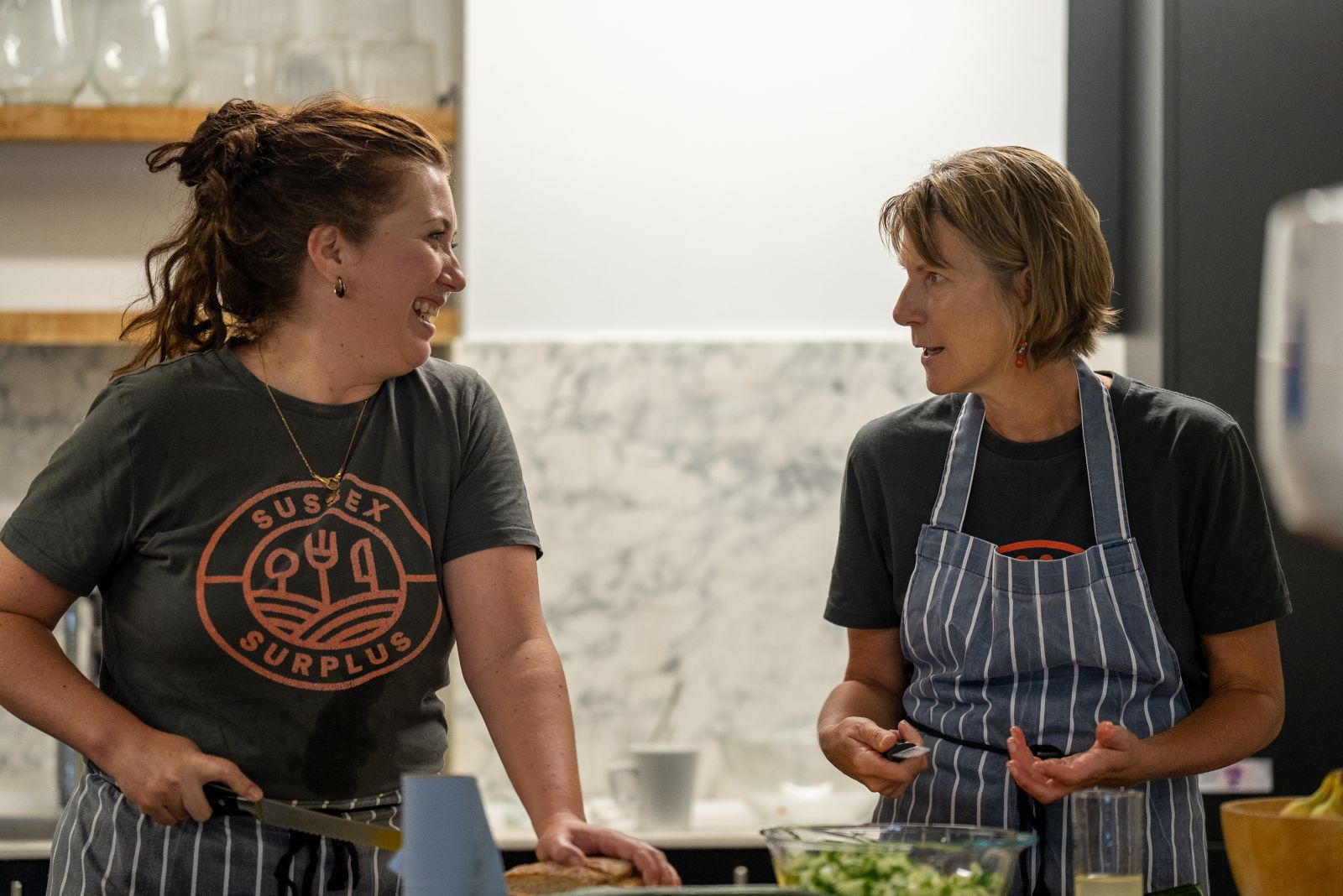
Becoming independent gives each organisation the space to grow, adapt, and respond to their communities’ needs with greater autonomy, while retaining the shared values of collaboration and solidarity that are inherent to Foodrise.
“It’s inspiring to see how thoughts and ideas have developed into proposals, proposals into projects, and projects into thriving, independent organisations. This milestone reflects not only the dedication of staff but also the support of our partners, funders, and the communities we serve together.
“We look forward to seeing Sussex Surplus and Seeding Reparations continue to flourish as independent, autonomous organisations. Their success is a testament to what can happen when activists with vision, collaboration, and determination come together to create meaningful change.”
Carina Millstone, Foodrise
For more information visit the new organisations’ websites:

The world’s major meat and dairy companies are generating combined greenhouse gas emissions on par with some of the biggest fossil fuel producers, according to new estimates from environmental and food policy experts issued ahead of the COP30 climate talks in Belém, Brazil. More than half of the estimated emissions stem from methane, a powerful but short-lived gas that scientists warn must be sharply reduced in this decade to keep global warming within 1.5°C.
The analysis, Roasting the Planet: Big Meat and Dairy’s Big Emissions, published today by Foodrise, Friends of the Earth U.S., Greenpeace Nordic, and the Institute for Agriculture and Trade Policy, estimates that 45 major meat and dairy corporations generated more than a billion tonnes of greenhouse gas emissions (in CO₂-equivalents) — more than has been reported for Saudi Arabia, the world’s second-largest oil producer. [1]
The study found that the largest five emitters of this group — JBS, Marfrig, Tyson, Minerva, and Cargill — together produced an estimated 480 million tonnes of greenhouse gas emissions (CO2eq), surpassing emissions reported for Chevron, Shell, or BP. [2] In addition, the estimated methane emissions of the 45 meat and dairy firms exceeded the reported methane of all EU countries and the UK combined.
Martin Bowman, Senior Policy and Campaigns Manager at Foodrise, said:
“These profit-hungry Big Meat and Dairy companies are shamelessly driving the climate crisis through their addiction to industrial-scale mass production of meat and dairy. This is despite crystal-clear evidence that to limit climate catastrophe, a shift to healthy, sustainable and plant-rich diets is essential, alongside some much smaller-scale animal farming.
“That’s why we’re sounding the alarm on Big Meat and Dairy’s sky-high emissions, which closely rival Big Oil and exceed those of entire countries. We urgently need to see policymakers step up to take on this powerful industry through both taxation and regulation. This is absolutely crucial for the health of people and planet, and to fund a just transition to healthy food which is sustainably farmed.”
Shefali Sharma, Global Agriculture Policy Expert for Greenpeace Germany, said:
“As governments head to COP30 in the heart of the Amazon — an ecosystem devastated by global meat giants — scientists are clear that a failure to bring down agricultural emissions will torpedo us well past the Paris 1.5°C red line. Farms that restore nature and communities, not corporate-controlled factories, should be at the center of our food system. It’s not too late for governments to commit to such a transition in their climate plans coming out of this COP.”
Kari Hamerschlag, Deputy Director of Food and Agriculture at Friends of the Earth, said:
“We cannot be fooled by shameless greenwashing by Big Meat and Dairy companies. The numbers are stark. Meat and dairy giants are responsible for a huge amount of greenhouse gas emissions, especially methane. If governments are serious about meeting climate goals, they can no longer ignore the climate impact of industrial meat and dairy. Binding agricultural emissions targets, full supply-chain reporting, and support for a just transition toward agroecology and more plant-based food systems are essential.”
Ben Lilliston, Director of Climate Strategies at the Institute for Agriculture and Trade Policy, said:
“Despite years of pledges to reduce emissions, major meat and dairy companies continue to recklessly drive climate-polluting production systems. It’s time for governments to step up and lead, with aligned regulations and public spending designed to cut emissions and support farmers in a transition toward more sustainable, lower-emitting farming systems.”
Other key findings from the study include:
With global methane emissions needing to drop by 45% by 2030 according to the UN [3] to stay within the Paris Agreement’s 1.5°C limit, the report’s authors are calling for urgent action from governments to:
ENDS
Notes to Editors:
Footnotes:
[1] The scope of research was 45 major processors of beef (12), pork (15), chicken (15) and milk (15)—see Annex 1 (Methodology) for more info on company selection. 2023 data was used for the number of animals processed for beef, pork and chicken. 2022 data on milk intake was used for dairy companies as 2023 data wasn’t available at the time of analysis.
The comparisons with reported emissions for countries and fossil fuel companies in this press release and report are indicative only, as these emissions are calculated using different methodologies. Country emission data have been sourced from: Our World in Data, ‘Annual Greenhouse Gas Emissions Including Land Use’, Our World in Data, 2025, https://ourworldindata.org/grapher/total-ghg-emissions?tab=table
[2] Fossil fuel company emission data have been sourced from: Carbon Majors, ‘Carbon Majors Dataset – High Granularity’, InfluenceMap, 2025, https://carbonmajors.org/Downloads.
[3] UNEP and Clean Air Coalition, Global Methane Assessment: Benefits and Costs of Mitigating Methane Emissions (United Nations Environment Programme, 2021), 11, https://www.unep.org/resources/report/global-methane-assessment-benefits-and-costs-mitigating-methane-emissions
Roasting the Planet: Big Meat and Dairy’s Big Emissions, a new report co-authored by Foodrise, Friends of the Earth U.S., Greenpeace Nordic, and Institute for Agriculture and Trade Policy, reveals the colossal, yet often overlooked, climate footprint of Big Meat and Dairy.
What’s the problem?
The global livestock sector is estimated to be responsible for between 12% and 19% of total human-caused greenhouse gas (GHG) emissions, making it one of the world’s highest emitting sectors.
This new report presents the latest global assessment of the meat and dairy industry’s outsized climate impact, estimating the greenhouse gas (GHG) emissions generated by 45 of the world’s major meat and dairy processing companies in 2023/22.
The findings make it clear: cutting fossil fuel emissions alone isn’t enough. Tackling emissions from Big Meat and Dairy is essential to limit global heating, at a time when every fraction of a degree counts.
Key findings:
Solutions
Research repeatedly shows that dietary changes in high-income nations are the single biggest option for cutting food system emissions that we have. An estimated 83% of global meat production and 77% of global meat consumption occurs in high and upper-middle income countries, compared to just 2% in low-income countries, according to a recent research paper.
Moving to a predominantly plant-rich diet — the EAT-Lancet diet — in high-income nations would reduce food emissions by an estimated 61% and save an area of roughly the size of the EU. Were this area returned to nature, the land could draw down around 14 years of global agricultural emissions. To achieve this, we will also need to hold Big Meat and Dairy companies to account.
Policy recommendations
We recommend that policymakers:
What the experts say
Martin Bowman, Senior Policy and Campaigns Manager at Foodrise, said:
“These profit-hungry Big Meat and Dairy companies are shamelessly driving the climate crisis through their addiction to industrial-scale mass production of meat and dairy. This is despite crystal-clear evidence that to limit climate catastrophe, a shift to healthy, sustainable and plant-rich diets is essential, alongside some much smaller-scale animal farming.
“That’s why we’re sounding the alarm on Big Meat and Dairy’s sky-high emissions, which closely rival Big Oil and exceed those of entire countries. We urgently need to see policymakers step up to take on this powerful industry through both taxation and regulation. This is absolutely crucial for the health of people and planet, and to fund a just transition to healthy food which is sustainably farmed.”
Shefali Sharma, Global Agriculture Policy Expert for Greenpeace Germany, said:
“As governments head to COP30 in the heart of the Amazon — an ecosystem devastated by global meat giants — scientists are clear that a failure to bring down agricultural emissions will torpedo us well past the Paris 1.5°C red line. Farms that restore nature and communities, not corporate-controlled factories, should be at the center of our food system. It’s not too late for governments to commit to such a transition in their climate plans coming out of this COP.”
Kari Hamerschlag, Deputy Director of Food and Agriculture at Friends of the Earth, said:
“We cannot be fooled by shameless greenwashing by Big Meat and Dairy companies. The numbers are stark. Meat and dairy giants are responsible for a huge amount of greenhouse gas emissions, especially methane. If governments are serious about meeting climate goals, they can no longer ignore the climate impact of industrial meat and dairy. Binding agricultural emissions targets, full supply-chain reporting, and support for a just transition toward agroecology and more plant-based food systems are essential.”
Ben Lilliston, Director of Climate Strategies at the Institute for Agriculture and Trade Policy, said:
“Despite years of pledges to reduce emissions, major meat and dairy companies continue to recklessly drive climate-polluting production systems. It’s time for governments to step up and lead, with aligned regulations and public spending designed to cut emissions and support farmers in a transition toward more sustainable, lower-emitting farming systems.”
Read the full report:
Natasha Hurley, Deputy Director of Foodrise, reflects on her visit to New York Climate Week in September 2025, highlighting the growing momentum around transforming global food systems to tackle the climate crisis.
Maybe it’s because of the job I do but everywhere I look in 2025, I see food rising up the agenda at national and international events.
This is unsurprising in the current context: as a report last year from the Council on Strategic Risks told us, with conflict and climate change continuing to disrupt food production and reduce food availability, including in traditionally stable countries, the geopolitical importance of food is growing. Distressingly, we have seen the weaponisation of food in multiple theatres of war including Gaza, Sudan and Ukraine.
Of course, our food system has become a major driver of climate change in its own right. In September I was in the United States for the annual New York Climate Week, which brings together civil society, philanthropy, policymakers and businesses to grapple with major issues of our time, including the energy transition, environmental justice and circular economy. This year, for only the second year in a row, it also had a dedicated ‘Food Day’ hosted by TILT Collective as well as an all-day event on Land, Forests and Food Sovereignty Foodrise co-hosted with Friends of the Earth US and allies.
I presented data we commissioned revealing that half a trillion dollars of private finance were pumped into production of high-emissions meat and dairy between 2015 and 2022 in the form of credit, which has facilitated the massive expansion of dozens of industrial livestock corporations over recent decades. This is a sector that requires huge amounts of land – both directly to graze cattle, and indirectly to grow feed crops and generates significant emissions of methane, a powerful greenhouse gas.
In fact the livestock sector alone will use up half of the world’s 1.5-degree Celsius emissions budget by 2030 (rising to 81% by 2050) if we don’t take action to follow the science by cutting meat and dairy production. However, as shown by a fascinating new report by Changing Markets Foundation launched in New York last week, the livestock industry is mobilising huge resources to stop that happening – notably in a carefully orchestrated drive to discredit scientists in the wake of the ground-breaking EAT-Lancet report in 2019. This defined a ‘planetary health diet’ to create a future in which both people and planet can thrive, stating that consumption of foods such as red meat and sugar would have to be reduced by more than 50%.
With the publication of the 2025 EAT-Lancet update, let’s brace for a new wave of misinformation-peddling. Foodrise’s Executive Director Carina Millstone was in Stockholm for the launch where she trailed some new research we have in the pipeline on the fertiliser industry – another key enabler of Big Livestock’s stranglehold on our food system – watch this space for further details!
As livestock emissions soar, countries around the world are also grappling with a spiralling public health crisis because we are producing and consuming (too much) food that is bad for us – including red meat and sugar. It’s shocking to think that one of the leading causes of non-communicable diseases, which kill tens of millions of people every year, is our diet. In the UK, childhood obesity rates are horrifying – a House of Lords Committee reported earlier this year that over one-third of children leave primary school overweight or obese. Add to this the fact that industrial meat and dairy production accounts for approximately three-quarters of global antibiotic use, which is driving the global spread of drug-resistant superbugs and it’s clear that our food system is currently a lethal mess.
So, huge problems to solve but also huge opportunities to improve. Denmark is leading the way in showing how dietary shift can be achieved through its National Action Plan for Plant-Based Foods. In France, childhood obesity has actually declined thanks to smart public policy interventions. The City of New York itself, which takes a “health first” approach to food procurement, announced a ban on processed meat in public schools and hospitals this summer. And of course, in many countries such as India, nutritious plant-based and plant-rich diets have been the norm for centuries.
As Prof Sridhar reminds us, transformation of food systems is not a linear, individual process, but a complex, societal one in which governments have a central role to play. For too long, Big Food has thrown us off the scent by emphasising consumer choice and demand-side policies over measures to regulate production and supply.
Through our work exposing how corporations (including retailers and global financiers) have moulded our food system to suit their interests, Foodrise and our allies are tackling that argument head-on – joining our voices to those of climate scientists and public health experts who share our vision of a fair food system that ensures everyone has access to healthy, affordable food without destroying the planet.
Links for further reading
Did you know that today is Global Fertiliser Day?
A day when we are told by the fertiliser industry that it ‘feeds the world’. The industry will portray itself as providing a public good, claiming it is indispensable to global food security.
But in reality, fertiliser production over the last 60 years has increased nearly nine-fold, at a huge environmental, social and economic cost for humanity.
Fertiliser companies have not fed the world, but fed their own profits: causing soil, water and air pollution, and increasing emissions of greenhouse gases, including nitrous oxide – which is 273 times more effective than carbon dioxide at trapping heat in the earth’s atmosphere.
When fertiliser companies claim to ‘feed the world’, they rarely mention the nitrogen pollution left behind. The recent 2025 EAT Lancet Report says nitrogen pollution from agriculture exposes five billion people to unclean water, contaminated above safe levels defined by the World Health Organization – that’s more than half of humanity.
When it comes to food production, the United Nations Environment Programme (UNEP) has confirmed that global nitrogen use is also extremely inefficient: ‘Considering the whole food chain, only around 20 per cent of the (reactive) nitrogen added in farming ends up in human food. This implies that a worrying 80 per cent is wasted as pollution’. This leads UNEP to declare: ‘nitrogen pollution is one of the most important pollution issues facing humanity.’
From dead zones in oceans to toxic air near farms, the damage is real. A healthy food system cannot be built on poison – and an inefficient poison at that.
Meanwhile, the fertiliser industry, dominated by a small number of powerful players, locks farmers and our food systems into a reliance on emission-intensive fertilisers (58% of fertilisers are made with fossil fuels), and strips farmers and communities of their power to grow and control their own food.
It is time to acknowledge the fertiliser industry’s role in creating devastating levels of pollution, the climate emergency and the loss of biodiversity.
Next time you see the fertiliser industry claiming to be a force for good, remember this:
And let’s call companies’ claims to be doing good what they really are: greenwashing.
Today is not a day for celebrating this toxic industry. There will be no food security as long as we are reliant on chemical fertilisers.
Today is a day for imagining a different future for our food system.
We know what the solutions are. Agroecology and local food systems build healthy soil, support farmers and feed communities. If we champion farmers and frontline communities as stewards of the land, and reject the model of corporate greed and pollution, we can guarantee a healthy and safe planet for all.
#FertilisersFailTheWorld
We need to talk about nitrogen. You weren’t expecting that were you?
In recent years you’ve probably heard much more about carbon, and its impact on our climate. But our excess use of nitrogen fertilisers (in the global north) has also pushed us beyond a ‘safe operating space for humanity’.
The fertiliser industry has sold us a narrative that they ‘feed the world’, and portray their product as an agri-business success story.
But Foodrise has taken a deep dive into this murky industry, and our upcoming report tells a different – and worrying – story.
We expose how this harmful industry, which has been almost entirely unaccountable, has been pushing a product with a huge environmental, social and economic cost for humanity.
We show how the harms of human-made nitrogen have long been known, but the fertiliser industry has continued to increase production, make huge profits, capture public policy and go about its business largely unquestioned and unchallenged.
For the first time, our report will name the companies responsible and identify their role in derailing efforts to tackle the nitrogen crisis, by seeking to distract from their environmental impacts and peddling myths about their benefits.
This crisis is also first and foremost a crisis of the food system. Foodrise reveals how the overproduction and overuse of nitrogen fertilisers have powered the industrialisation of our food system, including the excessive production of meat and dairy, which is harming people’s health and driving climate change and biodiversity loss.
But this crisis can be solved by transforming what we grow and what we eat.
In line with the findings of the 2025 EAT-Lancet report, Foodrise offers recommendations for our political leaders and policy makers to finally fix our nitrogen problem.
It is high time that the fertiliser industry was held to account. Urgent action is needed for people and planet. Find the full details in our upcoming report on the harms of the fertiliser industry.


Supermarkets now control more than 96% of British grocery sales [1]. But this near monopoly will cause the government’s food strategy to fail on its public health, cost of living and climate ambitions, according to new reports published today [30 September, 2025] by charity Foodrise revealing more than half (54%) of Brits favour a cooperative or employee-ownership model.
Despite their popularity and convenience, the actions of profit-driven supermarkets continue to harm the health of communities and livelihoods of British farmers – while contributing to food waste, climate breakdown, species extinction and jeopardising UK food security.
Foodrise is calling for major reform to the country’s food retail environment and government investment in alternative food networks. This includes government recognition that the current ownership structures of UK supermarkets cannot achieve the aims of its food strategy; and the urgent need to establish regional food hubs to supply shops, fruit and vegetable prescriptions, and business rate relief for independent sustainable food start ups.
Foodrise’s new YouGov polling shows widespread public support for member or employee-owned supermarkets, with more than half (54%) who think the best way for supermarkets to be run is by cooperatives rather than the state (3%) or private companies (16%).
While 65% think that a yearly salary of £1 million for the CEO of a large supermarket chain is too high, Tesco CEO Ken Murphy’s pay more than doubled in 2024 to £9.9million. Meanwhile, the survey also revealed more Brits prioritised saving money (33%) than buying healthy food (15%). This is in the context of rocketing food prices, with the Office for National Statistics’ latest inflation figures showing food and non-alcoholic drink prices rose by 5.1% in the year to August.
Published in July, the government’s food strategy – its plan to reshape the country’s food system – states that it is relying on industry and the private sector to drive the transition to a food system that will provide healthy, sustainable and affordable food for communities across Britain.
But the ownership structures of supermarkets make them structurally bound to maximise profit above customer health, the planet or food security. An example of this is the higher pricing found at “express” shops, mostly sited in low-income communities.
Additionally, there was some strong criticism of supermarkets as almost half (45%) of Brits think they do a bad job of both promoting local food products and helping people to cut down on food waste. Currently local food isn’t widely available with more than 80% of fruit and almost 50% of vegetables imported [2], while an estimated 40% of all food produced globally is wasted.
Carina Millstone, Executive Director at Foodrise, said: “Our food and farming is controlled by 10 profit-hungry supermarkets, with devastating consequence for public health, British farmers and for our planet. But our new data shows widespread public support for a different way forward courtesy of worker-owned food shops, which could help improve the nation’s health, while protecting the environment and making sure farmers get a better deal.
“We need to see urgent government action to fulfil the promises laid out in its food strategy by compelling supermarkets to change their practices, while working longer term to dismantle their control of the country’s food sector. Ministers are deluded if they think these big businesses are going to drive the change required for a healthy, sustainable food system without regulation forcing their hands.”
Supermarkets are bad for British farmers, health and climate
Supermarkets are also bad for British farmers. That’s why Foodrise is calling for proper regulation to stop supermarkets selling below cost and ensure farmers and suppliers are paid fairly. Shockingly, farmers earn three times more from alternative routes to market compared to selling to supermarkets.
But a better retail sector in the UK is already demonstrating what is possible with small and medium enterprises (SMEs), cooperative and community-owned grocery businesses working to create fairer and healthier food environments. For example, supermarket alternatives have been shown to improve diets by increasing fruit and veg uptake.
Yet this sector remains under-recognised and under-supported by national and local policy, despite the potential for independent food retail to deliver systemic change.
Julia Kirby-Smith, Executive Director at Better Food Traders, said: “The intersecting nature of food is both a challenge and a huge opportunity for the government. Rebuilding an independent food retail sector can help tackle multiple issues, including boosting our high streets and local jobs, building pride in our local communities, fair pay for farmers, access to healthier food, and a more sustainable food system.
“Collaboration between different parts of the food system offers a powerful way to achieve change across social, health and environmental issues. Too often, government support focuses on just the production side or just the public health side. We need to put a new emphasis on supporting independent food retail, building stronger local supply chains and unlocking better access to healthy, locally-grown food for all.”
References
[1] https://market.worldpanelbynumerator.com/grocery-market-share/great-britain
Our two sister reports show why the current, corporate-led approach to creating a better food system will fail – and highlight a better alternative.
Supermarkets are fundamentally unfit to deliver a food system that works for people, farmers, and the planet. But our two reports, Profit over Purpose: Why supermarkets will make the Food Strategy fail and Purpose over Profit: How alternative food retail can make the Food Strategy a success, highlight how alternative models could succeed where supermarkets fail.
Key findings
What’s the problem?
Supermarkets now control over 96% of Britain’s food retail. But their near-monopoly comes at a huge cost.
Foodrise’s report Profit over Purpose: Why supermarkets will make the food strategy fail reveals how supermarkets are structurally bound to maximise profit for shareholders, regardless of the consequences for farmers, public health or the environment.
The findings expose a litany of harms:
Government hopes that big retailers will drive progress towards a better food system is wishful thinking at best, delusional at worst.
Our solutions
In our companion report, Purpose over Profit: How alternative food retail can make the food strategy a success, we highlight the power of alternative food retail.
From cooperatives and employee-owned shops to veg delivery vans and farm shops, there’s a patchwork of small organisations that put people first.
Foodrise’s new YouGov polling shows strong public appetite for change, with 54% of people saying supermarkets should be run as cooperatives or employee-owned businesses – compared with just 16% preferring private companies.
People want public purpose, not private profits.
Across the UK, grassroots and community-owned initiatives are already proving what’s possible:
Foodrise is calling for urgent government support to supercharge these alternatives that put people first – including investment in regional food hubs, fruit and veg prescriptions, and fairer tax treatment for independent retailers.
What the experts say
“Our food system is primarily controlled by ten profit-driven supermarkets, and the consequences are devastating for farmers, communities and the planet,” says Carina Millstone, Executive Director of Foodrise. “But our new data shows the public want something different: worker-owned food shops that put people and the environment ahead of profits.
The government’s food strategy will fail unless it tackles supermarket dominance head-on and gives grassroots alternatives the recognition and support they deserve.”
Our demands
We’re calling on the government to recognise that the current ownership structures of UK supermarkets cannot support the action needed to achieve the priority outcomes of the food strategy, and instead back the solutions already taking root in our communities:
Read the reports
Profit over Purpose: Why supermarkets will make the food strategy fail
Purpose over Profit: How alternative food retail can make the food strategy a success
A policy paper has been published today that proposes ten policy measures the government can enact to increase production and consumption of plant-rich diets in the UK, in order to meet the goals outlined in the Good Food Cycle food strategy published by the Department for Environment, Food and Rural Affairs (Defra) in July 2025.
The call comes as the recent National Diet and Nutrition Survey (NDNS) revealed that just 9% of children and 17% of adults meet the ‘five-a-day’ recommendation for fruit and vegetables. [1]
The 10-Point Plan has been endorsed by leading organisations and businesses from the food, farming, health, sustainability and animal welfare sectors, including the Food Foundation, the British Growers Association, Doctors’ Association UK, UK Health Alliance on Climate Change, Oatly and Compassion in World Farming.
The plan has been submitted to new Secretary of State for Environment, Food and Rural Affairs, Emma Reynolds, and Defra Minister, Dame Angela Eagle, today.
“The government has highlighted the need to break the cycle of intensive animal agriculture in the UK, and produce a genuine Good Food Cycle,” says Liam Lysaght, Campaigns Officer at Foodrise.
“This paper shows widespread agreement from health, environment, and food professionals that we can achieve those goals with practical, integrated, policies to promote more plant-rich diets. It’s a perfect ‘cheat sheet’ for the new ministers at Defra.”
69% of respondents in a poll conducted by the organisations behind the plan said that the government should do more to help people eat fruit, vegetables and other plant-based foods. [2]
“The evidence is unequivocal that people in the UK are not eating enough plant-based foods – in particular, vegetables, pulses, legumes, fruit, nuts, seeds and wholegrains – and that public health will improve if we can secure a transition towards more plant-rich diets. That dietary transition can reduce the burden of disease and ease pressure on the NHS. The government has everything to gain by taking action,” says Dr Matthew Lee, Sustainability Lead from Doctors Association UK.
The plan also calls for more government support for the horticulture sector in order to improve food security and economic growth, more encouragement for food supply companies to focus on sales of plant-rich products and to make it easier and more affordable for people to access and eat healthy food.
“Only 53% of vegetables and 16% of fruit are home grown. The right support from the government could transform our horticulture sector from one where growers struggle to make a profit into a vibrant contributor to our rural economy and food security,” [3] says John Walgate, CEO of the British Growers Association.
70% of respondents in the poll agreed that the government should support animal farmers to transition to more sustainable practices, such as rewilding or plant-based crop production.
Plant-based foods can also help meet the government’s environmental goals. A 2023 study published in Nature Food concluded that “plant-based diets produce 75 percent less heat-trapping gas, generate 75 percent less water pollution and use 75 percent less land than meat-rich diets”. [4]
Caroline Reid, Sustainability Director at Oatly says: ‘If the government is committed to a food system that promotes health, supports farmer livelihoods, reduces climate emissions and ensures nature thrives, it needs to ensure support and a level playing field for the companies and products that make the transition to plant-rich diets easy. Plant-based products not only contribute to the reduction of greenhouse gas emissions, they also contribute to the public eating more fibre-rich, nutrient dense foods that come with a variety of health benefits including the prevention and treatment of certain diseases. It should be a no-brainer.” [5]
The Danish Government has already implemented a national action plan to promote plant-based foods and is seeking to use its current presidency of the Council of the European Union to introduce one across the EU. [6]
“Most importantly, our new polling shows that the vast majority of the public would like a healthier and more sustainable diet, they just need the government to set up the right conditions. With changes to procurement rules, supportive subsidy changes for farmers and a much-needed update to the Eatwell Guide, the government can use existing levers to meet its goals for the Food Strategy. In fact, it’s quite hard to see how they could ensure a resilient and sustainable food supply without doing so,” adds Liam Lysaght of Foodrise.
“We need to see the government commit to a change from the status quo and embrace these policies, to avoid the mistakes of the previous government’s Food Strategy.”
The paper is available at https://plantbasedhealthprofessionals.com/wp-content/uploads/2025/08/Joint-Position-Paper-Reaping-the-Benefits-of-Plant-rich-Diets-PBHP-Foodrise-TVS-et-al.pdf
Notes for editors
The Ten Points are:
References
[1] National Diet and Nutrition Survey 2021-2023,June 2025 https://www.gov.uk/government/statistics/national-diet-and-nutrition-survey-2019-to-2023/national-diet-and-nutrition-survey-2019-to-2023-report
[2] Survation survey of 1,091 UK adults, conducted 29-30 May 2025. Data were weighted to the profile of all adults in the UK aged 18+. Full results available on request.
[3] Department for Environment, Food and Rural Affairs, 2024, Horticulture statistics https://www.gov.uk/government/statistics/latest-horticulture-statistics/horticulture-statistics-2023
[4] Scarborough, P., Clark, M., Cobiac, L. et al. “Vegans, vegetarians, fish-eaters and meat-eaters in the UK show discrepant environmental impacts.” Nat Food 4, 565–574 (2023). https://doi.org/10.1038/s43016-023-00795-w https://www.nature.com/articles/s43016-023-00795-w
[5] Springmann, M., Wiebe, K., Mason-D’Croz, D., Sulser, T. B., Rayner, M., & Scarborough, P. (2018). Health and nutritional aspects of sustainable diet strategies and their association with environmental impacts: A global modelling analysis with country-level detail. The Lancet Planetary Health, 2(10), e451–e461. https://doi.org/10.1016/S2542-5196(18)30206-7.
[6] Government of Denmark, 2023, Action Plan on Plant-based Foods https://en.fvm.dk/news-and-contact/focus-on/action-plan-on-plant-based-foods ; Programme of the Danish Presidency https://danish-presidency.consilium.europa.eu/en/programme-for-the-danish-eu-presidency/programme-of-the-danish-eu-presidency/
We’re delighted to share that we’ve been working on a new innovative research project in collaboration with researchers at Leiden University and funded by Tiny Beam. Tiny Beam’s grant has enabled Foodrise to commission vital research working with Christina Drotenko, PhD student at Leiden University, under supervision of Prof Paul Behrens (British Academy Global Professor at Oxford Martin School), Prof Oliver Taherzadeh (Assistant Professor at Leiden University) and Prof Laura Scherer (Associate professor at Leiden University).
Foodrise applied for the grant to examine the land use of animal agriculture, to shed light on the environmental impacts of the overproduction and overconsumption of meat and dairy. We can’t give away further details of the research just yet – but watch this space!
Collaboration with academics has always been important to Foodrise’s work, forming the basis for many of our previous reports on subjects ranging from sugar to biomethane, animal feed to aquaculture. We’re really pleased to continue this tradition, collaborating with the excellent Leiden University team and enabled by Tiny Beam.
The grant has allowed us to deepen our understanding of the land use impacts of livestock production, and its implications for international justice. We look forward to sharing more later this year.
Imagine a world where decisions aren’t just made with humans in mind — but also informed by the living world. Where important choices about the land are made in dialogue with rivers, trees, birds, and soil…
That’s the vision I held earlier this year at Foodrise, as we prepared our response to the Department for Environment, Food & Rural Affairs’s (Defra) long-awaited Land Use Framework for England ahead of setting its vision and strategy.
When Defra finally invited contributions to its new framework, we welcomed the opportunity. But while there was much to welcome in the framework, I was struck – though not surprised – by its deeply human-centred lens. It was all about producing food for humans, providing housing for humans, protecting ecosystems for humans.
For whom? Always, and only, for humans.
At a time when ecosystems are collapsing and species are disappearing, I was dismayed that the government department responsible for the environment and rural life wasn’t putting the needs of other species front and centre.
The living world was framed as a service provider – a backdrop and resource. But when policy only reflects human interests and economic needs, the results are catastrophic to the ecological systems we rely on.
If Defra isn’t for the curlew, the barn owl, the river, the ash and the oak — who in government is?
That is why we partnered with Moral Imaginations and wyrd futures to host an Interspecies Council. This process, developed by Moral Imaginations, invites more-than-human voices into the policy-making conversation. It recognises the simple truth: humans are not separate from nature, but deeply embedded within it. Our health, food systems, futures and stories are bound to the lands, waters, and beings we live alongside.

So in April, 35 beings — from oak to river, earthworm to pig, mayfly to moss — gathered in London. Represented by human participants in deep listening and embodied storytelling, each species shared what it needed from the land, and from us.
What emerged was a strong cry for help. Frustration. Outrage.
The species called for a transformation in how Defra understands and governs land. They urged a shift from viewing land as a resource to recognising it as a relationship. They called for a move away from notions of land ownership to responsibility; from short to longer term and multiple time scales; and from governing and stewarding to being in partnership with the living world. For many of us in the room, the process was extremely moving.

From that council, we crafted a formal response to the Land Use Framework drawn entirely from the voices of the species and submitted it to Defra. In June, I had the privilege of sharing this work at the British Ecological Symposium on Nature, Farming and Food, where it sparked curiosity and conversation.
Will Defra listen to the voice of earthworm? Of river? Of oak?
The answer is we don’t yet know. The final Land Use Framework is expected this Autumn. But we’ve already heard on the grapevine that our response stood out and sparked conversations among civil servants working on this.
But I hope the government takes heed of earthworm’s wisdom, before it’s too late. As the proverb goes: “The cut worm forgives the plough, but is increasingly running out of the capacity to forgive.” Meaning even the most forgiving of entities has its limits.
Below, you’ll find our case study and a participant video which offers a broader reflection on what we heard, what we felt, and what we now carry forward. My hope is that it inspires others to try similar approaches and demonstrates that governance can centre not just human life, but all life.
— Carina, Executive Director, Foodrise
Click here to read the Case Study.

Campaign group Foodrise (formerly Global Feedback Limited) has applied to the Supreme Court over the government’s bid to remove a cap on costs in its legal challenge to UK legislation implementing the free trade agreement with Australia.
Foodrise warns that if the cap is removed, the costs of the legal case would be prohibitively expensive.
The group says this risks there being no judicial scrutiny of the legislation, despite the High Court giving permission to bring the challenge and confirming it was arguable that the government had acted unlawfully, and risks creating a potential cost barrier for future environmental cases.
The costs cap is provided under the Aarhus Convention, which protects access to justice by ensuring environmental legal challenges are affordable. UK rules designed to implement the Convention limit an NGO’s costs liability if the case is unsuccessful to £10,000.
The government is arguing that Foodrise’s claim, challenging the legislation that brought in the 2023 UK-Australia Free Trade Agreement, should not be covered by the cap.
In the claim, Foodrise argues that the trade agreement will negatively impact the environment due to allegedly higher climate impact of meat production in Australia. There are also concerns that it will undercut British producers of beef, lamb, mutton and dairy.
Foodrise says there is a higher emissions intensity and a larger deforestation footprint for meat produced in Australia than in the UK. The group says the government failed to have regard for the UN Framework Convention for Climate Change when signing the trade agreement.
The claim was launched in 2023, with permission to bring the judicial review challenge with an Aarhus costs cap granted in June 2024. However, in July the government filed an appeal against the judge’s decision to grant costs protection, arguing that the cap should not apply to Foodrise’s claim.
In May 2025, the Court of Appeal ruled that the claim should not be covered by the Aarhus costs cap. Now, Foodrise is applying for permission to appeal to overturn this ruling in the Supreme Court.
The Aarhus Convention was brought into UK law in 2005 to enable the public to have better access to environmental justice, with the legal costs cap introduced in 2013. Foodrise says that if the decision the remove the cap is upheld, prohibitive costs could limit access to justice for environmental campaigners bringing similar cases like this.
Carina Millstone, Executive Director at Foodrise, said: “Our fears about Australian meat and dairy flooding into the UK have predictably come to pass, with British farmers, the environment and climate paying the cost of this catastrophic, unscrutinised trade deal. That’s why we have no choice but to take our appeal to the Supreme Court in the hope of retaining the cost cap on our legal fees and ensure proper environmental scrutiny of both this and future trade deals. We’re in a climate emergency and it’s high time we start putting people and planet over profit.”
Leigh Day solicitor Rowan Smith, who represents Foodrise, said: “The Aarhus costs cap is vital for ensuring that NGOs like Foodrise are able to challenge the government hold it to account over its laws and commitments to the environment. Our client fears that the Court of Appeal ruling in the government’s favour limits the scope of the cap applying in future cases and, as a result, unlawfully constrains access to environmental justice. In the face of these potential consequences, they are now applying to go to the Supreme Court to argue their case.”
Following the publication of our Ocean Takeover report, we feature a guest blog by Fay Orfanidou, a key member of Aktaia – The Greek Alliance for the Protection of the Marine Environment from Aquaculture, about community resistance to industrial fish farming in Poros, Greece.
The island I call home, Poros, is one of the most beautiful places on the planet. Just an hour from Athens by ferry, it holds many delights that are enjoyed in equal measure by my neighbours and the tourists who holiday here.
Its biggest delight by far is the dazzling blue of the Saronic Gulf, visible from almost everywhere on the island, including the ancient Temple of Poseidon, Greek god of the ocean. What would Poseidon, master of the seas, make of the threat posed to Poros and so many other Greek islands by the encroachment of intensive fish farms along our stunning coastlines, I wonder?
The organisation I am part of, Aktaia, is a panhellenic alliance comprised of citizen groups, non-profit organisations, scientists and individuals from over 20 communities across Greece. Together, we stand united in opposition to the disastrous proposal to expand industrial fish farming 24-fold along our coasts, which presents an urgent and severe threat to our precious environment, local livelihoods, wild fish populations, and the centuries-old way of life cherished by both residents and visitors.

Photo credit – Tasos Rodis (and cover image)
As is described in Ocean Takeover, the unchecked growth of intensive fish farming across Greece and indeed right across the Mediterranean Basin risks forever altering the natural beauty and balance that have defined these coastal areas for generations. The waste from fish farms is suffocating the Posidonia meadows – the sea’s maternity ward and vital carbon sink that feeds and protects us all. What we want is a healthy marine ecosystem, rich in wildlife and natural regeneration, and resource use in balance with it. Anything else is unsustainable.
It is shocking to us that the European Union and national governments, including successive Greek governments, are actively supporting and promoting destructive fish farming, including the production of intensively reared seabass and seabream in the Mediterranean. It cannot be right that millions of euros of taxpayers’ money and subsidies are being pumped into foreign-owned industrial aquaculture producers who simply exploit our resources and offshore the economic benefits. By creating a lax regulatory regime which prioritises corporate profit and growth over environmental protection and the safeguarding of other, less impactful, economic activities, our governments are failing us.
Coastal waters are a priceless natural resource and belong to all. No single user has the right to use Greek waters to the detriment of others. For thousands of years, Greek seas have been shared in relative harmony by fishers, recreational boaters, sea transportation, commercial shipping, tourism-related businesses, and year-round and seasonal homeowners. Our seas belong to life and to all – not to the sterile pursuit of profit.
In ancient Greece, Aktaia was the nymph responsible for the settlement of relations between the sea and the coast, as her name indicates in Greek. We feel the weight of history on our shoulders as we stand united in common cause with our neighbours in Spain, Türkiye and Italy, who are fighting their own battles against destructive fish farming in our region. We are aghast at the pillaging of wild fish populations off the coasts of Africa, Latin America and Asia to produce feed for the fish farms which are blighting our lives here in Greece and throughout the Mediterranean. This is not food security. It’s theft: taking fish from the hungry to feed a polluting export industry.
Since the publication of Ocean Takeover, momentum in Poros has continued to build. Just last week the community took to the streets to stand against the fish farming industry operating off our coastline. More than 2,000 people marched along the sea and stood side by side in a human chain, calling for the government to protect our coast from industrial fish farming. Alongside community mobilisations, we have also had the opportunity to visit parliament where we were able to share the findings of the report with national politicians. Our seas are not for sale. Our fight is for the future of Greece – and we will not give up.
We are the voice of the coastal communities, and we will not be silenced.

Photo credit – Pavlos Nastas

We use cookies where necessary to allow us to understand how people interact with our website and content, so that we can continue to improve our service.
We only ever receive anonymous information, and cannot track you across other websites.
